
Here is the short answer Vancouver owners ask us for: most first wins land in three budget bands. Quick-win pilots CAD 1,000 to 4,000 in 1 to 2 weeks. Custom workflow integrations CAD 6,000 to 20,000 in 3 to 8 weeks. Ongoing care and tweaks CAD 300 to 2,500 per month. Those ranges come from what we actually quoted and shipped here. Examples below include a Metro Vancouver Shopify filter we put live for BlackBoxMyCar and production builds that followed the same pattern.
AI automation pricing in Vancouver is: a scoped, fixed-fee project that targets one repetitive workflow first, then a light monthly to keep it healthy. The payback window is usually measured in weeks when the workflow burns real staff time.
The problem it solves
Buyers search "ai automation vancouver" because they need two things now: a credible price and an honest timeline. The friction is that most "AI agencies" sell long audits or platform subscriptions. We do scoped, shipped projects that remove one bottleneck fast, then scale from there.
| Task | Manual (typical) | Automated (what we ship) |
|---|---|---|
| New order triage for a local area | Staff checks ZIPs, forwards to installers daily; misses happen on weekends | Filter at source, route in minutes, log to a sheet and backup store (live at BlackBoxMyCar) |
| Lead follow-up after-hours | Inbox checked next morning; stale by 12, 24 hours | Instant reply or draft + scheduled follow-up, logged to CRM |
| Weekly reporting rollups | 2, 5 hours in spreadsheets per week | Nightly job writes charts and a one-pager |
| Document extraction | Copy-paste from PDFs into sheets | Script extracts, validates, and flags exceptions |
| Social content drip | Calendar misses and copy-paste errors | Queue posts, post daily with a guard-railed harness (we dogfood this) |
Harvard Business Review reports that reaching inbound leads within 5 minutes makes you about 21 times more likely to qualify them compared with 30 minutes or more. Source: https://hbr.org/2011/03/the-short-life-of-online-sales-leads. Speed matters, which is why we design for first value in weeks, not quarters.
How the automation works
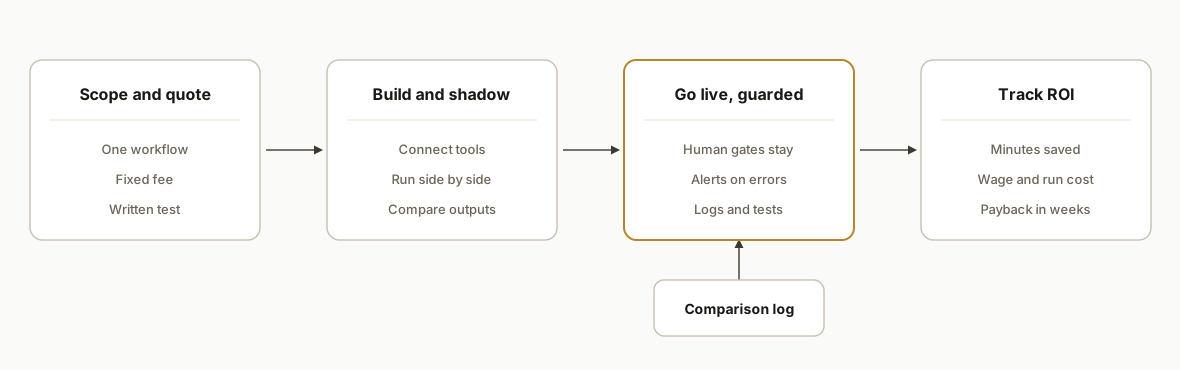
We scope one workflow, ship a narrow build, run it in shadow mode to prove accuracy, then switch it on with monitoring and a simple ROI log. The diagram shows the exact path we use on Vancouver projects today.
- Scope and fixed quote: One meeting to name the job. We write success criteria and a test plan. You get a fixed fee and a delivery date.
- Build and shadow mode: We connect to your tools, run side by side with your current process, and compare outputs before anything goes live.
- Go live with guardrails: We flip the switch. Human gates stay where the risk is high. Alerts and dashboards surface exceptions.
- Track ROI in plain math: Minutes saved × fully-loaded wage. Model/API costs logged. You see real payback, not hype.
Step-by-step: how to build it
1) Lock the scope in writing and price it
We always capture the first job in a tiny spec: data in, action, human gates, and a test we can both run.
# scope.yml
workflow: "Metro Vancouver order filter to install queue"
inputs:
  - source: Shopify Orders
    fields: [id, created_at, email, shipping_address.city, shipping_address.zip]
actions:
  - route: "append to Google Sheet tab: MetroVancouver"
  - backup: "HTTP PUT to Make.com Data Store (idempotent)"
controls:
  - exclude_status: [cancelled, refunded]
  - dry_run: true  # shadow mode until sign-off
tests:
  - name: "Postal V6A hits sheet"
  - name: "Refunded order is excluded"
Key gotcha: price the job, not the hours. You want a fixed fee tied to a defined test.
2) Implement the smallest slice and verify the filter logic
In the BlackBoxMyCar build, Make.com's expression language lacked regex helpers, so we nested contains checks to capture Metro Vancouver postal prefixes cleanly.
// Make.com style nested condition (no or()/match())
if(
  and(
    not(equal({{order.financial_status}}, "refunded")),
    not(equal({{order.cancel_reason}}, "customer")),
    or(
      startsWith({{order.shipping_address.zip}}, "V5"),
      startsWith({{order.shipping_address.zip}}, "V6"),
      startsWith({{order.shipping_address.zip}}, "V7")
    )
  ),
  true,
  false
)
Gotcha: Make's HTTP method must be lowercase "put" for PUT actions or it fails silently.
3) Dual-write to a primary sheet and a durable backup
We write to Google Sheets for ops and to a durable store for safety. The datastore write is via HTTP so we control payloads and retries.
curl -s -X put \
  -H "Content-Type: application/json" \
  -d '{"key":"{{order.id}}","area":"metro_van","payload":{{json(order)}}}' \
  "https://hook.make.com/datastore/records"
Gotcha: API-authored blueprints can drop fields in datastore modules. HTTP PUT avoids that.
4) Run in shadow mode and gate risky actions
For outbound email or SMS, we stage drafts or route to a human-approval lane first. When using Instantly or HTML bodies, wrap lines in div elements so sanitizers do not drop content.
<div>Hello {{first_name}},</div>
<div>We saw your order in {{city}}. Here are your next steps...</div>
<div>, Team</div>
Gotcha: a bare br can be removed by some providers. Wrap each line.
5) Add a minimal ROI log you can trust
We log minutes saved and costs so ROI is visible.
create table roi_events (
  id uuid primary key default gen_random_uuid(),
  workflow text not null,
  minutes_saved numeric not null,
  wage_cad numeric not null,
  run_cost_cad numeric not null,
  occurred_at timestamptz not null default now()
);
-- Example insert at the end of a successful run
insert into roi_events (workflow, minutes_saved, wage_cad, run_cost_cad)
values ('metro_van_order_filter', 20, 38.00, 0.02);
McKinsey estimates that generative AI can automate activities accounting for 60 to 70 percent of employee time in some occupations. Source: https://www.mckinsey.com/capabilities/quantumblack/our-insights/the-economic-potential-of-generative-ai-the-next-productivity-frontier.
6) Flip live, monitor, and schedule lightweight improvements
We keep logs, unit tests for key functions, and a checklist for quarterly tune-ups. For Apps Script jobs, create a time-based trigger from the owning account and version deployments so live URLs update predictably.
function sendDailyDigest() {
  const rows = getNewRowsSinceYesterday();
  const body = renderDigest(rows);
  GmailApp.sendEmail(Session.getActiveUser().getEmail(), "Daily Automation Digest", body, {name: "Automation"});
}
Gotcha: Apps Script live web-apps require a new deployment version to update /exec; push alone does not move prod.
Where it gets complicated
- Credential ownership: OAuth connections must live on your accounts. We swapped Google connections to client-owned before handoff on recent builds to avoid post-launch surprises.
- Vendor quirks: Make.com expressions omit common helpers. HTTP verbs must be lowercase. Some HTML sanitizers drop br elements. We code to those realities.
- Headless blockers: Invisible reCAPTCHA v2 killed a prior headless approach. The fix was a headed browser with de-automation on a normal office IP in production.
- Cost guardrails: We add overage guards where vendors allow quiet over-billing. One voice build now pauses campaigns when TTS characters approach quota.
- Backfill and blast risk: Backfills can email a lot of people if the UX is unclear. We gate backfills by investor or list segment and label everything dry_run until confirmed.
What this actually changes
- A Metro Vancouver automotive retailer went from manual next-day triage to instant, auditable routing on local orders. That build used a Shopify watcher, a postal filter, and a dual sink to Sheets plus a datastore, then scaled to backfill historic orders safely.
- For property operators and financial services clients, the same shadow-mode and ROI log pattern let us turn weekly document tasks and lead follow-ups into morning jobs that run without supervision.
The structural value is twofold: time returned to your team, and faster response cycles. HBR's 5-minute stat explains why speed compounds pipeline outcomes. McKinsey's 60, 70 percent automation estimate explains why simple workflows often justify themselves within weeks when scoped narrowly and priced as a project, not a platform.
Frequently asked questions
How much does an AI automation project cost in Vancouver?
Most first wins land in three bands: CAD 1,000 to 4,000 for a quick-win pilot in 1 to 2 weeks. CAD 6,000 to 20,000 for a custom integration in 3 to 8 weeks. CAD 300 to 2,500 per month for light care. We price fixed fee against a written test, not hourly guesses.
What is the timeline to first ROI for a small business?
When we target one repetitive workflow, the first payback often arrives in weeks. We ship a narrow build, run shadow mode, then flip live. ROI is logged in minutes saved times fully loaded wage, minus tiny model or platform costs.
Is an AI automation agency worth it for small businesses?
Yes when you scope it. Pick one job that burns staff time at real volume. We keep human gates on risky steps and ship in weeks, not months. You avoid a long audit and see if the model's economics work on your exact workflow.
Do you charge hourly or fixed-fee?
Fixed-fee for scoping plus delivery. Then a light monthly for uptime and tweaks if you want it. This keeps incentives aligned: the test passes, the job ships, the price was the price.
Which niches are most profitable for AI automation in 2026?
We see fast wins in ecommerce operations, property management reporting, professional services outreach, field-service reminders, underwriting pre-reads, and document extraction. The pattern is the same: repetitive, high-volume, low-tolerance for delay.
What do you need from us to start?
One meeting to pick the workflow and confirm tool access. Read-only where possible for discovery. We then write a two-page scope with a fixed fee and test plan. Shadow mode runs before go-live.
If you want a scoped quote tied to a specific workflow, start at our services page: custom AI integration. For a related local buyer's guide, see Best AI Automation Agency Vancouver. If you want us to scope your first win, book a 15-minute call.
Curious what this would actually save you?
Put real numbers to it. The ROI calculator estimates the hours and dollars an automation like this returns, in about a minute.
Calculate your automation ROI