
Anthropic released Claude Fable 5 on June 9, 2026. The business question is simple: can you turn that capability into revenue or cost savings fast. The short answer: yes, by picking one high-volume, multi-step workflow, running a short shadow test to measure tokens and accuracy, and either cutting internal operating cost or packaging the automation as a paid service to other businesses.
This post shows exactly how we picked workflows, measured viability, and productized outcomes for clients. It adds practical monetization patterns and points to a deeper walkthrough so you can answer the near-miss query we keep seeing: how to make money with Claude Fable 5.
The problem it solves
Most small to mid-market businesses have work that is repetitive, judgment-light for most cases, and multi-step across systems. That work costs your team hours and attention and is often too long for older models to finish reliably. A cheaper, long-context model like Fable 5 moves those workflows from "not worth automating" into "obvious to automate".
| Dimension | Manual today | Automated with a Fable 5 workflow |
|---|---|---|
| Typical operator work | Do it end-to-end across systems, manual copy-paste, reconciliation | One-pass automation that reads CRM, billing, and docs, returns a draft action list or reconciled result |
| Time to complete | Hours to days per run depending on volume | Minutes to hours per run. Runs can be scheduled overnight |
| Start-up cost | Tooling plus ongoing headcount | Engineering to integrate and run shadow tests, then low incremental API cost |
| Risk of incorrect decision | High without human review | Shadow-mode checks and human-in-loop thresholds reduce live risk |
What automating one manual process is worth
Move the sliders to your own numbers. The defaults are only an example business, not client data.
Revenue the freed hours could earn each year
$41,600
8 hrs a week × 52 × $100
- Cost of errors and rework each year
- $6,000
- $500 a month × 12
- Staff cost of doing it by hand each year
- $14,560
- 8 hrs a week × $35/hr × 52 weeks
- Hours handed to the system each month
- 35 hrs
- 8 hrs a week × 52 ÷ 12
How the automation works
The pattern we used in production builds had three layers: ingestion, orchestration with a swappable model adapter, and observability with a human-in-the-loop gate. The model is a component, not the product. Keep the model behind a small API adapter so you can swap providers as prices and accuracy change.
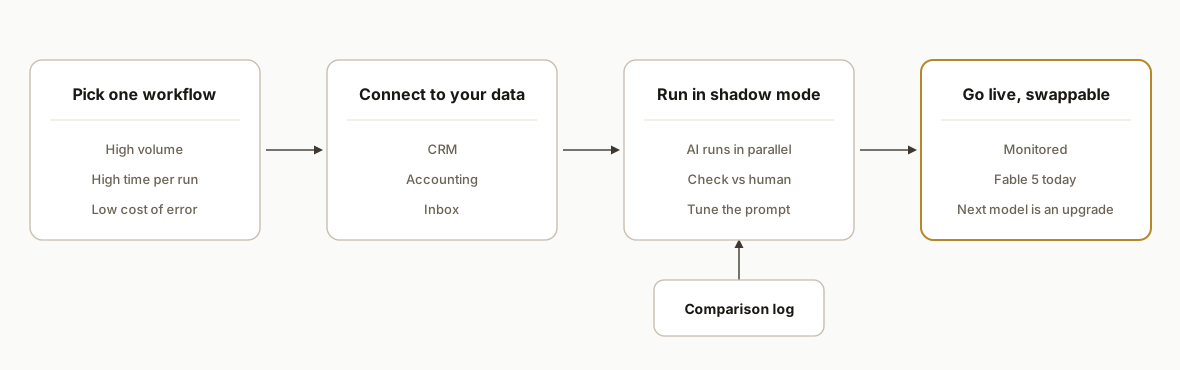
In production we used a queue for incoming jobs, a short preprocessing step to attach relevant context and redactions, a single model call that supports long context, and a postprocess step that validates output against business rules. All inputs, prompts, and outputs were logged for audit and improvement.
Step-by-step: how to build it
1. Define done and measure a baseline
Write a one-sentence definition of done. Example: "A reconciled invoice record with suggested GL codes and a confidence flag, delivered to the accounting queue." Capture baseline time per run and error rate.
{
  "done": "reconciled_invoice",
  "baseline_time_minutes": null,
  "baseline_error_rate": null
}
Measure a small sample manually so you can compare the AI output in shadow mode.
2. Build a lightweight data adapter
Ingest only the fields you need. Use a small service to fetch records, redact PII, and assemble a compact context bundle. Keep adapter credentials out of code.
// pseudo adapter pattern
const record = await fetchRecord(id);
const context = buildContext(record, { include: ['line_items','customer_notes'], redact: true });
await queue.push({ id, context });
3. Wrap the model behind a swappable adapter
Never bake the vendor into business logic. Read model selection from config and centralize retry, logging, and token accounting.
// model-adapter pseudocode
const modelClient = new ModelAdapter(process.env.MODEL_BACKEND_URL);
const resp = await modelClient.run({ model: config.model, context });
log(input: context, output: resp);
The adapter should expose cost estimation hooks so you can measure input and output tokens during the shadow run.
4. Run a shadow mode with a comparison log
Run the model in parallel with human work for 50 to 200 real runs. Store model outputs, human outputs, and a short accuracy verdict. Use these logs to build your error thresholds.
INSERT INTO ai_audit (job_id, input_snapshot, model_output, human_output, verdict, tokens_in, tokens_out)
VALUES (...) ;
5. Implement human-in-the-loop rules and observability
Set thresholds: auto-approve above X confidence, needs-review between X and Y, block below Y. Track success-rate, rework-rate, and time-saved.
if (confidence > 0.9) approve();
else if (confidence > 0.6) queueForReview();
else blockAndAlert();
6. Measure tokens and cost before pricing
During shadow runs, record input_tokens_per_run and output_tokens_per_run. Use the published Fable 5 unit rates to project per-run cost.
monthly_ai_cost = runs_per_month * ((input_tokens_per_run/1_000_000)*10 + (output_tokens_per_run/1_000_000)*50)Measure the hours saved and compute break-even. Use the audit logs to estimate ongoing error handling time.
7. Rollout, SLA, and swap plan
Roll out by cohort. Keep model selection and rate-limiting configurable so you can change providers or throttle usage without code changes.
Where it gets complicated
- Integration complexity: connecting CRM, billing, and document stores is where most effort went. Authentication, pagination, and schema drift consume engineering hours.
- Token usage is variable: long context helps, but superfluous context inflates cost. Trim context to what is relevant.
- Accuracy drift: training data or rule changes can change behaviour. Audit logs are mandatory.
- Ownership of credentials: keep connections in the customer's account to avoid handoff problems.
- Shadow-mode inertia: teams often under-sample. Run 50 to 200 real runs, not 5.
- Vendor-lock risk: if your orchestration ties directly to one API, upgrades become migrations. Keep the model swappable.
Direct ways to monetize Claude Fable 5
These are practical business patterns we used to turn a model capability into revenue. Each pattern is actionable with the build steps above.
- Cost arbitrage for internal services: replace an hourly human task with automation, then reprice the service internally. Track before and after hours and show savings to stakeholders.
- Fixed-fee per-run service: charge a predictable per-job fee for high-volume tasks, for example per-invoice or per-pre-read. Price includes AI cost, handling, and margin.
- Subscription for software-adjacent features: bundle the automation as a monthly add-on where customers pay for convenience and SLA.
- Managed-service for SMBs: run the integration and monitoring on behalf of smaller companies that cannot staff engineers. Offer onboarding plus monthly monitoring fees.
Each pattern requires a simple shadow-mode proof and a documented SLA. For lead-response services, we followed the same pattern used in our CRM playbook for paid pipelines. See our guide to automated CRM lead follow-up for specifics on response windows and SLA language.
Which Claude Fable 5 workflows make money fastest
If you need revenue quickly, pick one of these five. We shipped or templated each with the same adapter, shadow, and review pattern.
- CRM lead follow-up: score, draft, and send first replies within minutes, then route to sales. See the full playbook in Automate CRM lead follow-up.
- Customer response desk: triage emails across refunds, cancellations, and how-to requests. Use model outputs to draft replies and create tickets. See AI customer response automation.
- Failed payment recovery: detect failed charges, draft plain-language emails and SMS, and schedule retries. Start with Stripe dunning emails automation guide.
- Back-office packet summarization: compile multi-document pre-reads into bullet decisions for finance or ops, then push to the task queue. Price per packet.
- Content ops for low-edit assets: titles, blurbs, and alt text at scale with strict guardrails and a quick editorial pass. See automate article production with minimal editing.
Pick the one with the most monthly runs and the least subjective judgment. Run a 50 to 200 job shadow to confirm accuracy and token cost before you sell it.
Claude Fable 5 pricing calculator: tokens to margin
A simple, repeatable way to set price from your shadow logs:
Inputs you capture per run:
- input_tokens
- output_tokens
- review_minutes
- hourly_rate
- expected_runs_per_month
- build_cost
- amortization_months
- target_margin_pct (for example 35)

Formulas:
ai_cost_per_run = (input_tokens/1,000,000)*10 + (output_tokens/1,000,000)*50
review_cost_per_run = (review_minutes/60)*hourly_rate
fully_loaded_cost_per_run = ai_cost_per_run + review_cost_per_run + (build_cost/amortization_months)/expected_runs_per_month
price_per_run = fully_loaded_cost_per_run / (1 - target_margin_pct)
Sanity-check price with a floor and a ceiling: set a floor based on cost and a ceiling based on customer value. For broader context on ROI math, see automation ROI explained.
Starter SOW and pricing templates you can copy
You do not need to invent commercial terms. We standardize pilots, SLAs, and handoff in two reusable templates:
- Scope and SOW checklist: stages, data access, logging, review thresholds, and rollback plan. Start with AI automation agency contract and SOW checklist 2026.
- Pricing menu and packages: per-run, per-seat, and managed-service retainers with token-based cost guards. See AI automation agency pricing for SMBs.
Use these alongside your shadow logs to set a pilot price, then convert to fixed fees once error rates stabilize.
How to price and model profitability for a paid AI service
Price by covering: direct API cost, human review cost, engineering amortization, and margin. Use the shadow run logs to measure tokens and rework.
Step-by-step pricing approach:
- Measure: runs_per_month, input_tokens_per_run, output_tokens_per_run, and average review minutes per run.
- Compute monthly AI cost using the published Fable 5 rates: 10 dollars per 1,000,000 input tokens and 50 dollars per 1,000,000 output tokens.
- Compute review labor cost: review_minutes_per_run * hourly_rate * runs_per_month / 60.
- Add engineering amortization: one-time build cost divided over expected contract months.
- Add margin and SLA buffer.
Example (illustrative only): if a run uses 50,000 input tokens and 10,000 output tokens, the AI cost per run is roughly (50k/1M)*10 + (10k/1M)*50 = 0.5 + 0.5 = 1.0 dollars. Multiply by runs_per_month, add review and amortization, and set price as cost plus margin. Always label such estimates as "example" and validate with a live shadow run. For more examples, see our revenue playbook.
For guidance on deciding whether to automate a workflow at all, our automation ROI framework walks through the same decision rules we use when we consult with clients. See automation ROI explained.
What this actually changes
A model that finishes long jobs changes which workflows are viable to automate. Practically, it meant for clients we worked with that multi-document pre-reads, month-end packet summarization, and extended support backlogs could be processed overnight rather than by a daytime team. That outcome is the same pattern we applied in our underwriting work in the Forward Funding case study (/case-studies/forward-funding-ai-underwriting). The model getting cheaper made the next opportunity easier to justify.
For playbooks on the most deployable workflows, see our guides on automated CRM follow-up and AI customer response automation. Both are tight fits for Fable 5-class models and describe the routing and SLA choices you must make to sell the service.
Frequently asked questions
How can I charge clients for an Fable 5 automation? Charge by run, by subscription, or as a managed service. The practical path is: run a short shadow test, compute AI cost per run, add review and support costs, then add margin. Start with a pilot discount and move to a fixed price when error rates are steady.
Can I build a SaaS product on top of Claude Fable 5? Yes, but treat the model as a replaceable component. Build a model adapter and cache outputs where allowed. Expect recurring costs tied to volume. Price the product to cover AI usage, monitoring, and incident support.
How do I avoid vendor lock when Fable 5 prices or terms change? Abstract the model behind an adapter and keep a configuration switch for model selection. Store prompts, inputs, and outputs so you can run the same tests on a replacement model before a full switch.
What recurring costs should I expect running paid automations? API usage is one line, but plan for monitoring, human review, error remediation, and support. Use shadow logs to estimate these costs before you promise an SLA.
How fast will I see ROI after switching to Fable 5? If the workflow is high-volume and judgment-light, you can see payback in weeks once the integration is stable. Use the ROI checklist and a short shadow run to confirm before committing engineering hours.
Do I need a developer to sell automation to others? Yes, at least initially. Packaging automation as a repeatable product or managed service requires integration, logging, and an onboarding flow. After the initial build, operational tasks can be handled by less technical staff.
How do I get my first three paying clients with Fable 5 services? Pick one workflow, run a 50 job shadow, and turn the log into a one-page results brief. Offer a 30 day pilot at a fixed price with an SLA and a rollback plan. Use one referenceable client to sell the next two. Standardize price using the calculator above and the SMB pricing guide.
The most direct path to revenue is to pick one workflow, prove it in shadow mode, and either internalize the savings or productize the outcome as a paid service. If you want help choosing the workflow, we run a discovery that scopes the first integration in one call. For integration best practices see fastest way to integrate AI and for the ROI math see automation ROI explained. If you would rather skip the learning curve, book a short discovery call (/book) or request our custom AI integration service (/services#custom-ai-integration).
Curious what this would actually save you?
Put real numbers to it. The ROI calculator estimates the hours and dollars an automation like this returns, in about a minute.
See your options