
A WhatsApp AI bot is a program that reads and replies to WhatsApp messages using a language model, so customers or staff get accurate answers in seconds instead of waiting for a human. In 2026 it can answer product questions, qualify leads, send images, transcribe voice notes, update your CRM, and hand the conversation to a person the moment that is the right call.
We currently run two of these in production for clients: an internal assistant that lets a travel company's sales agents query roughly 110 hotels across six countries in their own language, and a customer-facing sales bot for a custom keepsake business that takes a lead from Instagram DM to a paid order. This post is what we learned building both, with the numbers.
Why WhatsApp is where this matters
More than 2 billion people use WhatsApp, and Meta has reported over 200 million businesses on WhatsApp Business. The behavioral difference from email is dramatic: industry benchmarks consistently put WhatsApp message open rates near 98%, against roughly 20% for a typical email campaign. When your customers already live in WhatsApp, every hour a question sits unanswered is an hour the lead cools.
The catch is that WhatsApp conversations are unstructured, multilingual, full of typos, and increasingly arrive as voice notes. That is exactly the shape of problem language models are good at, which is why the WhatsApp bot market moved so fast from canned menu bots ("press 2 for pricing") to assistants that actually read the question.
The two kinds of WhatsApp bots (pick one first)
Almost every WhatsApp bot worth building falls into one of two archetypes, and the architecture is different enough that you should decide which one you are building before anything else.
| Internal assistant | Customer-facing sales bot | |
|---|---|---|
| Who messages it | Your own staff | Leads and customers |
| Main job | Instant answers from business data | Qualify, answer, and close |
| Tone risk | Low (your team forgives a clunky reply) | High (a bad reply costs a sale) |
| Data source | Spreadsheets, databases, internal docs | Product catalog, FAQ, policies |
| Human handoff | Rarely needed | Non-negotiable, designed in from day one |
| Payment | Not applicable | Never in chat; hand off to a checkout page |
| Accuracy bar | High | High, plus brand voice and pacing |
Case 1: the internal assistant
The travel company's sales agents were answering customer questions by digging through a giant spreadsheet: which hotels have a spa, which accept young guests, what the shuttle times are, what a room actually contains. Multiply that by about 110 properties in six countries and an agent can spend more time searching than selling.
The bot replaces the digging. An agent asks in plain Hebrew, "which hotels in France have a pool and a free spa," and gets a correct, formatted answer in seconds. Under the hood the question goes through intent classification, a query against a normalized database that syncs nightly from the company's spreadsheet, and a language model that writes the reply. The agent never sees any of that.
The numbers after several months of iteration:
- 97.6% pass rate on the automated nightly regression suite (40 of 41 checks), run every night against the live system
- 428 of 428 retrieval test cases resolve to the correct hotel, including misspelled names
- Longest answers (full country listings) dropped from 25 seconds to about 12 after a model swap
- AI cost runs $10 to $15 per 1,000 answered questions
That last number surprises people the most. The economics of "every agent gets an instant expert" work out to about a cent per question.
Case 2: the customer-facing sales bot
The keepsake business had a funnel that worked but did not scale: organic Instagram, DMs with preliminary questions, a manual switch to WhatsApp, a long human conversation, then a payment link. Every order is tied to a customer's event date, so timing matters and follow-up matters, and all of it lived in one person's head.
The bot we built takes over the WhatsApp conversation: it answers the preliminary questions from a knowledge base, quotes prices, sends catalog images at the natural moment rather than dumping them upfront, collects the event date and product choice, and then sends a link to a hosted checkout page. About 80% of its conversations happen in Hebrew and 20% in English, and it mirrors whichever language the customer writes in. Customers who send voice notes get the same treatment: the audio is transcribed and flows through the same logic, and if the recording is unclear the bot asks them to type rather than guessing.
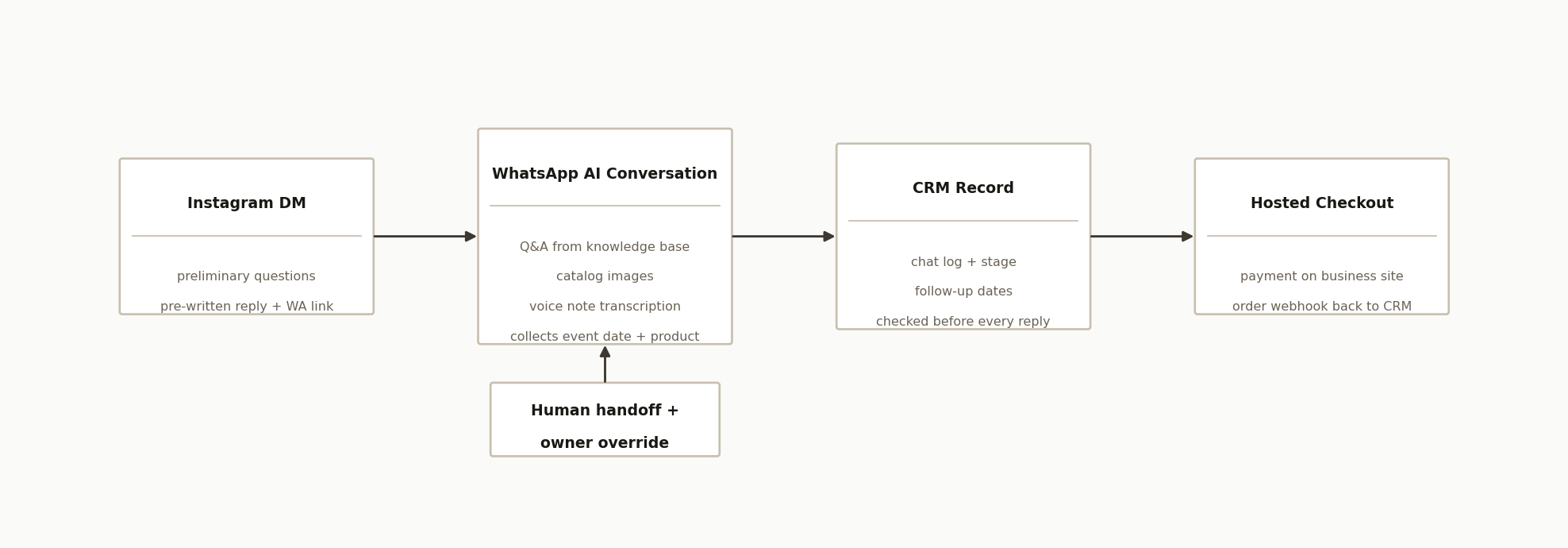
Three design rules made this bot trustworthy enough to put in front of paying customers:
- The bot never touches money. It hands the customer a checkout link on the business's own site. Payments, addresses, and order records live where they already lived. The bot's blast radius is a conversation, never a transaction.
- Handoff is a feature, not a failure. Three triggers route a conversation to a human and ping the owner's phone: the customer asks for a person, the bot does not know the answer, or the event is less than ten days away. The owner can also flip one field in the CRM and the bot goes silent on that thread instantly.
- The CRM is the source of truth. Every conversation writes to a CRM record with the chat log, the stage, and the dates that drive follow-ups. The bot checks that record before every single reply, which is what makes the owner override work.
What does a WhatsApp AI bot cost?
A scoped, single-purpose WhatsApp bot is a low four-figure build in 2026, not a five-figure platform project. The drivers are how many systems it touches (CRM, checkout, calendars), whether it needs your business data synced and queryable, and how much conversation logic it needs (qualification, follow-ups, handoff rules). Running costs are small: model usage for a busy bot is typically tens of dollars a month, ours runs $10 to $15 per 1,000 answers, plus your WhatsApp provider fee.
Timeline follows the same logic. Our builds in this space ship in one to three weeks: a knowledge-base Q&A bot sits at the short end, a bot wired into a CRM and a checkout with follow-up automations sits at the long end. If you want to put numbers on the return side, our automation ROI calculator covers the math for customer-response automation.
What goes wrong (the lessons that cost us)
These are the failure modes we either hit or designed against, and they are where most DIY WhatsApp bots die.
Your data drifts and the bot drifts with it. The travel assistant's source of truth is a spreadsheet the client edits constantly. Early on, a sync bug silently halved the catalog, and the bot confidently reported that hotels did not exist. The fix was not a one-time repair: it was a nightly automated check that counts the catalog, verifies every country is present, and raises an alert before anyone asks the bot anything. If your bot reads from living data, build the health check or the bot will eventually lie politely.
The model provider will fail you at the worst time. Mid-testing, an API account ran out of credit and every reply started erroring. Now the bot falls back to a second model automatically on any unrecoverable failure and logs it loudly. A customer-facing bot with no fallback is one billing hiccup away from total silence.
WhatsApp is not a web page. Language models love markdown: bold headers, tables, links in brackets. WhatsApp renders almost none of it, so a perfectly good answer arrives looking broken. Replies need a formatting layer that converts to WhatsApp's conventions and splits anything over the message length cap.
Conversations have memory, your bot needs one too. "What about the spa there?" only makes sense if the bot remembers which hotel "there" is. Multi-turn context with a sensible expiry (ours keeps the last several turns for under an hour) is the difference between an assistant and an FAQ search box. The subtle bug to watch: when a customer names a new topic explicitly, the new name must beat the remembered context, or the bot answers about the wrong thing with full confidence.
Test in the language your customers actually use. Tooling quietly mangles non-Latin text: one of our worst false alarms came from a terminal corrupting Hebrew characters in test scripts, making a healthy bot look broken. If your market writes in Hebrew, Arabic, or Thai, your test harness has to speak it too.
Frequently asked questions
Do I need the official WhatsApp Business API?
For customer-facing bots at scale, the official API through a business solution provider is the safe route: it is sanctioned by Meta and your number cannot be banned for automation. Gateway-style providers that drive a regular WhatsApp number are faster to start and fine for internal tools, but carry ban risk on a customer-facing number. Use a dedicated number either way, never the owner's personal one.
Can the bot send images and handle voice notes?
Yes to both. Sending catalog images at the right conversational moment is one of the highest-converting things a sales bot does. Inbound voice notes are transcribed to text and flow through the same logic as typed messages. The one rule we hold: if a transcription is unclear, the bot asks the customer to type instead of guessing at order details.
Will a bot replace my sales or support team?
No, and designing as if it will is the main way these projects fail. The bot's job is the repetitive 80%: instant answers, qualification, data entry, follow-up timing. The handoff triggers exist precisely so humans get the conversations that need judgment, with full context already in the CRM.
How accurate can a WhatsApp bot actually be?
Accuracy is an engineering outcome, not a model property. Our internal assistant holds 97.6% on a nightly automated test suite because the data is structured, synced, and health-checked, and because the suite runs every night. A bot pointed at a stale FAQ document with no testing will be exactly as accurate as that sounds.
Is it worth it for a small business?
The keepsake client is a small business, and the bot pays for itself by catching leads that used to go cold in DMs and by freeing the owner from repeating the same twenty answers. The honest qualifier: you need real message volume with repetitive questions. If you get three WhatsApp messages a week, answer them yourself.
Where to start
Decide which archetype you are building, write down the twenty questions your bot must answer perfectly, and identify the one system it has to read or write (usually a spreadsheet or CRM). That document is 80% of a working scope. If you want it built for you, see how we run these projects or book a 20-minute call and we will tell you what your version looks like, what it costs, and what we would not automate yet.
Want us to build this for you?
Nine questions, about 90 seconds. You see the revenue it is costing you, then pick a time. No pitch.
See your options