
An SMB-ready sales automation program captures every lead within minutes, enriches and routes it correctly, sequences follow-up, and fixes pipeline hygiene automatically. The outcome: faster responses, cleaner data, and a repeatable process you can scale.
Sales automation for SMBs is the practice of turning lead capture, enrichment, routing, follow-up, and reporting into a rules-driven system so reps spend more time selling and less time clicking.
If you are evaluating an ai sales automation for SMBs or searching for a sales automation agency, this guide shows how we scope the first 90 days, what it should cost, the deliverables to require, and how to choose and engage a vendor without wasting cycles.
The problem it solves
You lose deals when leads sit in an inbox, when enrichment is skipped, or when follow-up drifts. Manual sales ops create variable response times, inconsistent qualification, duplicate records, and forecasting that nobody trusts.
| Step | Manual reality | Automated reality |
|---|---|---|
| Lead capture | Forms and inboxes checked when someone remembers. | One pipeline listens to every source and standardizes fields. |
| Speed to lead | Minutes to hours vary by day. | Sub-5-minute auto-ack and tasking every time. |
| Enrichment | Ad hoc LinkedIn searches and skipped steps. | Deterministic enrichment and compliance-safe lookups. |
| Routing | Forwarded emails and guesswork. | Rules-based assignment with SLAs and fallbacks. |
| Sequencing | Copy-paste templates. | Programmatic sequences with throttles and opt-outs. |
| Pipeline hygiene | Stale stages and duplicates. | Guardrails: dedupe, required next steps, stage aging. |
| Reporting | Spreadsheet exports once a week. | Always-on dashboards with alerting. |
- Sales reps spend only about 28 percent of their week selling; the rest goes to admin and tooling navigation. Source: Salesforce, State of Sales 5th ed. https://www.salesforce.com/resources/research-reports/state-of-sales/
- Responding within an hour is 7 times more likely to qualify a lead than waiting longer. Source: Harvard Business Review https://hbr.org/2011/03/the-short-life-of-online-sales-leads
How the automation works
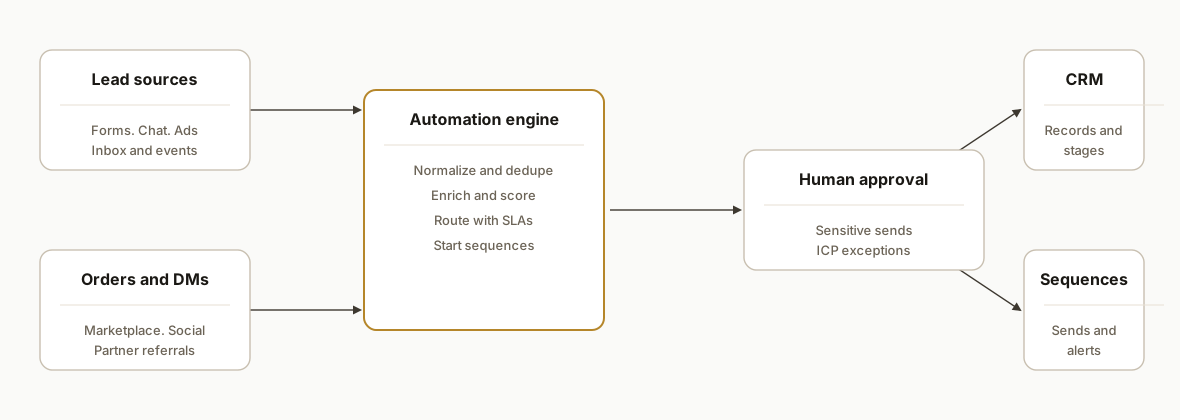
A simple, durable architecture works across most stacks: unify inputs. enforce rules in one orchestration layer. keep humans where judgment matters.
- Sources: website forms, chat, marketplaces, ads, referrals, events, inboxes. All land in one intake.
- Automation engine: normalizes data, dedupes, enriches, scores, and routes. SLAs fire timers and alerts.
- Human-in-the-loop: approval gates for sensitive sends, ICP exceptions, or high-value deals.
- CRM and outreach: create or update records, start sequences, and log activity with stage and owner locks.
- Reporting: ops dashboards, SLA breach alerts, and weekly executive summaries.
Step-by-step: how to build it
1) Define ICP rules, sources, and SLAs in one place
Start by writing the playbook as data: who you sell to, where leads come from, and timing rules. Keep it vendor-neutral so the rules outlive any tool change.
# rules.yaml
icp:
  geo: ["US", "CA"]
  employee_range: "10-500"
  excluded_industries: ["students", "agencies"]
lead_sources:
  - name: website
  - name: inbound_email
  - name: paid_search
slas:
  p0: { response_minutes: 5, notify: ["owner", "sales_manager"] }
  p1: { response_minutes: 30 }
routing:
  round_robin: ["rep_a", "rep_b", "rep_c"]
  territories:
    west: ["CA", "OR", "WA"]
Key gotcha: keep the rules in version control. Changing automation without a versioned rules file is how drift starts.
2) Normalize and dedupe before you enrich
Normalize names, emails, and domains. Then block duplicates at the gate. Enrichment after dedupe avoids wasted credits and person merges later.
-- check.sql
WITH incoming AS (
  SELECT lower(trim(email)) AS email,
         regexp_replace(lower(trim(company_domain)), '^www\.', '') AS domain
  FROM staging_leads WHERE id = $1
)
SELECT EXISTS (
  SELECT 1 FROM crm_contacts c
  JOIN incoming i ON c.email = i.email OR c.domain = i.domain
) AS is_duplicate;
Key gotcha: your duplicate definition is business-specific. At minimum: same email, same domain plus same name, or same phone.
3) Enrich and score with deterministic fallbacks
Run a primary enrichment, then fall back to cheaper or cached sources. Store a confidence score and the provenance so reps know what to trust.
# enrichment.yml
providers:
  - name: primary_graph
    fields: [company_size, industry, linkedin]
  - name: fallback_serp
    fields: [website, hq_city]
scoring:
  weights:
    employee_range: 0.4
    industry_match: 0.4
    geo: 0.2
thresholds:
  mql: 0.7
Key gotcha: never gate routing on enrichment finishing. Route immediately. Backfill data asynchronously when enrichment returns.
4) Route and start sequences with SLA timers
Assign an owner, create tasks, and place the lead into the right program. Start an SLA timer that escalates if nothing happens.
# sla.py
import time
from datetime import timedelta

RESP_DEADLINE_MIN = 5

def start_sla(lead_id, owner_email):
    deadline = time.time() + RESP_DEADLINE_MIN * 60
    save_timer(lead_id, deadline)

def tick(now):
    for t in due_timers(now):
        if not first_touch_logged(t.lead_id):
            notify([t.owner_email, 'sales_manager'], f"SLA breach: {t.lead_id}")
            escalate(t.lead_id)
Key gotcha: first touch must include phone, email, or meaningful DM. Page views and automated messages do not satisfy SLAs.
5) Guard pipeline hygiene automatically
Enforce required next steps, prevent stage backslides without notes, and auto-advance on clear signals like booked meetings.
# hygiene.yml
required_fields_by_stage:
  discovery: ["next_meeting_date", "pain_summary"]
  proposal: ["decision_maker", "budget"]
locks:
  prevent_backslide_without_reason: true
  max_days_in_stage:
    discovery: 14
    proposal: 21
Key gotcha: publish the hygiene rules to reps. Surprise automation breeds workarounds.
6) Ship reporting that measures time, not just totals
Show SLA compliance, first-touch latency, stage aging, and sequence reply rates. Totals are vanity without the timing picture.
# dashboards.yml
widgets:
  - name: SLA compliance
    metric: pct_on_time
  - name: First-touch latency
    metric: p50_minutes
  - name: Stage aging
    metric: avg_days_by_stage
  - name: Sequence replies
    metric: reply_rate_by_template
Key gotcha: alert on trend deltas week over week, not single-day spikes.
Where it gets complicated
- Data trust: If marketing and sales disagree on field definitions, automation amplifies confusion. Write a shared data dictionary and freeze it for a quarter.
- Duplicate prevention: Every source tries to be the source of truth. Enforce one intake and block writes that skip it.
- Speed to lead: Business hours matter. Use separate SLAs for after-hours. Auto-ack quickly, then schedule human follow-up.
- Outreach reputation: Sequences without throttles and suppression lists damage domains. Put suppression and warmup rules in code, not just in docs.
- AI drafts: Keep math and pricing deterministic. Let AI draft text but never compute quotes.
- Compliance and consent: Store opt-in provenance and honor regional rules. Silence is not consent for email or SMS.
What this actually changes
A proper first 90 days replaces handoffs and hope with timing guarantees and clean data. Reps get work queued automatically, managers see where time is leaking, and owners get a pipeline they can forecast.
- Reps spend more time selling because the system handles capture, routing, and follow-up scaffolding. Salesforce found reps spend about 28 percent of time actively selling; automating the rest is where the hours return. Source: Salesforce, State of Sales. https://www.salesforce.com/resources/research-reports/state-of-sales/
- Faster responses convert better. Firms that contacted leads within an hour were seven times more likely to qualify them. Source: Harvard Business Review. https://hbr.org/2011/03/the-short-life-of-online-sales-leads
- Generative AI has large potential in marketing and sales, which supports the business case for AI-assisted drafting and triage. Source: McKinsey, 2023. https://www.mckinsey.com/capabilities/quantumblack/our-insights/the-economic-potential-of-generative-ai
Frequently asked questions
What should a sales automation agency deliver in the first 90 days?
A unified intake, dedupe and enrichment layer, routing with SLAs, baseline sequences, hygiene rules, and an ops dashboard. You should also get a versioned rules file and a change process so you can evolve without breaking what works.
How much does ai sales automation for SMBs cost to implement and run?
Typical ranges: a four to eight week initial build at a one-time fee, then a light monthly for hosting and maintenance. Ongoing platform costs depend on your CRM, enrichment, and sending tools. Keep ownership on your accounts so you can switch vendors.
Can this work for ecommerce and a marketplace-heavy funnel?
Yes. Treat orders and chats as sources just like forms. The same engine normalizes events, dedupes, and routes tasks, while sequences handle post-purchase, win-back, and B2B wholesale outreach. Add channel-specific suppression and timing rules.
Do I need an ai automation agency or can a non-technical owner set this up?
If you only need one sequence and a form handoff, a builder can work. If you need dedupe, routing, SLAs, and reporting that span tools, you benefit from a partner who has shipped the pattern before. The risk is silent drift and bad data.
How do you prevent duplicates across tools?
Pick one intake. Normalize email and domains, then block writes that skip intake. Use deterministic keys and log merges with provenance. Enrich after dedupe to avoid wasted credits and shattered person merges.
Is an ai automation agency the same as a sales ops consultant?
Overlap exists. The difference is that a good agency both designs the rules and builds the connective tissue. You should leave with running systems, not just a deck.
If you want a concrete, quarter-long plan that maps to your stack, we can outline it on a short call. See our services for ai sales outreach at /services#ai-sales-outreach, read our pricing breakdown in the related post at /blog/ai-automation-agency-pricing-2026-smb, and book a 20 minute discovery call at /book.
Want us to build this for you?
Nine questions, about 90 seconds. You see the hours it is costing you, then pick a time. No pitch.
Get your free assessment