
Hiring automation works by parsing every application into a structured profile, scoring it against the must-haves you define, and moving qualified candidates straight into interview scheduling, so your team reviews a short ranked list instead of a hundred raw resumes. A fully operational system takes a role from "posting is live" to "qualified candidates booked" with almost no manual screening.
If you are a business owner or hiring manager drowning in applications, ghosting good candidates because scheduling is a mess, or screening so inconsistently that good people slip through, this guide covers how the system is built, what to expect from it, and where it gets complicated.
The problem it solves
Hiring is a volume-and-speed problem disguised as a judgment problem. A single open role at a growing company commonly draws 100 to 250 applications. A human skims each resume for a few seconds, which means the review is fast, inconsistent, and biased toward whatever caught the eye that day. Strong candidates get missed, weak ones advance, and the whole thing takes weeks.
Then comes scheduling, which is its own swamp. Lining up an interview is a back-and-forth of emails across calendars, and every day of delay is a day your best candidate is interviewing somewhere else. The single biggest reason companies lose good hires is not pay, it is speed.
None of this is skilled work. It is reading, sorting, comparing against the same criteria, and chasing calendar slots. The automation replaces that loop: it reads every application the same way, ranks them against the criteria you set once, and books the qualified ones automatically. Your team spends its judgment on a short list of real contenders, not on triage.
Here is the difference in practice:
| Manual hiring | Automated hiring funnel | |
|---|---|---|
| Resume review | A few seconds each, inconsistent | Every resume parsed and scored the same way |
| What the team sees | 100-250 raw resumes | A short ranked shortlist |
| Time to first interview | Often weeks | Days |
| Scheduling | Email back-and-forth | Candidate self-books from open slots |
| Pipeline visibility | Scattered inboxes | One tracked board with status on every applicant |
How the automation works
The system is a pipeline built in Make.com that turns raw applications into a ranked, scheduled shortlist. Each stage reads from and writes to one place, so the whole funnel is visible and editable without touching code.
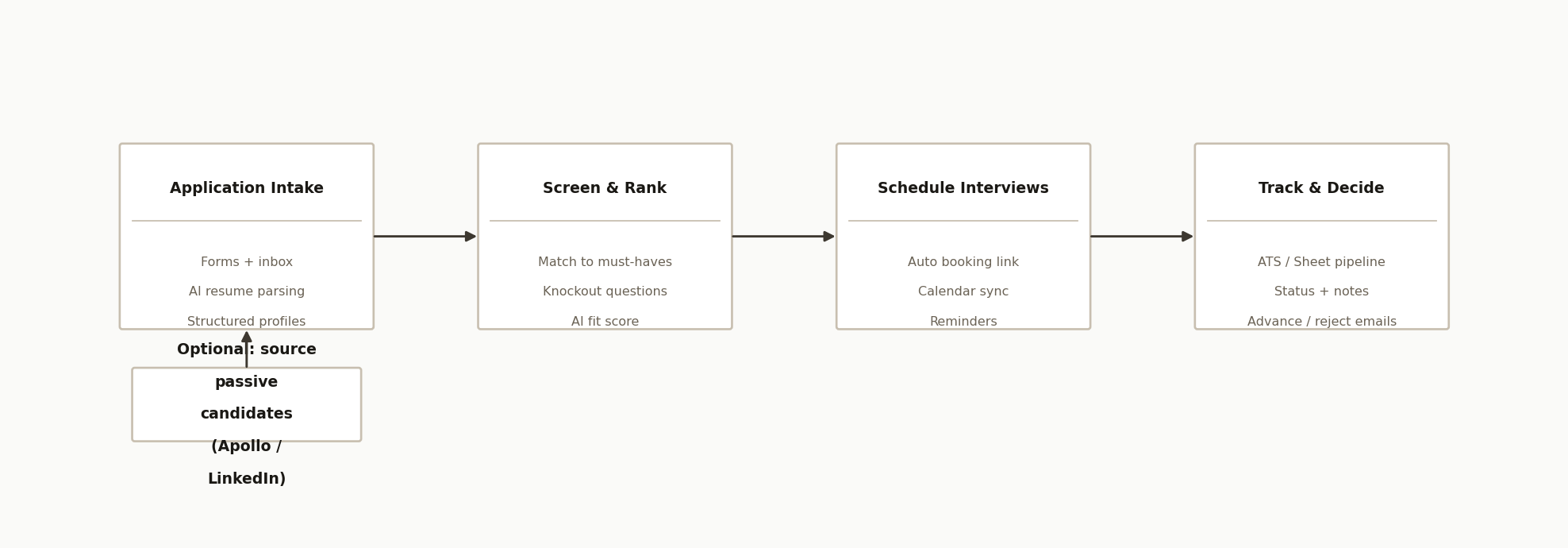
The architecture has four stages, with an optional sourcing add-on:
-
Application intake (forms, inbox, AI parsing). Applications arrive from your job form or inbox. An AI step parses each resume into a structured profile: skills, years of experience, titles held, education, and location. Messy PDFs become clean, comparable data.
-
Screen and rank (AI scoring). Each profile is scored against the must-haves you defined for the role. Hard knockouts (no required license, wrong location, not enough experience) filter out immediately. Everyone else gets a fit score with a short reason, so the ranking is explainable, not a black box.
-
Schedule interviews (calendar automation). Qualified candidates are automatically sent a booking link tied to your real availability. They self-book, the event syncs to your calendar, and reminders go out. The email back-and-forth disappears.
-
Track and decide (pipeline). Every applicant sits on one board or sheet with their score, status, and notes. Advancing or rejecting a candidate fires the right templated email, so nobody is left ghosted.
The optional sourcing add-on flips the funnel outbound: when inbound volume is thin, the same stack can source passive candidates from Apollo or LinkedIn and pull them into the top of the pipeline.
Step-by-step: how to build it
Step 1: Capture applications in one place
Point your job form (or a dedicated inbox) at a Make.com webhook or watch trigger. Every application, with its resume attachment, lands in one pipeline instead of scattered across email. This single front door is what makes the rest consistent.
Step 2: Parse resumes into structured data
Pass each resume to an AI step (OpenAI or Claude) with a prompt that returns structured fields: skills, years of experience, most recent titles, education, and location. Force the output into a clean schema so the next stage can compare candidates on the same axes.
The trick is asking for explicit fields, not a summary. You want "years_experience: 6", not a paragraph that says "experienced."
Step 3: Score against your must-haves
Define the role's requirements once: the hard knockouts and the nice-to-haves. Run each parsed profile against them. Knockouts (missing a required certification, wrong country, below the experience floor) drop out automatically. Everyone else gets a 0-to-100 fit score plus a one-line reason.
Knockout rules (auto-reject):
  - location not in {eligible regions}
  - years_experience < {minimum}
  - missing {required license/credential}

Then score the rest on weighted nice-to-haves and return:
  { "score": 0-100, "reason": "one line" }
Keep the reason field. It is what lets a human trust and audit the ranking.
Step 4: Auto-schedule the qualified ones
For candidates above your score threshold, send a booking link tied to your live calendar availability. They pick a slot, the interview lands on your calendar, and reminders fire automatically. This step alone recovers most of the candidates you would otherwise lose to scheduling delay.
Step 5: Track everyone on one board
Write every applicant to a single board or sheet: name, score, reason, status, and links. This is your pipeline. Advancing or rejecting a candidate triggers the appropriate templated email, so every applicant gets a timely, human response even at high volume.
Step 6 (optional): Source passive candidates
When inbound is thin, add a sourcing scenario that pulls matching candidates from Apollo or LinkedIn and drops them into the top of the same pipeline, where they flow through screening and scheduling like any other applicant.
Where it gets complicated
The six steps are the skeleton. The real work is in fairness, accuracy, and trust.
Bias and fairness are non-negotiable. An AI screen is more consistent than a tired human, but only if you build it carefully. Score on job-relevant criteria, never on proxies for protected characteristics, keep the reasoning visible, and have a human review the borderline band rather than auto-rejecting it. Consistency is the goal, not a black box.
Resume parsing breaks on messy inputs. Career gaps, non-standard formats, image-only PDFs, and creative layouts all trip up naive parsing. The extraction step needs fallbacks and a confidence flag so low-confidence parses go to a human instead of being silently mis-scored.
Your must-haves are usually wrong on the first pass. The first version of the scoring criteria over-filters and rejects good people. The system needs to be easy to tune, and you should watch the rejected pile for the first week to catch criteria that are too strict.
Scheduling logic has edge cases. Time zones, buffer times, panel interviews, and last-minute cancellations all need handling, or the automation creates double-bookings that are worse than manual scheduling.
Candidate experience is the brand. Automation should make candidates feel attended to, not processed. Fast responses, real scheduling, and a human reply on rejection beat a slow manual process. Done badly, automation feels cold, so the templates and timing matter as much as the logic.
What to expect
These are typical, illustrative ranges for this kind of build, not a guarantee, since results depend on your volume and how well your criteria are tuned.
Start with the screening math. A single role commonly draws 100 to 250 applications, and a careful manual screen runs 3 to 5 minutes each, so reviewing 150 applicants by hand is roughly 8 to 12 hours per role. The automation parses and ranks the same stack in minutes and hands your team a shortlist of the top 10, which removes the large majority of the screening time.
Speed is the other lever. Time-to-first-interview commonly drops from a couple of weeks to a couple of days, because the shortlist is ready the moment applications arrive rather than after someone finds time to review. Since the most common reason companies lose a good candidate is being too slow, self-scheduling that books interviews while interest is hot recovers a meaningful share of people who would otherwise drop off. And every applicant is measured against the same criteria, which is both fairer and easier to defend than a tired human skim.
The structural win is that your team's judgment moves to where it matters. Instead of skimming a hundred resumes, they review a short ranked list with reasons attached, and spend their time interviewing real contenders. Treat the numbers above as a first-pass estimate; your volume and roles will move them.
Frequently asked questions
Can AI screen resumes fairly?
It can be more consistent than manual screening if it is built right: scored only on job-relevant criteria, with visible reasoning, and with a human reviewing the borderline cases. The risk is using AI as an opaque auto-reject. The goal is consistency and explainability, with a person owning the final decision, not a black box that silently filters people out.
What does it cost to run?
The recurring cost is mostly AI usage for parsing and scoring (cents per application) plus your automation platform and scheduling tool, which are inexpensive. For most companies it is a fraction of the cost of a single bad hire or a single recruiter's hours, and it scales with applications rather than headcount.
Will this work with my ATS or job board?
Usually yes. The pipeline can sit in front of an existing applicant tracking system or replace a spreadsheet-based process entirely. It connects to common job forms, inboxes, calendars, and ATS tools through their APIs, and writes status back so your system of record stays current.
Do I still interview people, or does the AI decide?
You interview. The automation handles the parts that are repetitive and inconsistent, parsing, screening, ranking, and scheduling, and hands you a short ranked shortlist with reasons. Every hire decision stays with a human. The system removes the busywork, not the judgment.
How long does it take to set up?
A focused build of the core funnel (intake, screening, scheduling, tracking) typically takes a couple of weeks, with the first week spent tuning the scoring criteria against real applications so it stops over-filtering. Sourcing and deeper ATS integration are natural phase-two additions once the core is running clean.
If you are losing time and good candidates to manual screening and scheduling, we build this exact funnel: parse, screen, rank, and book, with your judgment kept on the shortlist. Book a 20-minute call and we will map what it would take for your roles and your tools. You can also see our custom AI integration service and recent case studies for more of what we build.
Curious what this would actually save you?
Put real numbers to it. The ROI calculator estimates the hours and dollars an automation like this returns, in about a minute.
See your options