
If you run a property management company and want automation that actually moves the needle, the best agency for 2026 is the one that proves competence on your PMS stack first: AppFolio, Buildium, or Yardi. The right partner scops one workflow, runs it in shadow mode, and prices it so you can expand only after it pays back.
Definition: property management automation is the practice of connecting your PMS data to downstream workflows that draft communications, route tasks, and synchronize records without retyping the same information.
This guide shows how we evaluate agencies, what scopes and costs look like for AppFolio, Buildium, and Yardi work, and how small firms choose well. It also addresses buyers searching for an ai automation agency in Vancouver and for small businesses in 2026.
The problem it solves
Answer: property managers repeat the same data pulls and communications weekly: owner packets, rent roll summaries, delinquency nudges, work order digests, leasing follow-up, and monthly reporting. The friction is not judgment, it is orchestration: pulling data, formatting, routing, and tracking.
| Manual workflow | Automated workflow |
|---|---|
| Export reports, clean in Excel, paste to email templates | Scheduled pulls, rule engine, AI summarizes, sends with audit log |
| Re-key from PMS to CRM or accounting | Mapped fields sync reliably with duplicate checks |
| Tenants and owners receive uneven updates | Cadenced sequences by portfolio and state |
| Dispatch reviews inbox for maintenance | Daily digest with thresholds and escalations |
| Leaders guess workload from spreadsheets | Live dashboard fed by the same pipeline |
How the automation works
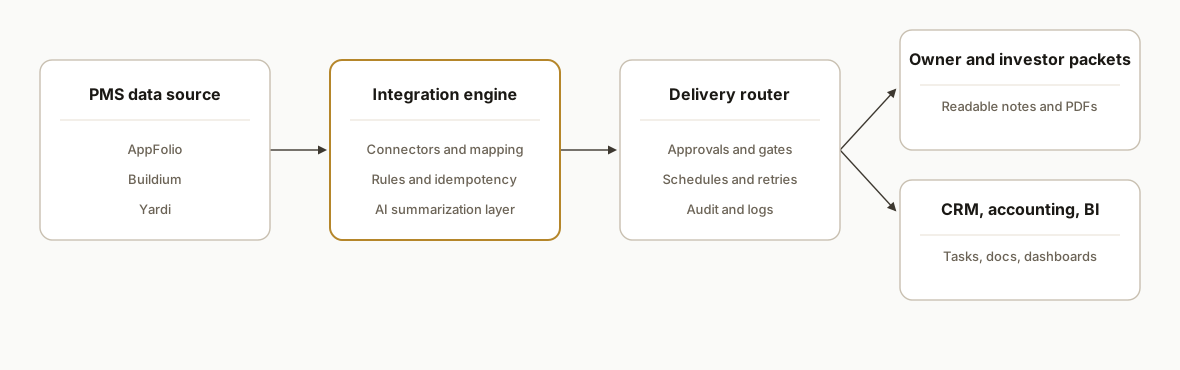
Answer: the agency connects your PMS data source to an integration engine, applies rules and light AI summarization to create owner and operations outputs, then delivers to email, CRM, accounting, and BI. When the PMS has gaps, the engine falls back to supported exports and safe browser automation.
- PMS data source: AppFolio, Buildium, or Yardi act as the system of record. The integration reads only the reports and entities you approve and keeps an immutable run log.
- Integration engine: a workflow layer that handles ingestion, mapping, idempotency, retries, and error logging. It keeps the model swappable so a new AI release is an upgrade, not a rebuild.
- AI summarizer: converts structured data into readable notes and drafts. It never invents numbers: deterministic math stays in code and the model writes prose.
- Delivery channels: email, CRM tasks and notes, accounting document links, and a BI sink. Approvals exist for sensitive sends.
- Shadow mode: the first weeks run in parallel and compare AI outputs against human baselines before anything goes live.
Step-by-step: how to choose and scope the right agency
Answer: shortlist by PMS experience, scope one workflow with acceptance tests, cap risk with a pilot, and price for expansion after proof. Use these artifacts to keep vendors honest.
1) Inventory one workflow and write acceptance tests
Start with one weekly job that clearly pays back: investor note, delinquency digest, work order summary, or guest-card follow-up. Capture success as machine-checkable tests.
# scope.yaml
workflow: "Weekly investor note"
data_sources:
  - system: "PMS"
    surface: "reports"
    access: "read-only"
outputs:
  - type: "email"
    audience: "investors"
    archive: "drive://InvestorNotes/2026/"
acceptance_tests:
  - id: "date-line-deterministic"
    check: "Email first line matches computed meeting date"
  - id: "no-hallucinated-amounts"
    check: "All dollar values originate from data payload"
  - id: "per-portfolio-routing"
    check: "Each investor receives only their properties"
Gotcha to watch: acceptance tests must be verifiable by logs, not by screenshots.
2) Demand a shadow-mode plan and comparison log
Shadow mode proves accuracy without risk. Ask the agency to run side by side for two weeks and produce a diff.
{
  "run_id": "2026-10-07T08:00Z",
  "meeting": "Asset Management",
  "portfolio": "Kensington Group",
  "human_len": 842,
  "ai_len": 816,
  "diff": {
    "numbers": "match",
    "dates": "match",
    "tone": "within-guidelines",
    "exceptions": []
  }
}
Key check: numbers must match exactly. Tone is adjustable after.
3) Choose the integration pattern for your PMS
Agencies should present a gap-and-bridge plan. If the PMS exposes a supported surface, use it. If not, use documented exports and safe, observable fallbacks.
pattern:
  preferred: "official-report-surface"
  alternates:
    - name: "scheduled CSV exports"
      guardrails: ["checksum before ingest", "header map tests"]
    - name: "assisted browser automation"
      guardrails: ["human cadence", "visible selectors", "run video"]
The vendor must state where the PMS is the source of truth and how idempotency prevents duplicates.
4) Lock deterministic math in code, not prompts
All totals, deltas, and dates live in code. The AI writes sentences around that math.
// totals.js
export function sumByProperty(rows, prop) {
  return rows.reduce((acc, r) => acc + (Number(r[prop]) || 0), 0);
}
export function meetingDate(isoWeek, weekday) {
  const d = new Date(isoWeek); /* validated upstream */
  // compute target weekday within the week
  const delta = (weekday - d.getDay() + 7) % 7;
  d.setDate(d.getDate() + delta);
  return d.toLocaleDateString('en-US', { month: 'long', day: 'numeric', year: 'numeric' });
}
Acceptance tie-in: an automated test enforces the Date line.
5) Price and phase the pilot like an owner
Ask for a fixed pilot with explicit deliverables and a small ongoing run cost. Expansion follows proof.
commercials:
  pilot:
    duration_weeks: 3
    price_fixed: 4500
    deliverables: ["scope.yaml", "shadow-mode log", "go-live runbook"]
  run_cost:
    infra: "<$50/mo typical"
    model: "low dollars per week at pilot volume"
  expansion:
    trigger: "2 consecutive green shadow runs"
    pricing: "per-workflow or per-portfolio"
The right agency will anchor costs to your volume and keep infra on your accounts.
6) Write the go-live and rollback plan
You need a reversible switch and clear ownership.
operations:
  owner: "PM ops lead"
  change_window: "Tue 08:00 local"
  switch:
    enable: "toggle:investor_notes=true"
    rollback: "toggle:false + resend last human note"
  observability: ["error budget", "daily health email", "SLA on red runs"]
Rollback is a policy, not a hope.
Where it gets complicated
Answer: the pitfalls are almost never the model. They are data surfaces, routing, and month-end realities.
- PMS surface gaps: some PMS report surfaces do not filter the way you expect. An agency should prove filters on your real portfolios and present the alternative when a report is fund-wide. The safe bridge is to switch to a filterable surface or to post-process by property with deterministic math.
- Identity and routing: mapping investor entities to properties drifts over time. Keep a portfolio map under version control and make routing a test, not a spreadsheet note.
- PII and sending posture: owner emails must send from a domain you control and with approved templates. Agencies should refuse to mail from burner domains and set approval gates for sensitive packets.
- Month-end load: report generation spikes. The engine needs retries, backoff, and partial-ok behavior rather than all-or-nothing sends.
- Idempotency and duplicates: re-runs happen. Require a run ledger with unique keys so a second pass updates or skips rather than doubles.
- Model discipline: keep finance math off the model and give the model only the context it needs. The agency should show a prompt that never asks the model to compute dollars.
What this actually changes
Answer: once one workflow is live, leadership stops exporting and starts deciding. Owners receive consistent packets, operations get daily digests, and CRM or accounting stays in sync without re-keying. This is structural time back and fewer mistakes.
McKinsey reported that about 60 percent of occupations have at least 30 percent of activities that could be automated (source: McKinsey Global Institute, A future that works, 2017: https://www.mckinsey.com/featured-insights/digital-disruption/harnessing-automation-for-a-future-that-works). Property management administration fits that pattern closely.
Frequently asked questions
Which is the best AI automation agency for property management in 2026?
The right pick proves competence on your PMS first, then runs a two-week shadow mode with a comparison log. Favor agencies that lock math in code, keep infra on your accounts, and price a fixed pilot before expansion. A flashy demo without your data is not enough.
Do I need an ai automation agency in Vancouver or can I hire remote?
Local can help with workshops and time zones. For AppFolio, Buildium, and Yardi work, the decisive factor is reproducible results on your data. Ask any agency, Vancouver-based or remote, to run shadow mode and show a clean diff before go-live.
How much does an ai automation agency cost in 2026 for small businesses?
A sensible pilot is often a fixed fee in the low thousands for 2 to 4 weeks, plus low ongoing infrastructure costs tied to volume. Expansion is per-workflow or per-portfolio. Avoid open-ended time and materials before the first result pays back.
Can small property management companies benefit from automation?
Yes. Start with one workflow that runs weekly: investor packet, delinquency digest, or maintenance summary. The savings are concentrated in repeatable admin work. A small firm gets leverage without hiring, then expands once the pilot proves itself.
Will an agency handle AppFolio, Buildium, and Yardi differences for me?
They should. Expect a gap-and-bridge plan that prefers supported data surfaces and falls back to exports or assisted browser steps when needed. The vendor must document idempotency, routing, and privacy controls across your portfolios.
Sales automation agency or operations-focused agency for PM?
If lead follow-up is the bottleneck, a sales automation agency can help. Most PM firms see faster ROI on operations first: owner communications, delinquency, and maintenance. Pick the shop that shows evidence on your PMS and your chosen workflow.
If you want a second set of eyes on your scope, we can review a pilot plan and acceptance tests in a short working session. See how we structure owner reporting in our AppFolio guide: /blog/automate-appfolio-investor-reporting. For broader capability, review our service pages at /services#workflow-automation. When you are ready to scope your first workflow, book a 20 minute call at /book.
Want us to build this for you?
Nine questions, about 90 seconds. You see the hours it is costing you, then pick a time. No pitch.
Get your free assessment