
Generative engine optimization (GEO) is the practice of making your website the source that AI answers quote, not just a link that ranks. In 2026, search splits into two jobs: classic SEO keeps you in the index, and GEO gets you cited inside Google AI Overviews, ChatGPT, and Perplexity. We rebuilt our own site for both, and this guide is the exact playbook we used.
If your organic traffic is slipping while AI-generated answers sit on top of the results, this is for you. We cover why search changed, what we changed on rexautomaton.com, and how to apply the same playbook to your business.
Why search changed in 2026
Search stopped being a list of links. AI Overviews now appear on roughly 26% of US searches and about 39% of informational queries, and when an AI answer sits at the top, organic click-through drops by 15 to 46%. The query gets answered before anyone clicks.
The flip side is the opportunity. Being the source the AI cites can lift click-through by up to about 35%, because your name sits inside the answer everyone reads. And 99.5% of AI Overview citations still come from page-one organic results, which means classic SEO is not dead, it is the entry ticket. You cannot be cited if you are not already ranking.
Two more shifts matter. Google's AI Mode uses query fan-out: it silently decomposes one question into many parallel sub-questions and assembles an answer from all of them. And the March 2026 core update, the most volatile on record, tilted hard toward authoritative, first-party, brand-owned sources and away from thin content built for search, whether a human or an AI wrote it. The direction of travel is clear: real experience and verifiable expertise win.
What getting cited actually requires
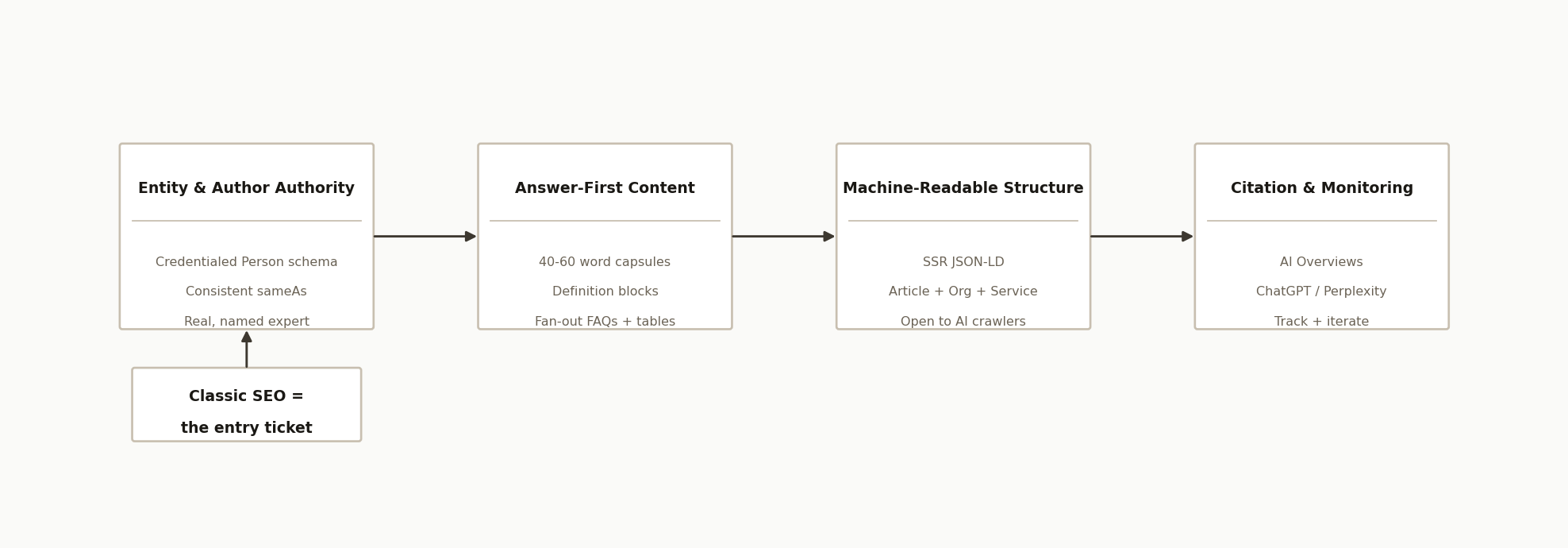
Getting cited is a different goal than ranking, and it needs different work on the page. Ranking is about relevance and links. Citation is about being the clearest, most trustworthy, most machine-readable answer to a specific question. The page has to prove who is talking, answer the question in the first breath, and be structured so a parser can lift the answer cleanly.
That breaks into four layers, and they build on each other.
What we changed on our own site
We ran the full playbook on rexautomaton.com before recommending it to anyone. Here is what each layer looked like in practice.
Author and entity authority
AI engines and the March 2026 update both reward demonstrable expertise, so we anchored every article to a real, named author with a credentialed Person schema: job title, a genuine bio, the topics the author actually knows, real certifications, and a sameAs link to their public LinkedIn. We did the same at the organization level, with consistent sameAs references tying the brand to its real profiles across the web.
The rule we held to: only claim what is verifiable. A certification or credential that contradicts the author's public profile is a negative trust signal, not a positive one. Experience-first means real experience.
Answer-first content
Under every heading, we lead with a direct 40 to 60 word answer before any context, because AI extractors lift the first clean answer they find. We added definition blocks (the "X is..." sentence that AI Overviews pull for "what is X" queries), and we restructured our FAQ sections to cover the query fan-out: cost, comparison, "is it worth it," how long it takes, what you need. We also added comparison tables, which are the single most-cited format in the research (the Princeton GEO study found tables lift AI citation rates by about 33%).
Machine-readable structure
All of our structured data is rendered server-side as JSON-LD, not injected by client-side JavaScript, because most AI parsers do not run your scripts. If the schema is not in the raw HTML, the machine never sees it. We emit Article, Organization, LocalBusiness, Person, and Service schema this way, so the page describes itself to any engine that reads it.
One honest note on schema: FAQPage and HowTo rich results are effectively dead in Google's blue-link results as of 2026. We keep the markup anyway because it still helps AI systems parse the page, but we do not expect star ratings or accordions in the SERP from it. The visible question-and-answer text is what earns the citation now, not the schema decoration.
Crawler access and monitoring
None of this matters if the AI crawlers cannot read the page, so we explicitly allow the agents that ground AI answers: GPTBot and ChatGPT-User, ClaudeBot, PerplexityBot, and Google-Extended (which controls whether Gemini and AI Overviews can use your content). Then we monitor which answers cite us and iterate on the pages that should but do not.
The playbook for your business
You can run the same sequence on any site. Here is the order that works.
- Fix the entity layer first. Make sure your brand and your authors exist as real, consistent entities: named author bios, credentials you can prove, and
sameAslinks to real profiles. This is the foundation everything else sits on. - Rewrite for answer-first. For every important page, put a direct answer in the first 40 to 60 words under each heading. Add a one-sentence definition near the top.
- Restructure FAQs for fan-out. Replace generic FAQs with the adjacent questions a buyer actually asks: cost, comparison, time, requirements, "is it worth it."
- Add comparison tables. Wherever you describe a choice or a before-and-after, put it in a table. It is the highest-cited format.
- Move schema server-side. Confirm your JSON-LD renders in the raw HTML, not via JavaScript. View source and search for the schema. If it is not there, a parser cannot read it.
- Open the gates to AI crawlers. Check your robots file allows the AI agents you want grounding your content.
- Keep classic SEO healthy. Page-one organic is still the prerequisite for citation. Do not abandon the fundamentals.
Here is the shift in one view:
| Optimized for ranking only | Optimized for AI search | |
|---|---|---|
| Goal | Rank in the blue links | Be the cited source in the answer |
| Content opening | Background, then the answer | The answer first, in 40 to 60 words |
| Authorship | A byline, maybe | A real, credentialed author entity |
| Structured data | Client-rendered, if any | Server-rendered, machine-readable |
| FAQs | A few generic questions | Fan-out questions an AI decomposes into |
| AI crawlers | Often blocked by default | Explicitly allowed and monitored |
What does not work
Plenty of AI-search advice is noise, and chasing it costs you. A few things we deliberately did not do.
Thin, AI-spun content at scale. The March 2026 core update punishes content built for search, regardless of who wrote it. Publishing fifty shallow AI articles is now a liability, not a growth lever. Depth and real experience win.
Fake author personas or invented credentials. A credential that does not match the author's public profile reads as a negative trust signal. We tie authorship to a real person with a verifiable record, and we recommend you do the same.
Betting on llms.txt. The proposed llms.txt standard sounds tidy, but 2025 studies showed near-zero AI-crawler adoption and no measurable citation lift. It is low effort with no proven benefit, so we skipped it and put the time into content and schema instead.
Expecting rich results from FAQ schema. As above, those SERP features are gone. Keep the schema for AI parsing, but do not build your strategy around a feature Google retired.
How we help
This is a service we run, not just a thing we did once. We do AI search optimization (GEO and AEO) end to end: the entity and author schema, the answer-first content rewrite, the server-side structured data, the crawler configuration, and the monitoring. Because we are an automation company first, we also build the part most agencies skip: systems that generate the schema, keep it consistent across every new page, and flag the pages that should be cited but are not, so the optimization maintains itself instead of decaying the moment the project ends.
If you want the full breakdown of what that includes, see our AI search optimization service.
Frequently asked questions
What is generative engine optimization (GEO)?
GEO is the practice of optimizing your website so AI systems quote it in their answers. Where SEO targets a ranking in the list of links, GEO targets a citation inside the AI-generated answer in Google AI Overviews, ChatGPT, or Perplexity. It overlaps heavily with SEO but adds author authority, answer-first content, and machine-readable structure as priorities.
Is SEO dead now that AI answers the question?
No. Classic SEO is the entry ticket, because 99.5% of AI Overview citations come from page-one organic results. If you are not ranking, you cannot be cited. SEO and GEO are two layers of the same job: ranking gets you eligible, and GEO-specific work gets you quoted. Abandoning fundamentals is the fastest way to disappear from both.
How do I get my content cited by ChatGPT or Perplexity?
Lead each section with a direct 40 to 60 word answer, back claims with concrete statistics and sources, use comparison tables and clear structure, and publish under a credentialed, real author. Make sure your structured data is server-rendered and that the AI crawlers (GPTBot, ClaudeBot, PerplexityBot) are allowed in your robots file. Different engines favor different sources, so consistency across the web helps.
Does structured data still matter if rich results are gone?
Yes, just for a different reason. FAQ and HowTo rich results are retired from Google's SERPs, but JSON-LD schema still helps AI systems understand and parse your page, and entity schema (Organization, Person, Service) reinforces who you are in the knowledge graph. Keep it, render it server-side, but do not expect SERP rich-result features from FAQ or HowTo markup anymore.
How long does GEO take to show results?
Plan on a few months. The on-page work (answer-first content, schema, crawler access) can ship in weeks, but AI engines re-crawl and re-evaluate on their own cadence, and citation share builds as your entity authority and topic coverage grow. It is closer to compounding than to a switch you flip.
Can I do this myself or do I need an agency?
The content changes (answer-first writing, definition blocks, better FAQs) are doable in-house with discipline. The technical layer (server-side JSON-LD, entity and author schema, crawler configuration, and especially automating it so it stays consistent across new pages) is where most teams get a specialist. We handle the whole stack and build it to maintain itself.
Search is splitting into ranking and being quoted, and the businesses that adapt early will own the citations their competitors are still trying to rank for. We rebuilt our own site for exactly this, and we do it for clients as a service. Book a 20-minute call and we will audit where your site stands on AI search, or see the full AI search optimization service for what a complete engagement looks like.
For a first-hand walkthrough with the exact steps and numbers, see how to get your business in AI search results.
Want us to build this for you?
Nine questions, about 90 seconds. You see the revenue it is costing you, then pick a time. No pitch.
See your options