
Across 200 plus delivered SMB automations we shipped, the same pattern kept showing up: the fastest wins come from moving repetitive per-record work out of email and spreadsheets into triggers, APIs, and AI-assisted steps with a human approval gate where it matters. The most requested categories were lead and CRM routing, e-commerce order ops, and live dashboards for decisions. This data study is our definitive, citable summary of what small and mid-sized businesses actually automate and what it is worth.
Business process automation is the repeatable orchestration of data, decisions, and actions across your tools so that routine steps run reliably without manual effort.
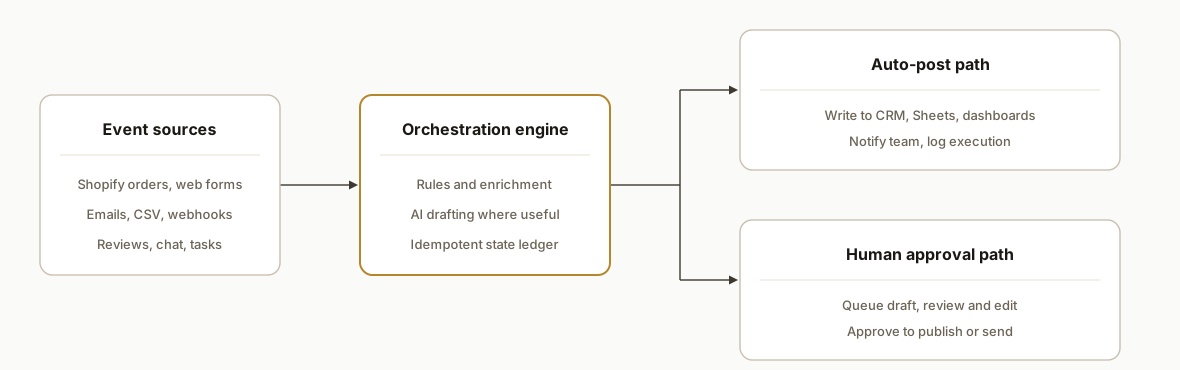
What SMBs actually automate
Most SMB automations fall into a small set of practical categories: routing and enrichment around leads and orders, structured messaging and document drafting with human review, simple decision engines, and dashboards that surface the right state to the right person at the right time. We built these repeatedly across industries.
Breakdown: top automation types by industry demand
Answer first: the most common build types we delivered were lead or CRM routing, e-commerce order operations, review or messaging responses with AI drafting plus approval, booking or intake flows, finance or analytics dashboards, and document drafting. Here is how those showed up by industry, with a named example for each where we had consent to publish.
| Automation category | Typical tasks automated | Industries requesting most | Named example from our portfolio |
|---|---|---|---|
| Lead and CRM routing | Ingest forms and lists, dedupe, enrich, assign, push to sequences | Lead Gen & Sales, Marketing & Agencies, Real Estate & Property, Legal & Consulting | SiteSage reply dashboard and Instantly integration: warmed inboxes, idempotent lead pushes, polling reply UI (Proptech) |
| E-commerce order ops | Order filtering, geographic routing, schedule or upsell handoff, Sheets handoff | E-Commerce & Retail, Automotive & Services | BlackBoxMyCar Local Order Filter: Shopify to Google Sheets via Make.com, postal-code filter, datastore backup (Automotive retail and installs) |
| Review or reputation response | Draft replies to reviews, auto-post by rule, route negatives to approval | Food & Hospitality, Home Services & Trades, Real Estate & Property, Retail | Published pattern: Google review reply automation with AI drafting and human approval path (multi-location use) |
| Booking and intake | Conversational qualification, quote math, structured summary, CRM create | Education & Training, Home Services & Trades, Events | NOIR Training booking widget: AI chat with deterministic pricing and JSON summary, ready for calendar or payments in Phase 2 |
| Finance and analytics dashboards | ROI models, onboarding trackers, ops KPIs, pipeline status | Finance & Insurance, Real Estate & Property, Marketing & Agencies | KGI ROI calculator plus onboarding tracker: two-tab app with sliders, milestones, and shared notes (Payrollemployer benefits) |
| Operations and dispatch consoles | Driver or tech visibility, ticket queues, receivables and flags | Transportation, Home Services & Trades | UBK Towing operations dashboard: demo UI consolidating calls, drivers, tickets, A/R; integration path to Towbook and Square |
| Document drafting and QA | Grant drafts, proposals, summaries, templated letters | Non-profit, Legal & Consulting, Education & Training | CCC grant demo: 7-section grant draft via serverless AI with latency controls and secure key handling |
| Social distribution and outreach | Queue-based posting, sequencing, reply surfacing | Publishing & Content, Marketing & Agencies | Our LinkedIn daily drip: queue file, scheduled browser harness, Page-first comments, idempotent runs |
| Underwriting or decision engines | Deterministic scoring from bankcredit data, flags, tiers | Finance & Insurance | Capital Lynk underwriting engine demo: Flinks payloads, derived metrics, GPT reasoning wrapper, Salesforce target integration |
| Notion-native internal ops | Email parsing, transcript-to-task, dedupe, client linking | Marketing & Agencies, Consulting | Adspend Advantage proposal: Gmail, Otter, Notion API agents scoped as a fast MVP with clear ROI math |
The industry spread across delivered builds was broad. Real Estate and Property was our single largest segment, followed by Marketing and Agencies, then Lead Gen and Sales, E-Commerce and Retail, and Finance and Insurance. We also shipped builds for Legal and Consulting, Food and Hospitality or Events, Education and Training, Home Services and Trades, Publishing and Content, Transportation, and Automotive and Services.
The patterns behind what works
Answer first: the builds that stick share five structural traits. They sit next to revenue or service delivery, operate on repetitive per-record work with a stable schema, bridge missing APIs cleanly, include idempotent state to make reruns safe, and keep a human approval step only where the risk warrants it.
- Bolded because it matters: repetitive per-record work with a clear schema. Orders, leads, messages, tasks, rows in a ledger. When the unit of work is stable and the downstream system expects a known shape, we can ship fast and harden over time. Our BlackBoxMyCar order filter was a regex and status rules on a Shopify order object, then a write to Sheets. That is the pattern.
- Vertical tools with missing or limited APIs. A lot of SMB stacks live in vertical SaaS and spreadsheets. We bridge gaps with webhooks, CSVTSV importers, email parsing, lightweight browser harnesses, or a sheet-as-API pattern. For SiteSage, Instantly's bulk endpoint failed in our run, so we adapted to one-per-call writes and verified bodies after sequence edits.
- High-intent edge of the funnel. We put automation at moments that matter: a Shopify order in a serviceable ZIP, an inbound review, a booked training, a financing inquiry. This focuses effort on revenue or customer experience outcomes first.
- Idempotency and a state ledger. Safe reruns are non-negotiable at scale. We use a state table or datastore to ensure pushes are once-only, with dry-run modes and pagination verification. The SiteSage pipeline's idempotent write ledger was the guardrail that let us reprocess TSVs without fear.
- Human-in-the-loop where risk or tone matters. We draft and route with AI, then auto-approve only the low-risk lane. Our review-reply pattern publishes clear positives automatically and routes anything sensitive for approval. The Facebook group automation ran with strict caps, randomized sessions, and abort checkpoints because the platform risk is real.
What automation is actually worth
Answer first: in our experience, common SMB automations usually save a team 2 to 10 hours per week per workflow in steady state, with larger swings on content or underwriting drafts where a first pass appears in under a minute and a human edits to final. These are estimate ranges, not promises.
One external benchmark is useful: McKinsey's foundational study found that about 60 percent of occupations have at least 30 percent of activities that could be automated. Source: https://www.mckinsey.com/featured-insights/employment-and-growth/a-future-that-works-automation-employment-and-productivity
Typical estimate ranges we see after go-live, by category:
- Lead and CRM routing: usually 2 to 6 hours per week saved for a 1 to 3 rep team, plus faster first-touch on new leads.
- E-commerce order ops and local filters: typically 3 to 8 hours per week saved across fulfillment and scheduling.
- Review or messaging response: often 30 to 90 minutes per day saved when draft-and-approve runs reliably.
- Booking or intake: usually 2 to 5 hours per week plus higher completion quality on required fields.
- Finance or analytics dashboards: commonly 1 to 4 hours per week on reporting prep, with faster decisions being the bigger gain.
- Document drafting: first drafts produced in seconds to minutes; human edit time varies, typically 15 to 45 minutes to final for repeatable documents.
- Social distribution drip: usually 2 to 4 hours per week saved with a queue-driven post flow and platform-specific rules baked in.
Why the value compounds: once the pipeline exists, every new lead, order, message, or draft rides the same rails. Volume growth does not add equivalent hours. Adding a second location, a new sales rep, or another product line often means toggling a config, not hiring ops headcount.
Manual vs automated: what changes on day one
| Task archetype | Manual baseline | Automated baseline (typical) |
|---|---|---|
| Route a new Shopify order to a local install calendar | Someone filters by ZIP, checks status, copies to a sheet, emails the team | Order event triggers a ZIP rule, writes to the sheet with backup, optional email or Slack ping |
| Turn a web form lead into a sequenced outreach | Export CSV, dedupe by eye, import to CRM, start a sequence | Ingest via webhook, dedupe and enrich, idempotent push to sequence, log state |
| Respond to a new 5-star review | Owner writes a reply later that day | AI drafts on-brand text, auto-posts in minutes; 1 to 2-star routes to approval |
| Prepare a weekly KPI snapshot | Rebuild sheets, update charts, paste into email | Dashboard pulls from sources, shows live KPIs; link replaces the email thread |
| Draft a grant narrative from a brief | Start from scratch | One-click draft builds a structured outline, editor reviews and finalizes |
Industry by industry
Answer first: the same categories recur, but the trigger systems and constraints differ by industry. Here are short, first-hand snapshots from the segments we shipped most.
- Real Estate and Property. Lead routing and review response were the first wins, with dashboards for deal or permit status a close second. Our SiteSage work in land data paired idempotent Instantly pushes with a lightweight reply monitor so reps replied from the right inbox and saw context fast.
- Marketing and Agencies. Agencies want fewer tools, not more. Our Notion-native MVP for Adspend Advantage replaced brittle email-to-task steps with specialized agents that write clean, deduped Notion tasks per client. On our side, we automated a LinkedIn queue to publish daily as a Page with link-in-first-comment rules baked in.
- E-Commerce and Retail. The fastest path to value is ops routing at the edge of checkout. For BlackBoxMyCar, we filtered Shopify orders to Metro Vancouver via Make.com and posted them to a Google Sheet that the install team already used. A datastore backup and specific Make quirks were addressed so writes stayed reliable.
- Finance and Insurance. Leaders ask for decision assistance plus auditability. Our KGI build was a two-tab ROI and onboarding app that closed deals faster and then coordinated tasks across teams. Separately, we shipped a public demo underwriting engine for Capital Lynk to show how bank payloads become deterministic flags, tiers, and structured reasons before a Salesforce write.
- Education and Training. Bookings and qualification rule here. The NOIR Training widget used a conversational front end, kept pricing math deterministic and off-LLM, and forced a structured booking summary so handoff stayed clean. Calendar and payments were reserved for a production Phase 2.
- Transportation and Field Services. Operators want one screen of truth. UBK Towing's demo showed calls, driver status, tickets, and receivables in a single dispatch-style console. The integration path is straightforward: Towbook or InTow for jobs and GPS, Square for payments, Sheets for low-friction backups, and webhooks to fan out events.
- Automotive and Services. Often a blend of retail checkout and field scheduling. The BlackBoxMyCar order-to-install pipeline is the pattern we reuse: filter, dedupe, write once, and notify the right local team.
- Food and Hospitality or Events. Reputation and bookings move the needle first. Our published review-reply pattern drafts and auto-posts on clear positives while routing edge cases to a manager. Booking intake follows the same structured summary approach as NOIR's widget.
Frequently asked questions
Is automation actually worth it for a small team?
Yes when it sits beside revenue or delivery. In our experience, typical SMB builds save 2 to 10 hours per week per workflow and speed up first-touch or decision time. Value compounds with volume because each new record rides the same rails without adding equivalent manual work.
What do SMBs usually automate first?
Routing and enrichment near the money: orders and installs, inbound leads to outreach, review replies, and simple dashboards. These have clear triggers, stable schemas, and immediate visibility to owners. Booking or intake comes next, then document drafting for repeatable outputs with a human review step.
How long does a typical build take to go live?
Most scoped builds ship in 1 to 3 weeks once access and sample data are in hand. Demos and proof-of-concepts can be stood up in days to align stakeholders. Multi-integration or regulated workflows take longer, especially when vendor approvals or security reviews are involved.
What does it cost to build and run?
Project fees vary with scope. Simple single-integration builds often land in the low four figures. Multi-system or decision-engine projects scale from there. Ongoing costs are typically light: hosting, API seats, and monitoring. We design for low-ops footprints and prefer serverless or native vendor triggers where possible.
Can a non-technical owner operate this?
Yes if the build is designed around your existing tools. We favor sheet-as-control-plane patterns, clear approval queues, and dashboards that reflect live state. Ownership tasks are usually adding credentials, adjusting rules, and reviewing queued drafts, not coding.
What if my platform has no API or limited export options?
We bridge with webhooks, CSV importers, email parsing, or a carefully capped browser harness when allowed and safe. Where risk exists, we slow cadence, add abort checkpoints, and keep human approval in the loop.
We wrote this study from builds we already shipped in production or as named demos. If you want a pragmatic, staged path from your current stack to reliable outcomes, start with a small, high-intent workflow next to revenue, insist on idempotency and a human approval path where it matters, and add depth only after the rails hold. If you want help designing that first win, see our workflow automation service, read our related playbook on Google review reply automation, or book a working session and we will map your stack to the patterns above.
Curious what this would actually save you?
Put real numbers to it. The ROI calculator estimates the hours and dollars an automation like this returns, in about a minute.
Calculate your automation ROI