
The short answer: pick one workflow, insist on a pilot-first build with shadow mode and clear acceptance tests, require client-owned credentials, and make the model swappable. That is how we ship production systems and how you can evaluate any AI automation agency in Vancouver or beyond without risk.
AI automation agency definition: a delivery team that designs, builds, and runs software to connect your systems and use AI where it helps to deliver a finished business result on a schedule.
The problem it solves
Most small businesses do one of two things: hire an agency on a vague promise or pause because it all feels risky. We have built and shipped dozens of automations. The failures we get called to replace started the same way: no pilot, no acceptance criteria, no ownership of keys, and no audit trail.
| How buyers evaluate | Manual vendor search | Pilot-first evaluation |
|---|---|---|
| Scope clarity | Sales deck bullets | One workflow, acceptance tests, deadline |
| Risk | Live systems touched day one | Shadow mode first, go live after proof |
| Ownership | Agency holds keys and accounts | Client-owned creds, swappable stack |
| Proof | Anecdotes | Pass-fail log with sample IDs |
| Cost control | Time-and-materials creep | Fixed-scope pilot with cap and exit |
How this buyer's checklist works
You run a small audition: questions that force real engineering answers, a scoped pilot that runs in shadow mode, and go-live only after it passes. These are the same mechanics we use in production: they surface platform limits early and prevent surprises.
- Pilot anchor: a single workflow with acceptance tests
- Data safety: client-owned credentials and reversible changes
- Observability: health endpoints, logs, and an audit trail
- Shadow mode: AI runs in parallel before touching customers or money
- Swappable model: architecture does not lock you to one LLM
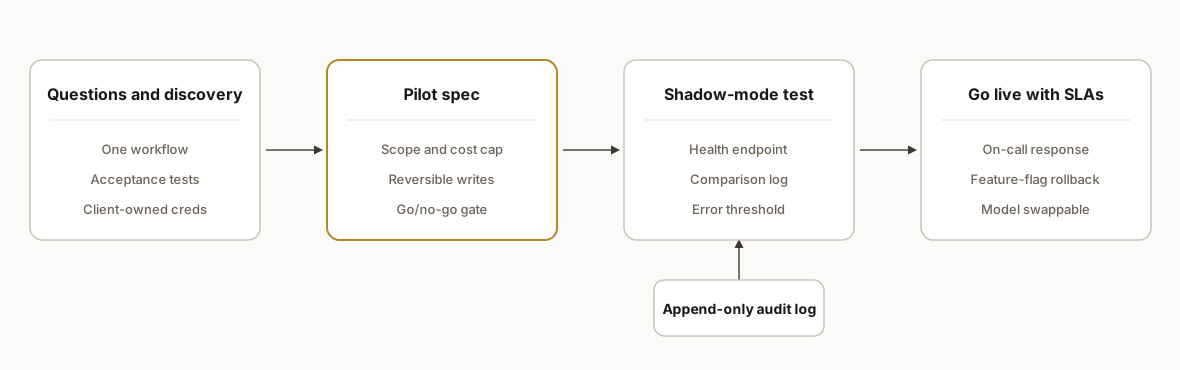
Step-by-step: how to run a safe evaluation
1) Start with one workflow and acceptance tests
Pick one job with clear success criteria. Ask the agency to return a short spec and tests you can read.
# pilot-spec.yml
workflow: "New Shopify order in Metro area -> Sheet row + backup store"
acceptance:
  - "Ignore cancelled/refunded/pickup orders"
  - "Regex match postal codes V5*, V6*, V7*"
  - "Append 10 consecutive test orders with idempotency"
  - "Produce an audit row with source_id, action, status"
limits:
  runtime_seconds: 30
  monthly_cost_cap_usd: 50
Key gotcha: acceptance tests prevent scope creep and make the pass-fail unambiguous.
2) Require client-owned credentials and reversible writes
Your accounts, your API keys. Writes must be reversible or sandboxed until go-live.
# Minimal env contract
printf "%s" "SHOP_URL=...\nAPI_KEY=...\nAPI_SECRET=...\nSHEET_ID=...\n" > .env
# Agency returns a creds-ownership.md that lists every key and tenant
Key gotcha: if the agency owns the keys, you cannot switch vendors cleanly.
3) Ask for a health endpoint and comparison log
You need an observable system. Health endpoints catch stalls. A comparison log proves shadow-mode accuracy.
# Health check example
curl -sS https://your-pilot.example.com/health | jq
# => {"ok":true,"uptime":"3d 4h","queue":0,"last_run":"2026-09-13T08:14:11Z"}
Key gotcha: a healthy cron that publishes status avoids silent failures.
4) Demand an immutable audit log
Every change should be traceable. Append-only logs with who, what, and when protect you when something goes wrong.
create table action_audit (
  id bigserial primary key,
  ts timestamptz default now(),
  actor text not null, -- system or user email
  source_id text not null, -- e.g., order_id
  action text not null, -- created_row, skipped_refund, retried
  details jsonb not null
);
Key gotcha: immutable logs are how we satisfied compliance asks in financial and healthcare-adjacent builds without heavy software.
5) Run shadow mode before touching customers or money
The AI drafts or routes. A human or a parallel baseline verifies output until the error rate meets your threshold.
{
  "shadow": true,
  "target_error_rate": 0.02,
  "compare_to": "human_label",
  "promotion_rule": "7 consecutive days below threshold"
}
Key gotcha: we prevented false bookings in a voice-dialer rollout by adding server-side guards and a shadow window before toggling live.
6) Go live with SLAs and a rollback plan
Green-light after the shadow log passes. Lock in response windows and who is on the hook during incidents.
# sla.yml
incident_severity:
  P1: "Down/blocked. Response 30 min. Fix or rollback 4 h."
  P2: "Degraded. Response 2 h. Fix 1 business day."
rollback:
  strategy: "feature flag"
  steps:
    - "set FEATURE_LIVE=false"
    - "drain queue"
    - "notify channel #ops"
Key gotcha: a feature flag or toggle is faster and safer than code deploys under pressure.
Where it gets complicated
Vendor platform quirks. Webhook URLs often change when a scenario is imported. If your buttons still call the old URL, nothing runs. We fix this in handoffs by listing every trigger URL and a rebind checklist.
Rate limits and timeouts. Cloud functions time out and APIs rate-limit. We size pilots with realistic budgets, add retries, and meter pushes. A single bulk endpoint that returns 400 can force one-by-one writes.
Closed systems with no API. Some tools do not expose an API. We bridge with safe browser automation only when needed, add human-like pacing, and isolate credentials. Or we shift to read-only sync first while you evaluate ROI.
LLM reliability and guardrails. We never put an AI guess in a critical field. Deterministic logic handles prices and dates. AI drafts get scored or gated. This is how we stopped misclassifications from creating false bookings.
Data ownership and exit. We keep model prompts, mapping code, and logs in your repo. If a vendor disappears, your pipeline does not.
What this actually changes
For a Vancouver small business searching "ai automation vancouver" or "ai automation agency for small businesses 2026," the pilot-first approach turns a risky contract into a controlled audition. We have shipped this pattern across ecommerce order routing, CRM syncs, investor reporting, outreach, and transcription to legacy databases. McKinsey estimated generative AI could add 2.6 to 4.4 trillion dollars of value annually across industries, which is the macro reason pilots pencil out even on small workflows (source: McKinsey, 2023).
In practice this looked like: dual-writing during migrations to avoid downtime, client-owned credentials so you can switch vendors, immutable logs to satisfy audits, and shadow-mode runs that remove guesswork before go-live. You get a result without handing over your stack.
Frequently asked questions
What questions should I ask an AI automation agency in 2026?
Ask for a one-workflow pilot, acceptance tests, client-owned credentials, a health endpoint, an immutable audit log, and shadow mode with a pass-fail threshold. Confirm model swappability and a rollback plan. Ask who is on call and response times for incidents. These answers separate sellers from builders fast.
How much should a small-business pilot cost?
A tightly scoped pilot should be fixed-fee with a cap and a clear exit if it misses acceptance tests. We price pilots to fit one workflow and one week of engineering. Ongoing costs are the tools you already use plus low AI usage. Avoid open-ended retainers before proof.
Do I need a local Vancouver agency, or is remote fine?
Local is useful for trust and on-site work. The real gating factor is engineering hygiene: tests, logs, and shadow mode. We build remotely and on-site in Vancouver. If you need in-person, ask for a half-day discovery. Otherwise, a remote pilot is faster to start.
How long until we go live?
A safe pattern: 3 to 5 days for the pilot build, then 5 to 10 business days in shadow mode depending on volume. Go-live follows once the comparison log meets the agreed threshold and rollback is in place. Bigger workflows can be split into multiple pilots.
What are red flags when hiring an AI automation agency?
No acceptance tests. No audit log. Agency-owned credentials. Live changes on day one. A single vendor model welded into the code. No response time commitments. Big-bang scope instead of one workflow. These are the patterns behind the rescues we have done.
What services should an AI automation agency list for small business in 2026?
Expect workflow automation, CRM syncs, AI voice or chat agents where appropriate, document extraction, reporting, and custom integrations. The common denominator is finished outcomes and observable systems, not just prompts or chat widgets.
If you want a second set of eyes on a pilot spec before you hire, we can review it and tell you in the first five minutes whether your setup maps to what we have shipped. See our service menu under custom AI integration, compare this guide to our local perspective in Best AI Automation Agency Vancouver, and when you are ready to scope your first workflow, book a 15-minute call.
Curious what this would actually save you?
Put real numbers to it. The ROI calculator estimates the hours and dollars an automation like this returns, in about a minute.
Calculate your automation ROI