
We built a white-label joint-venture pre-sales engine for The Credle Group so they could sell automation under their brand: a named, co-branded demo, a scoped SOW template, NDA-gated proof assets, and a clean lead handoff. If you sell into property managers, investors, or realtors and need a vendor-invisible way to prove value fast, this is the pattern we shipped.
White-label JV pre-sales enablement is a co-branded, vendor-invisible sales layer: partners demo and scope deals using your proven assets while you deliver under their brand.
The problem it solves
A partner wants to sell modern automation into a trusted network but lacks a proof asset, a scoped offer, and a vendor-safe handoff. Without those, pre-sales calls stall, scope creeps, and vendor branding spooks buyers who expect one face.
| Manual partner pre-sales | White-label JV pre-sales engine |
|---|---|
| Ad hoc demos. Each call is a screen share with no persistent link or brand alignment. | Co-branded, named demo site with the partner's logo and language. Shareable URL that survives calendar churn. |
| Scope changes mid-call. No standard SOW or guardrails. | Pre-written SOW with toggles and price bands. Clear in-scope and out-of-scope list. |
| Vendor shows up too early and confuses ownership. | Vendor-invisible demo, NDA-gated assets, and a handoff route that keeps the partner as the face. |
| No lead routing or record of what was shown. | Lead capture, NDA acceptance log, and a notes handoff to delivery. |
| Promises drift. Quotes vary by mood, not by rules. | Offer math templated. Variables drive consistent quotes and timelines. |
How the enablement works
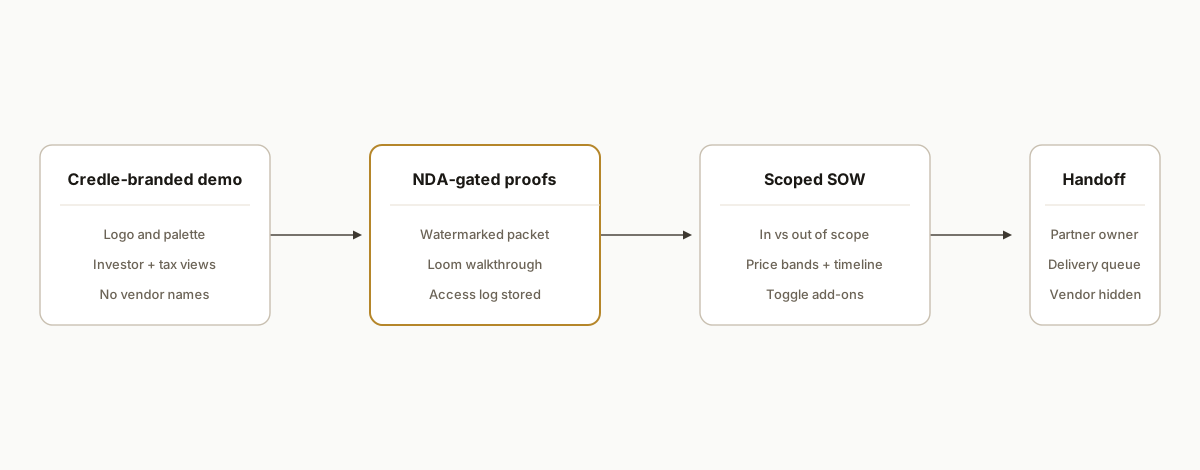
The Credle Group needed a turnkey way to show credible automation, under their name, to a real-estate network. We assembled a partner kit that keeps us invisible until signature while giving their prospects something concrete to click.
- Co-branded demo site: a live, partner-named demo that shows an investor reporting tracker and a tax-appeal tracker. Logos, palette, and copy match The Credle Group.
- NDA-gated proof assets: sample owner-investor packet, one-pager, and a Loom walkthrough available after a short NDA acceptance screen. Access logs are stored for follow-up.
- Pre-scoped SOW template: a modular scope with in-scope, out-of-scope, and optional upsells. Price bands and timelines are parameterized so quotes stay consistent.
- Lead capture and handoff: a single form collects contact, interest, and the asset viewed, then posts to a partner inbox and our delivery queue with partner-as-owner.
- Vendor secrecy and white-label guardrails: no vendor names in demo, links, or PDFs. We deliver under The Credle Group brand until contract terms allow attribution.
Step-by-step: how to build it
Answer first: we stand up a co-branded demo, gate proof assets behind an NDA, parameterize the SOW, and wire a partner-owned handoff so the partner stays the face while we deliver.
1) Define the partner config once
Create a single config object that drives brand, contact, and pricing bands. This keeps every asset aligned and prevents scope drift.
{
  "partner": {
    "name": "The Credle Group",
    "brand": {
      "logoUrl": "https://cdn.partner-assets/credle/logo.png",
      "primary": "#0F3D3E",
      "accent": "#C8A34B"
    },
    "contact": {
      "salesEmail": "hello@thecredlegroup.com",
      "handoffInbox": "projects@thecredlegroup.com"
    }
  },
  "offer": {
    "name": "Owner Reporting + Tax Tracker",
    "tiers": [
      { "id": "starter", "priceBand": "$",   "delivery": "2, 3 weeks" },
      { "id": "core",    "priceBand": "$$",  "delivery": "3, 4 weeks" },
      { "id": "plus",    "priceBand": "$$$", "delivery": "4, 6 weeks" }
    ]
  }
}
Key gotcha: keep this in one source of truth so the demo, PDFs, and SOW render from the same variables.
2) Stand up the co-branded demo route
We deploy a simple, static demo that reads the config and sets partner brand at build time. The URL is human and partner-named.
// demo.config.js
export const PARTNER = {
  name: "The Credle Group",
  logo: "/assets/credle-logo.svg",
  palette: { primary: "#0F3D3E", accent: "#C8A34B" }
};
// pages/demo.js
import { PARTNER } from "../demo.config";
export default function Demo() {
return (
<main style={{ borderTopColor: PARTNER.palette.accent }}>
<img src={PARTNER.logo} alt={`${PARTNER.name} logo`} />
<h1>{PARTNER.name} Owner Reporting Demo</h1>
<p>See investor views and a tax-appeal tracker in one place.</p>
</main>
);
}Key gotcha: vendor names never appear. The path, title, and assets are partner-first.
3) Gate proof assets behind a lightweight NDA
We use a simple acceptance screen before showing downloadable proofs. The acceptance log routes with the lead.
---
title: NDA Acceptance
partner: The Credle Group
---

By clicking "I Agree," you confirm:

- You will not redistribute these materials.
- You will not publish screenshots or recordings without written permission.

[ I Agree ]  [ Decline ]
Key gotcha: store timestamp, email, and IP on accept. Route a copy to the partner inbox.
4) Parameterize the SOW with toggles
We keep the SOW templated with clear in-scope, out-of-scope, and optional add-ons. Price bands come from the config.
# Statement of Work: {{ partner.name }}, {{ offer.name }}

Scope:
- Owner reporting dashboard (core)
- Tax-appeal tracker (core)
- Optional: review requests automation (toggle)

Out of scope:
- Custom data warehouse
- Third-party subscription fees

Price band: {{ tier.priceBand }}  •  Delivery: {{ tier.delivery }}
Key gotcha: the cover email must mirror the SOW. Mixing observations and deliverables in email reads like scope creep.
5) Wire the lead capture and handoff
A single, partner-branded form posts leads to the partner and to our delivery queue with partner-as-owner.
{
  "lead": {
    "name": "Ash Patel",
    "email": "ash@fundco.com",
    "assetViewed": "Investor Packet PDF",
    "notes": "Wants owner statements monthly; 400+ units"
  },
  "route": {
    "partnerInbox": "projects@thecredlegroup.com",
    "deliveryQueue": "rex-delivery@internal"
  }
}
Key gotcha: do not auto-insert vendor on replies. Partner stays front-of-house until signature.
6) Record a Loom and lock content controls
One Loom walkthrough is enough. We keep it behind the NDA gate and watermark it with the partner brand.
loom:
  url: https://loom.com/share/credle-demo
  watermark: The Credle Group
  gated: true
  download: false
Key gotcha: confirm permission before publishing recorded calls or clips. This prevents accidental disclosure.
Where it gets complicated
Answer first: most failures are not technical. They are commercial and process.
- Vendor secrecy is non-negotiable. Keep vendor names out of domains, PDFs, and page source. If you ever need attribution, make it a contract term after delivery proves itself.
- Scope creep starts in cover emails. If the email lists problems beyond the SOW, buyers will hear that as quoted scope. Keep emails scoped, and move observations into a separate advisory note.
- Price language must be consistent. If a teammate floated a monthly range verbally, keep the written quote inside that band unless you reset expectations first.
- Asset control matters. Demos and Looms need NDA gating, watermarking, and no-download flags. This protects the partner's face and your IP at the same time.
- Audience and language. The Credle Group has Spanish and LatAm angles. Decide now which assets need a Spanish voiceover rather than ad hoc translation later.
- Rev-share and lead ownership. Define who owns the client, who invoices whom, and what happens on churn. Do not wait until handoff day to do this.
What this actually changes
For The Credle Group, the pre-sales engine turned a vision into a concrete, named demo with a scoped SOW and a partner-owned handoff. That let Carlos start real conversations with property managers, investors, and realtors without exposing vendor branding. Results are qualitative at this stage: assets and flow are live, terms are not yet signed.
One reason this approach works: buyers increasingly want to explore digitally before talking to a vendor. Gartner projects that 80 percent of B2B sales interactions will occur in digital channels by 2025 (source: https://www.gartner.com/en/newsroom/press-releases/2020-11-24-gartner-says-80--of-b2b-sales-interactions-between-suppliers-and-buyers-will-occur-in-digital-channels-by-2025). A co-branded, self-serve demo plus a templated SOW meets that preference and shortens the time to a real scope.
Frequently asked questions
How do you keep the vendor invisible while still delivering?
We remove vendor names from every public surface, gate proofs behind an NDA, and route leads with the partner as owner. We only appear post-signature in delivery notes that the partner forwards or rebadges, based on contract terms.
What goes into the white-label demo?
A named page with the partner's logo and palette, a focused flow that mirrors the first deliverable, and one Loom walkthrough. No multi-feature kitchen sink. The demo proves one result and links to the NDA-gated packet and SOW.
How long does this take to stand up?
A first version is days, not weeks: co-branded demo, NDA gate, SOW template, and lead routing. Future iterations add language variants, additional proofs, and optional upsells.
How do you prevent scope creep?
We use a templated SOW with in-scope, out-of-scope, and toggled add-ons. The cover email mirrors the SOW exactly. Any advisory notes go into a separate appendix so buyers do not conflate analysis with quoted work.
Who invoices and who owns the client?
In a JV, the partner remains the client owner and invoices the end customer. We invoice the partner or net out via a rev-share. These rules are decided up front and reflected in the SOW.
Can this expand beyond real estate?
Yes. The same pattern applies anywhere a trusted introducer wants to sell automation under their brand. We swap the proof assets and SOW modules for that vertical while keeping the same enablement spine.
If you want to arm a partner with a vendor-invisible way to sell automation, we have shipped this exact enablement for The Credle Group. See our related breakdown on using a two-tab ROI and onboarding app to speed alignment in Partner ROI Onboarding Dashboard. For customizations or to scope your partner kit, see our custom AI integration services or book a 15-minute call.
Want us to build this for you?
15-minute discovery call. No pitch. We tell you what to automate first.
Book a Discovery Call