
You do not always need a Vancouver-based AI automation agency. We built and shipped local and remote programs for BC companies and the pattern is simple: remote is fine for pure software integration. Local wins when you need on-site discovery, Canadian hosting you can audit, BC PIPA paperwork, and field validation at customer sites.
Definition: a Vancouver AI automation agency is a team that designs, builds, and runs software and AI workflows for businesses in Metro Vancouver, with the ability to work on-site and to host data in Canadian regions when required.
This guide answers the buyer query behind "ai automation vancouver" and "ai automation agency vancouver": when local matters, what you get from on-site days, how Canadian hosting and BC PIPA change your DPA, and how pricing models compare for small businesses and SMEs.
The problem it solves
You are choosing between a local Vancouver partner and a remote shop. The wrong choice adds friction: slow facility access for discovery, delays on security forms, confusion about BC PIPA vs PIPEDA, and missed field nuances that break otherwise good automations. For many small businesses, a hybrid model is the answer: local for the high-leverage days and remote for the build.
| Decision dimension | Local Vancouver agency | Remote-only agency |
|---|---|---|
| Discovery and buy-in | In-person whiteboarding, site walks, access to floor staff | Zoom-based, relies on your notes |
| Field validation | Same-day ride-alongs and pilot tweaks | Scheduled windows, slower iteration |
| Data residency | Canadian regions you can audit and reference in contracts | Often US or mixed regions unless you insist |
| Privacy paperwork | BC PIPA-aware DPA and consent language | Generic DPA, you carry local adaptations |
| Time-to-access | Easier badging, SOC tour, and room bookings | Requires remote exceptions and escorts |
| Cost per day | Higher on days on-site, but fewer loops later | Lower travel cost, more cycles to land the same insight |
Two concrete points for Vancouver buyers:
- BC's private sector privacy law is the Personal Information Protection Act. BC's regulator provides the overview and obligations for private organizations in the province. Source: Office of the Information and Privacy Commissioner for BC, PIPA overview https://www.oipc.bc.ca/privacy-legislation/private-sector/
- Major clouds provide Canadian regions if you need residency. AWS lists Canada Central and Canada West. Azure lists Canada Central and Canada East. Google Cloud lists Montreal and Toronto. Sources: AWS regions https://aws.amazon.com/about-aws/global-infrastructure/regions_az/ and Google Cloud regions https://cloud.google.com/about/locations
How the engagement works
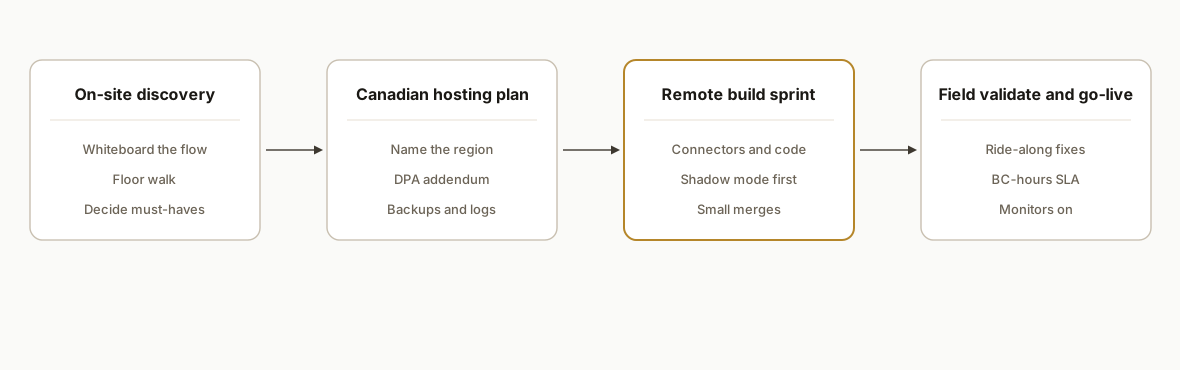
Our production pattern in Vancouver is hybrid: the high-leverage pieces are local. The rest runs as a remote sprint with clear gates and a DPA that references Canadian regions.
- On-site discovery day: We map the real workflow with operators in the room. One whiteboard plus one walk-through usually surfaces constraints that docs never capture.
- Canadian hosting plan: We pin storage and compute to Canadian regions and put that in the DPA. You get a named region and a contact path to verify it.
- Remote build sprint: Code, connectors, and prompts ship as small merges against a test account. Shadow mode runs first.
- Field validation window: We sit with staff during a real shift. We watch, fix edge cases, and measure the gap to go-live.
- Go-live and support: A simple SLA: BC business hours for human escalations and 24 by 7 monitors for uptime.
Step-by-step: how to scope and contract this right
1) Lock Canadian regions in your plan
Pin data to Canada and write it into your infra notes. If you self-host, pick a Canadian region up front.
# Terraform: AWS pinned to Canada (use one per system)
provider "aws" {
  region = "ca-central-1"   # Montreal. Or use "ca-west-1" for Calgary
}

resource "aws_s3_bucket" "app_data" {
  bucket = "my-bc-app-data"
  force_destroy = false
}
Gotcha: many vendor dashboards default to US. Ask for the Canadian region at account creation, not after.
2) Add a BC PIPA-aware DPA clause
Do not overcomplicate this. Name the region and your obligations in plain language, then attach your vendor DPA.
Data Location and Privacy: Service data at rest and backups are stored in Canadian cloud regions selected by Client. Provider will not copy or process service data outside Canada without written consent, except for transient routing. Provider will implement safeguards that are reasonable in the circumstances and will use and disclose personal information only for purposes identified by Client, consistent with BC PIPA.Source for BC PIPA obligations: OIPC BC PIPA overview https://www.oipc.bc.ca/privacy-legislation/private-sector/
3) Pick stacks with Canadian regions available
If you manage the cloud, set the region when you create resources.
# Google Cloud example: create a bucket in Montreal
PROJECT_ID=my-bc-project
BUCKET=bc-app-archive
REGION=northamerica-northeast1   # Montreal

gcloud config set project "$PROJECT_ID"
gsutil mb -l "$REGION" gs://$BUCKET/
Key check: dashboards and backups. Verify snapshots and logs inherit the same region policy.
4) Schedule one on-site discovery day and one field window
Put it on the calendar at quote time. The agenda is simple.
agenda:
  - 09:00 kickoff: goals, constraints, systems map
  - 10:00 whiteboard: swimlanes and failure points
  - 12:30 floor walk: observe the actual process
  - 14:00 decision: must-haves vs deferrals
  - 15:00 security: DPA review and access plan
Local day reduces rework. In our experience, on-site uncovers at least one hidden constraint that would have taken weeks to surface by email.
5) Set BC-hours support and escalation rules
Write a tiny SLA that fits how you work.
sla:
  support_hours: Mon, Fri 08:30, 17:30 America/Vancouver
  p1: 2h response, 4h workaround, daily updates
  p2: 4h response, next-business-day fix or rollback
  p3: 1-business-day response, scheduled release
  channels: [email, phone, statuspage]
6) Choose a pricing model that matches risk
For "ai automation agency for small business" and SMEs, a hybrid price keeps risk down: a scoped fixed fee for discovery and phase 1. Then milestones. A simple model:
# Rough planning math for a first milestone
on_site_days = 2
on_site_rate = 1500
build_weeks = 2
week_rate = 4800
contingency = 0.12
subtotal = on_site_days*on_site_rate + build_weeks*week_rate
quote = round(subtotal * (1+contingency))
print(quote)
We keep on-site days tight and reserve build time for what was proven on the floor.
7) Close the loop on invoicing and tax
BC clients often need GST or GST plus PST noted. Set this up on day one.
Invoice lines
  Discovery day x 1           $1,500.00
  Field validation x 1        $1,500.00
  Build sprint, 2 weeks       $9,600.00
  Subtotal                    $12,600.00
  GST 5%                      $630.00
  Total                       $13,230.00
Where it gets complicated
BC PIPA vs FIPPA. Private-sector businesses in BC follow PIPA. Public bodies follow FIPPA. FIPPA has its own rules and history on data residency. If you are not a public body, reference PIPA in your DPA. Sources: OIPC BC PIPA and FIPPA pages https://www.oipc.bc.ca/privacy-legislation/
Data residency myths. Many private businesses prefer Canadian regions. That is a preference or a contractual term. Write it down. Do not assume your vendor did it for you.
Backups and logs. Teams set the app to Canada and forget snapshots. Confirm backups, logs, and analytics follow the same region policy.
On-site safety and access. If your floor requires PPE or inductions, schedule them. We book a 30-minute safety check before the walk.
Procurement forms and DPAs. Local presence helps get vendor forms signed faster. Assign one owner for privacy, one for security, and one for finance to reduce churn.
Time zones and handoffs. Remote teams outside PST can be great for builds. Do not schedule field validation that needs same-day fixes if your team is asleep.
What this actually changes
For "ai automation agency for small businesses" and SMEs, local days concentrate decisions and unblock field access. The rest of the work runs as a normal remote build. The hybrid saves loops and gets to stable production faster.
Two external anchors matter when you justify this to leadership:
- Small businesses are the vast majority of Canadian firms. SMEs account for 98 percent of employer businesses in Canada. Source: ISED Key Small Business Statistics https://ised-isde.canada.ca/site/sme-research-statistics/en/key-small-business-statistics
- Speed to first contact drives revenue. Firms that responded to web leads within an hour were seven times more likely to qualify the lead than those that waited longer. Source: Harvard Business Review https://hbr.org/2011/03/the-short-life-of-online-sales-leads
Local presence does not replace good engineering. It removes avoidable friction: access badges in hours not weeks, a DPA you can sign as-is, and a field-ready pilot that matches what staff actually do in Vancouver.
Frequently asked questions
Do I actually need a Vancouver-based AI automation agency?
Not always. If your work is pure software integration, a remote shop is fine. Choose local for on-site discovery, field validation, Canadian hosting you can verify, and BC PIPA paperwork you do not want to author yourself.
Can you guarantee Canadian data residency for my project?
Yes if the chosen stack supports Canadian regions. Name the region in the DPA and set each resource at creation. Verify backups and logs inherit the same policy. Clouds list Canadian regions publicly. See AWS and Google Cloud region lists above.
How does pricing differ for local vs remote work?
Local adds on-site day rates and travel. We keep those days focused. The build runs on a fixed fee or milestone plan. For small businesses, a 1 to 2 day on-site plus a 2 week sprint is a common first phase.
How fast can we start in Vancouver?
We typically schedule an on-site discovery within one to two weeks. Remote builds start immediately after the discovery debrief and DPA signature. Field validation is booked in the same kick-off thread.
What do I need to supply for BC PIPA compliance?
State your purposes, get consent where needed, minimize collection, and require reasonable safeguards. Your DPA should name Canadian regions and processing purposes. We supply a simple addendum you can attach to your vendor DPA.
What is the most profitable AI automation agency model in 2026 for SMEs?
For SMEs, a hybrid model is healthy: fixed-fee discovery, scoped milestone builds, and a light support retainer. It aligns work to outcomes and avoids open-ended time and materials that small teams dislike.
If you want to see how we price and structure local work, read our Vancouver pricing guide, then grab a slot and we will scope your first phase on the call. See also our service details for custom integrations.
We design and ship Vancouver projects this way because it avoids weeks of rework. If you need Canadian hosting and BC PIPA paperwork plus fast field validation, we can help you scope a hybrid that fits. See our services at /services#custom-ai-integration, read our related post on data residency in Vancouver /blog/ai-automation-vancouver-data-residency, and when you are ready to move, /book a 15 minute call.
Curious what this would actually save you?
Put real numbers to it. The ROI calculator estimates the hours and dollars an automation like this returns, in about a minute.
Calculate your automation ROI