
An AI implementation agency builds the working system inside your tools and stays contractually responsible for it after launch, where an AI consultant usually delivers a plan and stops. This guide compares an agency, a consultant, a freelancer and an in-house hire for owners and ops leads at 10 to 200 person companies. The test we use is two questions: who is accountable once the demo works, and can you leave with the system intact. It also covers the cases where an agency is the wrong choice.
Rex Automaton is an AI implementation agency that builds and runs this kind of system for mid market operators.
The problem it solves
In the systems we ship, the model is rarely what blocks a launch. Access to a closed system, unclear ownership and a missing maintainer in month four do. Gartner predicted that at least 30 percent of generative AI projects would be abandoned after proof of concept by the end of 2025, so compare the options by what each is accountable for after the demo works. The last two columns below are the ones to press on.
The ranges below come from vendor blogs (RaftLabs, P0stman, Justin Harris and similar), not market data. Treat them as ballparks and get written quotes.
| Option | Typical cost (vendor-blog range) | Typical timeline | Who owns the code by default | After launch | Check before signing |
|---|---|---|---|---|---|
| Agency | $40k to $150k | 12 to 16 weeks | Whoever the contract says | Support retainer or handover package | IP assignment, accounts in your name, a named maintainer |
| Freelancer | $30k to $60k | 8 to 12 weeks | The freelancer, unless a signed assignment says otherwise | Depends on one person's availability | Signed assignment, repository access, a backup person |
| Consultant | $15k to $50k | Not confirmed in sources | You own the document | None unless separately contracted | Whether a build quote is part of the deal |
| In-house hire | $190k to $260k in year one | 3 to 6 months to full productivity | You | Your employee | Who covers integration, evaluation and support alone |
What automating one manual process is worth
Move the sliders to your own numbers. The defaults are only an example business, not client data.
Revenue the freed hours could earn each year
$41,600
8 hrs a week × 52 × $100
- Cost of errors and rework each year
- $6,000
- $500 a month × 12
- Staff cost of doing it by hand each year
- $14,560
- 8 hrs a week × $35/hr × 52 weeks
- Hours handed to the system each month
- 35 hrs
- 8 hrs a week × 52 ÷ 12
How an AI implementation engagement works
Providers differ in how many stages they sign for. A consultant typically stops after scope, which is why the after-launch cell above reads none.
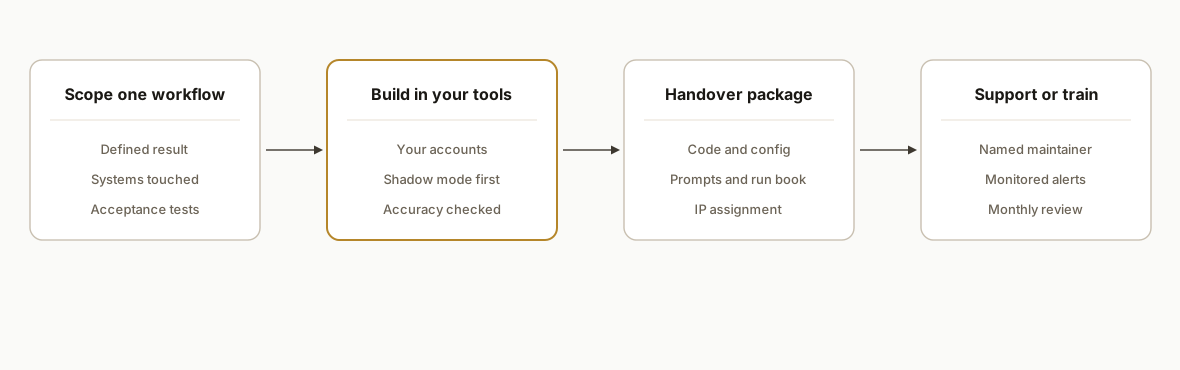
Handover and support decide the outcome. Sources describe staged IP transfer, with documentation and co-managed pipelines at around day 60 of a longer engagement, and warn that teams move on after sign-off. Two of our own builds show what staging looks like in practice. For UBK Towing we built a case-study demo, a static Next.js dashboard on mock data only, and its PRD puts the paid integration work (Towbook or InTow, Square, Google Sheets, webhooks, GPS, then an AI layer) into separate phases after the demo. It is a proof of concept, not a live deployment. On the BlackBoxMyCar Shopify order filter, which is live, the Google connection sat on a team member account until it could be swapped to the client's account at handoff. Steps 2 to 6 below turn both lessons into contract terms you can check.
Step-by-step: how to choose and run the engagement
Step 1: Decide whether you need a plan or a build
Start by writing one sentence that states the job and the result. Whether you can fill in this template decides most of the choice.
Workflow: inbound lead response
Result: every web lead gets a reply within 5 minutes, logged in the CRM
Systems touched: web form, CRM, email
Acceptable error: a wrong reply is caught by a human before it sends for the first 2 weeks
Then apply these rules in order:
- You cannot fill it in: buy a plan from a consultant, or run an internal discovery exercise. Paying a builder to guess the workflow is the expensive way to learn it.
- You can fill it in, it touches one tool, and it is a one-off: a skilled freelancer, with repository access and documentation written into the scope.
- You can fill it in, it touches several systems, and you need someone accountable after launch: an agency.
- AI is your core product and you will ship changes weekly for years: hire.
Step 2: Put ownership in the contract before anything else
Ownership is set by contract, not by default. One source notes that under US copyright law, code written by an independent contractor belongs to the contractor unless there is a signed IP assignment. Rights to AI-specific assets such as prompts, fine-tuned model improvements and derived data may not fit traditional IP wording, so name them. Have a lawyer review the final terms.
ip_and_ownership:
  code_and_configuration: assigned_to_client_on_final_payment
  prompts_and_evaluation_sets: assigned_to_client
  derived_data_and_logs: owned_by_client
  agency_reusable_tooling: licensed_to_client_perpetually
  third_party_accounts: opened_in_client_name
Step 3: Run every build in accounts you own
The single most reliable way to avoid lock-in is for the system to live in your accounts from day one. Ask for a short access list you can audit.
Cloud project: owned by client, agency added as member
Automation platform workspace: owned by client
Model API keys: billed to client, rotated at handover
Source repository: client organisation, agency has write access
If an agency insists on hosting everything in its own environment with no export path, price that lock-in into the decision.
Step 4: Require a shadow-mode period before go-live
The system should run in parallel with your people and have its output compared before it acts on its own. Define the exit criteria in writing.
Shadow mode: 2 weeks minimum
Sample: every run logged with AI output and human decision
Pass rule: agreed accuracy threshold on real inputs, set before the test
On fail: tune prompts and rules, extend shadow mode, do not go live
Step 5: Name the maintainer before go-live
Teams move on after sign-off. Before launch, one named person (yours or the agency's) owns monitoring, alerts and fixes.
Maintainer: named person and a backup
Alerts: failures and low-confidence outputs go to a monitored channel
Review: monthly check of accuracy and cost
Change process: who approves a prompt or rule change
Step 6: Specify the handover package as a deliverable
Treat handover as something you pay for and accept, not a courtesy.
Handover package
- Source code and configuration in the client repository
- Architecture diagram and data flow
- Prompt library and evaluation set
- Run book: how to restart, roll back and rotate keys
- Recorded walkthrough for the maintainer
Where it gets complicated
Vendor-blog numbers conflict. The ranges above come from agency and consultant blogs with an interest in the answer. A widely repeated claim that agency projects fail at 2.4 times the rate of something else could not be traced to a primary source, so we do not use it. Ask each vendor for references and a written scope, and compare line items, not headline ranges.
Provider labels blur. A consultant who also builds is an agency, and a freelancer who documents and hands over is close to one. Put them in the same table and compare the after-launch column. Steps 3 and 6 remove most of the single-person risk, so require them whoever builds.
Delays come from approvals and access, not the model. On the BlackBoxMyCar order filter, a delayed Shopify custom app approval at the client blocked the install upsell pipeline. We used Make OAuth to Shopify as a stopgap, filtered Metro Vancouver orders by postal regex, excluded cancelled, refunded and pickup orders, and wrote qualifying orders to a Google Sheet with a Data Store HTTP PUT backup. We verified it end to end on 2026-04-24 with 3 real Shopify orders, and as of 2026-04-30 no issues had been reported. Ask every provider what they do when a platform approval stalls, because it will.
Fast unblocking drifts account ownership. The same build ran on a Google connection owned by a team member until the swap to the client's account at handoff. That is the gap Step 3 closes: put the connection in the client account first, or put the swap in the handover checklist with a named date.
Platform quirks belong in the run book. On Make.com we hit several: the HTTP method must be lowercase put for PUT actions, Data Store AddRecord fields can be dropped when a blueprint is authored through the API so we write with HTTP PUT instead, and the Google Sheets module needs the spreadsheetId with a leading slash. A maintainer who inherits the build without these notes will lose hours. This is why Step 6 asks for a run book, not just code.
In-house is a hiring problem first. Vendor sources put a hire at 3 to 6 months to full productivity, and one person rarely covers engineering, integration, evaluation and support alone.
Who builds it and what it costs
We build fixed-scope automations and AI agents with the system running in accounts the client owns and a written handover package. We price per workflow after a scoping call, and we do not publish a range, since we would rather quote against your scope than repeat the vendor-blog figures above. What moves the price is the number of systems the workflow touches and how clean the data is. We also phase it: the UBK Towing demo shows the pattern, a mock-data screen first so the owner can react to it, then separately scoped work to connect each live system. For a Canadian-specific view, see our AI implementation agency page for Canada. If you want to check fit before a call, the qualification questions take a few minutes.
An agency is the wrong choice in several cases. If you have no defined workflow, start with a consultant or an internal discovery exercise. If AI is your core product and you will ship changes weekly for years, hire. If the job is a small one-off with a single tool, a skilled freelancer is cheaper and perfectly adequate. If you cannot assign an internal owner who will answer questions during the build, any provider will struggle.
What this actually changes
The provider label matters less than who holds the credentials, the prompts and the run book on the day the first person leaves. Our own builds show it: the live system worked because it was verified on real orders before anyone relied on it, and the open item at handoff was an account swap, not a bug. Decide first whether your gap is knowing what to build, building it, or running it for years, then use Steps 2 to 6 to make the answer checkable.
Frequently asked questions
Can I trust the cost ranges in this guide?
Treat them as ballparks. They come from vendor blogs with an interest in the answer, and the consultant timeline could not be confirmed. A widely repeated 2.4 times failure-rate claim could not be traced to a primary source, so we left it out. Compare written quotes line by line.
When is an AI implementation agency the wrong choice?
When you have no defined workflow, when AI is your core product and needs a standing team, when the job is a small one-off a freelancer can do, or when you cannot assign an internal owner. In those cases, start with a consultant, hire, or use a freelancer.
What happens if a platform approval blocks the build?
Look for a stopgap that does not change the final architecture. On BlackBoxMyCar, a delayed Shopify custom app approval was bridged with Make OAuth to Shopify, then the connection ownership was planned for swap at handoff. Ask any provider for their stopgap and how it gets retired.
Is a demo the same as a delivered system?
No. Our UBK Towing dashboard is a case-study demo on 100 percent mock data, with no APIs, database or login. It shows the screen. Connecting Towbook or InTow, Square, Google Sheets, webhooks and GPS is separate scoped work, so ask any provider which of the two a quote covers.
Who should hold the connections while the system is being built?
You should, from day one. On a fast unblock a connection may start on a builder's account, as ours did for a Google connection on BlackBoxMyCar. If so, write the swap into the handover checklist with a date and confirm it by testing a run after the change.
If you already know the workflow and want it built in your own accounts, see our custom AI integration service, read why most automation projects fail, and book a 20 minute call. We will tell you in the first few minutes whether you need an agency, a consultant or a hire.
Sources
- 1.Gartner Predicts 30% of Generative AI Projects Will Be Abandoned After Proof of Concept By End of 2025gartner.com
- 2.Computer and Information Research Scientists : Occupational Outlook Handbook: : U.S. Bureau of Labor Statisticsbls.gov
- 3.Survey Analysis: Moving AI Projects From Prototype to Productiongartner.com
Curious what this would actually save you?
Put real numbers to it. The ROI calculator estimates the hours and dollars an automation like this returns, in about a minute.
See your options