
If you are choosing an AI automation agency for a small business, or deciding who should build your automation, shortlist the ones that ship a scoped pilot in 30 days with shadow mode validation, clear rollback, and your data living in your accounts, and review boutique AI automation agencies and voice automation agencies for examples to benchmark. We built and run these systems in production for SMBs. This guide shows how we evaluate agencies and the workflow a credible vendor follows, and how to sequence work in a 90 day pilot plan. For more context on what SMBs automate most often, see our field notes in what SMBs actually automate.
AI automation agency: a specialist team that designs, builds, and operates automations across your real tools and data so a repeatable business workflow runs without manual effort.
The problem it solves: which agency will actually ship a working automation?
Answer first: pick an agency that proves one workflow end to end before selling a platform. You want a pilot with your data, a comparison log against today's process, and clear success criteria tied to time saved or speed-to-response, not a demo reel.
Most small businesses face the same selection trap: lots of pitch decks, few production references. We learned this by building live systems for gyms without APIs, property management teams on closed PM software, credit resellers with bureau proxies, and real estate teams using AI dialers. The gap is not ideas. It is shipping and operating a safe system in your stack.
| Approach | What you do manually | With a capable agency |
|---|---|---|
| Vendor screening | Watch demos, guess fit | Pilot one workflow against live data with rollbacks |
| Scope clarity | Fuzzy goals, moving targets | Written success criteria, comparison log, and owner approvals |
| Data access | Shared passwords, vendor-held keys | Your accounts, least-privilege, exportable state |
| Accuracy | Hope and spot-checks | Shadow mode, error budgets, controlled go-live |
| Maintenance | Break-fix tickets | Monitored jobs, tested updates, incident postmortems |
Two outside anchors matter when you evaluate impact. McKinsey estimated that about 45 percent of workplace activities could be automated with current technology. Source: https://www.mckinsey.com/featured-insights/employment-and-growth/automation-what-is-the-future-of-work. And for any lead-handling pilot, rapid response matters: researchers writing in Harvard Business Review reported firms were far more likely to qualify a lead when responding within five minutes versus later. Source: https://hbr.org/2011/03/the-short-life-of-online-sales-leads.
What automating one manual process is worth
Move the sliders to your own numbers. The defaults are only an example business, not client data.
Revenue the freed hours could earn each year
$41,600
8 hrs a week × 52 × $100
- Cost of errors and rework each year
- $6,000
- $500 a month × 12
- Staff cost of doing it by hand each year
- $14,560
- 8 hrs a week × $35/hr × 52 weeks
- Hours handed to the system each month
- 35 hrs
- 8 hrs a week × 52 ÷ 12
How a credible automation engagement works
Answer first: the flow is scope one workflow, secure access, shadow mode, pilot go-live with guardrails, then handoff and monitoring. Anything else is a science project.
- One-workflow scope: name the job. Example: iClass-style trial exports into a CRM, investor-note generation on a schedule, AI receptionist for missed calls, or parsing inbound emails to trigger downstream actions.
- Secure integration: vendor builds in your tools and logins live in your accounts. Credentials are least-privilege and revocable. Data models and logs are exportable.
- Shadow mode validation: automation runs in parallel for one to two weeks. Outputs are compared against the human baseline before switching anything on.
- Guarded go-live: caps, queues, allow-lists, and pause switches exist. Rollback is documented and tested.
- Operate and improve: monitoring, alerts, and a change window for model or prompt updates. Ownership of logs and artifacts stays with you.
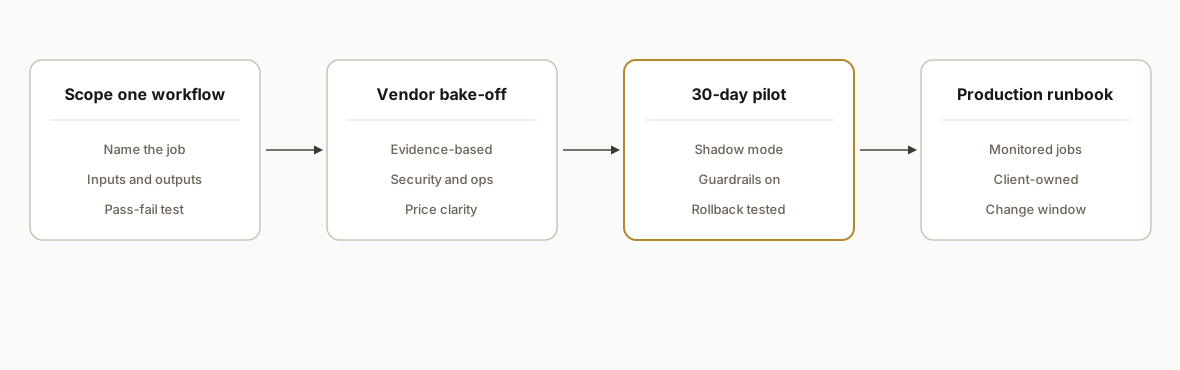
Step-by-step: how to run a 30-day pilot that proves value
1) Write a one-page pilot brief
Answer first: describe one workflow, inputs, outputs, and a pass-fail test. Keep it to one page.
pilot:
  workflow: "New trial signup -> CRM contact + follow-up tag"
  inputs:
    - source: "Vendor portal CSV export"
    - cadence: "Hourly, 7, 21 local"
  outputs:
    - crm_upsert: true
    - audit_log: true
  success:
    - no_duplicate_contacts: ">= 99%"
    - end_to_end_latency: "< 15 min"
    - rollback_tested: true
Key gotcha: avoid multi-workflow pilots. One measurable job beats a bundle that never finishes.
2) Score agencies with a factual rubric
Answer first: use a common scorecard across vendors and attach evidence links, starting with questions to ask an agency and a cross-check against SMB boutique agencies, and align terms with a contract and SOW checklist and an RFP scope and pricing template; for sales-focused builds, review sales automation scope and cost and compare with top sales automation firms.
scorecard:
  references: ["production case similar to ours", "on-call runbook"]
  security: ["build in client-owned accounts", "least-privilege keys", "exportable state"]
  validation: ["shadow-mode plan", "comparison log sample"]
  operations: ["pause switch", "alerts", "rollback doc"]
  pricing: ["pilot fixed fee", "clear run-rate"]
Key gotcha: a lab demo is not a reference. Ask for a production artifact or log snippet with sensitive data removed, and pair that with vendor vetting questions.
3) Provision safe access and a sand-boxed dataset
Answer first: create dedicated API keys and test lists in your accounts. Never hand over your primary credentials.
access:
  crm: "scoped API key, contacts write, no billing access"
  storage: "separate folder, audit logs on"
  email: "draft-only sender for shadow mode"
  data_set: "seeded test slice, 200 rows"
Key gotcha: if a vendor insists on putting data and keys in their cloud, pause. You should be able to revoke access and keep running.
4) Run shadow mode and compare against today
Answer first: capture automation outputs next to human results for 7 to 14 days and review deltas.
validation:
  window_days: 10
  checks:
    - duplicates: true
    - accuracy_notes: "date formatting, entity mapping"
    - latency_minutes_p95: 15
  review:
    cadence: "twice weekly"
    owners: ["ops lead", "vendor lead"]
Key gotcha: declare how disagreements are resolved. The log is the truth, not a hunch.
5) Go live with caps, alerts, and a pause switch
Answer first: launch with rate caps, allow-lists, and on-call notifications. Test pause and rollback in real time.
go_live:
  caps:
    max_records_per_hour: 200
    email_mode: "approve_negatives, auto_approve_positives"
  controls:
    allowlist: ["pilot properties", "pilot inboxes"]
    pause_endpoint: true
  alerts:
    channels: ["email", "slack"]
    thresholds: ["error_rate>1%", "latency_p95>20m"]
Key gotcha: do not bypass approvals for negative or risky actions on day one. Stage drafts or queue for human review.
6) Hand off a production runbook and ownership
Answer first: insist on documentation, test coverage where practical, and account ownership transfer.
handoff:
  docs: ["runbook.md", "env-vars.md", "rollback.md"]
  tests: ["unit-critical", "smoke selectors"]
  monitoring: ["health endpoint", "uptime check"]
  ownership: "client controls billing and credentials"
Key gotcha: model and vendor lock-in. Keep prompts, mapping logic, and state portable so you can swap components later.
Where it gets complicated
Closed or missing APIs. Many SMB platforms do not expose clean programmatic access. A credible agency uses safe browser automation or exports with rate caps and audit logs. Expect slower cadences and careful dry runs.
Model lock-in and drift. A build welded to one model becomes brittle as vendors update behavior. Keep the model swappable and run change windows with checks before updating prompts or versions.
Data ownership and compliance. Your keys and data should live in your accounts. For sensitive workflows, keep raw data out of logs and redact at the edges. Ask how consent and retention are enforced.
Human-in-the-loop boundaries. Production systems need gates for risky actions: refunds, deletions, negative review replies, or voice agent bookings. Approvals and caps are not optional.
Rollback realism. Rollback must be tested, not a line in a doc. We have reverted live voice campaigns, paused SMS pipelines during vendor quota events, and drained queues back to draft safely. Your pilot should prove this once before expansion.
What this actually changes
Answer first: a good agency collapses months of trial-and-error into a 30-day pilot that runs a real workflow safely, then hands you a monitored, owned system. That is the difference between demos and durable value.
In our own production work, the pattern repeated. We shipped trial-to-CRM syncs for gyms where the source had no API, investor-note systems on PM software with API blind spots, inbound email parsers that trigger bureau pulls, and AI dialers guarded against false bookings and vendor overage. The common thread: one-scope pilots, shadow-mode validation, and client-owned infrastructure.
One practical anchor if you are piloting any lead-response automation: respond faster. Harvard Business Review reported firms were far more likely to qualify a lead when responding within five minutes. Source: https://hbr.org/2011/03/the-short-life-of-online-sales-leads. A 30-day pilot that closes that window pays back quickly even before full automation scale.
AI sales automation for SMBs in 2026: what actually works
Answer first: focus on speed-to-lead and consistent follow-up with safe approvals; if you are budgeting, see agency scope and cost and shortlist specialist sales automation agencies.
- Speed-to-lead triage: capture web forms, missed calls, and DMs in one queue. Auto-tag and draft first replies inside five minutes. See patterns in automate CRM lead follow-up.
- Qualification at scale: use an AI dialer to qualify warm backlogs and route only bookable calls. Guard with caps and a pause switch. We shared the stack in AI dialer to qualify lead backlogs.
- Booking without surprises: allow-list the calendars an agent can book. Draft-only for edge cases and negatives. For accuracy tradeoffs, read best way to build AI phone booking and AI phone agent appointment booking accuracy.
- Reactivation cadences: queue win-back texts and emails with deduped segments and strong opt-out handling. Keep drafts for risky messages and auto-send for clear positives.
ROI and earnings in 2026: how small businesses see payback
Answer first: payback comes from captured demand you used to miss, faster first touch, and reclaimed hours. Expect pilots to show value inside 30 days when scoped to phones or lead follow-up.
What to model before you buy: your missed-call rate and after-hours volume, the age of your unworked leads, and the manual hours spent on triage. Then compare against guarded automations that handle these reliably. For cost break-evens and warm-transfer options, see AI receptionist vs human cost breakeven and AI receptionist ROI: warm transfer vs bot. If you want a deeper revenue example, read how we replaced a 6k month sales team with AI and the framing in automation ROI explained.
What a successful AI automation agency business model looks like in 2026
Answer first: as a buyer, choose vendors whose incentives match production reliability.
- Pilot-first economics: fixed-fee, one-workflow pilots that must prove value before any run-rate.
- Client-owned infra: your accounts, least-privilege keys, exportable logs. No hostage data.
- Operate like ops: alerts, pause switch, change windows, incident postmortems.
- Model-agnostic core: adapters you can swap when accuracy or price shifts.
- Transparent pricing: clear ranges and what is in scope. See our 2026 SMB pricing guide and compare vendors with best boutique AI automation agencies, and use an RFP scope template to standardize asks.
Best AI agents for small business automation in 2026
Answer first: use agents that start from clear triggers, finish a bounded task, and expose safe approvals. These are the patterns that worked in production for SMBs.
- Voice receptionist and booking: answers missed calls, qualifies, and books only on an allow-listed calendar; for a vendor short list, see leading voice automation agencies. We shared what works in AI voice agents in practice.
- Lead router and follow-up: de-dupes, tags, and sends the next best touch across SMS or email with drafts for negatives and auto-send for positives.
- Inbox triage and reply drafting: classifies inbound emails, extracts entities, proposes replies, and files to the CRM. Keep drafts and escalation rules.
- Data sync and dedup: normalizes exports from a vertical app into the CRM or data warehouse, with idempotent upserts and audit logs.
- Reporting and summaries: rolls up weekly performance, flags anomalies, and posts summaries to Slack. Keep source links in every note.
AI automation agency success stories 2026: small business examples
Answer first: ask for production artifacts and a short write-up like these.
- BlackBoxMyCar: we shipped a Make.com scenario that watches Shopify orders, filters for Metro Vancouver by postal regex, and appends qualifying orders to Google Sheets with a datastore backup. This unblocked install scheduling while a custom app approval was pending. Read the build notes in Shopify local orders to Google Sheets automation.
- UBK Towing (demo): we built and deployed a single-screen Next.js dashboard that consolidates calls, drivers, and finances as a sales-grade demo. It shows the integration path to Towbook, Square, Google Sheets, and GPS before a live cutover. See how a demo becomes operational in tow company ops dashboard: demo to live.
- Anonymized service businesses: we ran AI dialers and inbox parsers in shadow mode first, then turned on guarded go-live with caps and a pause switch. The pattern held across gyms, property managers, and real estate teams. For voice economics and setups, see AI voice receptionist pricing and ROI.
What we would build for you and what it costs to scope
Answer first: we scope and ship one of three pilots in 30 days, then hand you the runbook and ownership.
- AI voice receptionist pilot: missed calls answered, qualified, and booked on an allow-listed calendar with drafts for edge cases. See scripts and routing patterns in voice receptionist call flows.
- Lead follow-up and routing: de-dup in your CRM, tag, and send the next touch over SMS or email with drafts for negatives. See applied patterns in AI customer response automation and our dialer notes in AI dialer to qualify lead backlogs.
- Data sync and dedup: safe upserts from a vertical app into your CRM or warehouse with an audit log. A similar build shipped here: Shopify to Sheets local filter.
Scope and cost: pilots are fixed-fee and sized to one workflow and one month; mirror this in your SOW checklist. Pricing is presented as a range based on complexity and data access. We publish how we price and the ROI math in AI automation pricing and ROI and our updated 2026 SMB pricing ranges. No run-rate starts until success criteria are met in shadow mode.
Timeline: day 0 to 3 brief and access, with expansion mapped in a 90 day pilot plan. Day 4 to 10 sandbox and mappings. Day 11 to 24 shadow mode with comparison logs. Day 25 to 30 guarded go-live with caps and a pause switch.
First step: send three example records and a read-only seat. We confirm viability and propose a one-page pilot brief you can accept or reject without commitment.
Common objection: what if this hurts our brand or books the wrong thing. Response: we run drafts-only for risky actions, approve negatives, and cap sends at pilot scale. Rollback is tested before any live switch.
SMB demand in 2026: where small businesses see ROI first
Answer first: demand concentrates where response time, duplicate work, or unclaimed backlog cost you money.
- Phones and reception: after-hours or overflow call handling to stop missed leads. See what works in AI voice agents in practice.
- Lead triage and follow-up: consistent next touches across SMS and email with human approval for negatives. See the economics in automation ROI explained.
- CRM hygiene and reporting: idempotent upserts and weekly rollups so ops can act. Clients adopt these first because the payback is visible inside 30 days.
Best niches for AI automation agencies in 2026
Answer first: pick niches with repetitive workflows, structured source systems, and measurable paybacks.
- Property management: report generation, owner statements, and CRM follow-up around AppFolio style exports; see top property management automation agencies. Clear wins in finance and owner relations.
- Dental and veterinary: recall reminders, review requests, and CRM syncs from practice software. Strong ROI from faster recall cycles and retained patients.
- Towing and field service: dispatch visibility, ticket triage, and invoice sync. Blended dashboard plus lightweight automations show immediate ops lift.
- Ecommerce and retail: order filtering, local install scheduling, return triage, and subscription dunning. Fast pilots using store platforms and help desks.
- Insurance agencies: renewal reminders and AMS to CRM syncs. Revenue impact from earlier, consistent renewal touches.
- Gyms and classes: trial-to-CRM sync, no-show follow-up, and win-back. Measurable lift in trial conversion and utilization.
Frequently asked questions
How much does a small-business pilot cost?
Answer first: expect a fixed pilot fee sized to one workflow and one month. Ranges depend on workflow complexity and data access. We publish how we size pilots and why in AI automation pricing and ROI, plus a detailed 2026 pricing guide for SMBs.
How long until we see results?
Answer first: a credible agency ships a scoped pilot in about 30 days. Shadow mode can show value within the first two weeks if the comparison log proves fewer errors or faster response times.
Should we hire in-house instead of an agency?
Answer first: if you have sustained volume across many workflows and can staff engineering and operations, in-house can win; for a deeper comparison of options, see how to choose a builder. For most SMBs, an agency pilot gets a result faster and transfers the runbook when you are ready.
Which model should we standardize on?
Answer first: do not. Build model-agnostic interfaces so you can swap when price or accuracy justifies it. Measure on your data in shadow mode and keep the option to change.
How do we keep data safe?
Answer first: require builds in your accounts, least-privilege keys, and exportable logs. Redact sensitive fields, set retention, and confirm rollback for incident response. Never accept long-lived vendor-held credentials.
Which AI agent should a small business start with in 2026?
Answer first: start where the backlog is most expensive. For most SMBs that is phones or lead follow-up. A voice receptionist or lead router with drafts for negatives, caps, and a pause switch tends to unlock the fastest payback with low risk.
What is the difference between a PoC and a pilot?
Answer first: a PoC proves a concept on sample data. A pilot runs in your stack with guardrails, validates accuracy in shadow mode, and includes rollback and runbook. Buy pilots, not lab demos.
If you want an outside set of hands to run this exact pilot flow, we build and operate custom automations across CRMs, inboxes, phones, and vertical software. See our service detail at /services#custom-ai-integration, read why many projects stall in /blog/why-90-percent-of-automation-projects-fail, explore how voice fits in /blog/ai-voice-agents-actually-work, and when you are ready, /book a 20 minute call.
Sources
- 1.Automation what is the future of workmckinsey.com
- 2.The Short Life of Online Sales Leadshbr.org
Want us to build this for you?
Nine questions, about 90 seconds. You see the revenue it is costing you, then pick a time. No pitch.
See your options