
AppFolio API access in 2026 works like this: AppFolio offers APIs, but access is plan and program gated. Core has no API. Plus includes read access, and Max adds read and write. Buyers on Core can still integrate today by scheduling report exports to a secure ingestion inbox while their upgrade or partner approval is in motion. We built both approaches in production for property managers who needed reporting, CRM sync, and investor communications to run without manual exports.
AppFolio API integration is: connecting AppFolio's Stack and AppFolio API surfaces when your plan allows, or running a reliable CSV pipeline when it does not. This guide answers who gets access, how to request it, pricing and limits, supported objects, and the buyer-ready paths we use in production.
The problem it solves
Property managers ask one question when they want a data warehouse, CRM sync, or automated investor notes: does AppFolio have an API and how do we get our data out safely? The blocker is access. API access is gated by plan and partner status. Teams on Core end up exporting reports manually, emailing files, and copy pasting into other systems.
Definition: AppFolio API integration is the process of programmatically reading or writing AppFolio data through its plan-gated APIs, or using scheduled report exports as a bridge until API access is enabled.
| Workflow | Manual path | Automated path |
|---|---|---|
| Weekly reporting | Staff downloads multiple reports and merges in Excel | API pull or scheduled CSV to an ingestion endpoint writes to a warehouse every morning |
| CRM updates | Team copies new leads or guest cards into a CRM | API read of supported objects or a daily CSV import job updates the CRM |
| Investor notes | Analyst formats data into emails | Scheduled pipeline composes notes from warehouse tables and sends |
| Error handling | Ad hoc checks after failures | Monitored jobs with retries, idempotent upserts, and logs |
How the automation works
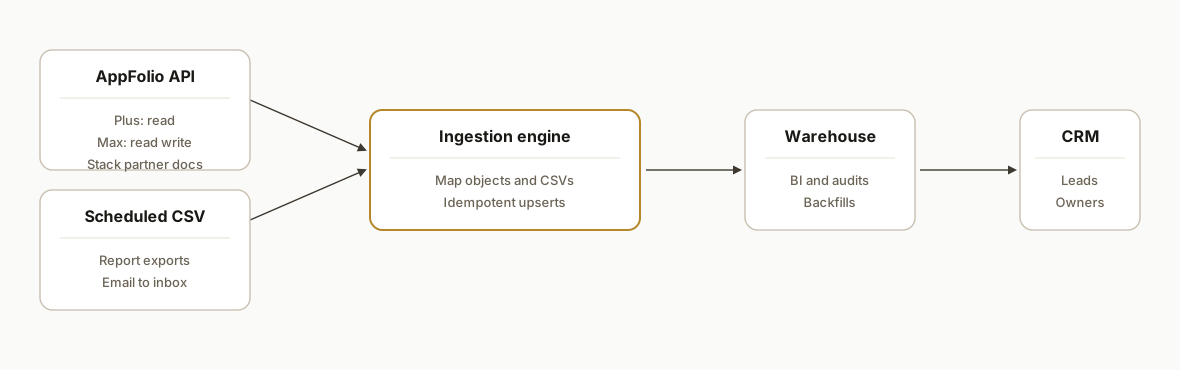
We ship two patterns. The API path is used when you are on Plus or Max, or you are an ISV in the Stack partner program. The CSV path is used when you are on Core or in an approval queue. Both end at the same sinks: a warehouse, a CRM, or a downstream document system.
- API path: Available to AppFolio customers on Plus or Max and to approved Stack partners. Plus is read only. Max is read write. Full developer docs and sandbox access are provided through the Stack partner program. Pricing is plan tied. Some Stack integrations require a Stack Premium add on that AppFolio lists at $0.50 per unit per month with a $100 minimum. Source: AppFolio pricing and Stack pages.
- CSV path: In app reports export to CSV or Excel. Many teams schedule report emails from Report Builder to a dedicated inbox, which we watch and ingest. This is the safest bridge while you wait for API access. Source: AppFolio help and third party scheduled export guidance.
- Objects and events: AppFolio's public Stack pages enumerate common objects such as Bills, Bank Accounts, Leads, Listings, Journal Entries, GL Accounts, Owners, Work Orders, and Attachments. Source: AppFolio Stack partner API page.
- Zapier and Make: AppFolio Investment Manager Premier advertises a Zapier integration. For AppFolio Property Manager, no official Zapier or Make apps are documented publicly. We design around this by using the API or the CSV path.
Step-by-step: how to build it
1) Pick your access path and request enablement
Answer first: if you are an AppFolio customer, Plus provides read access and Max provides read write. You request access through Sales or the pricing page flow. If you are a vendor, apply to the AppFolio Stack partner program to receive developer docs and sandbox access. Some integrations require Stack Premium at $0.50 per unit per month with a $100 minimum. If you are on Core, plan the CSV path immediately.
Decision tree
- On Core today: set up scheduled report exports to a dedicated inbox. Build ingestion now.
- On Plus: implement API reads where needed. Keep the CSV bridge for objects not yet migrated.
- On Max: implement read write integrations per business need. Keep a backstop CSV feed for continuity.
- ISV: apply to Stack partner program to receive docs and sandbox.
Key gotcha: AppFolio does not publish API auth details or rate limits publicly. Treat the API as a black box until your account or partner access is approved, then follow the official docs provided to you.
2) Stand up the CSV bridge with a dedicated inbox
When API access is pending, we start with scheduled exports. Create a dedicated inbox for report delivery and a Drive folder for attachments. Use strict subject and sender filters so only AppFolio reports reach the ingestion label.
Gmail filters
Matches: from:(no-reply@your-appfolio-domain) subject:(Report) has:attachment
Do: Apply label "AppFolio/Reports", Never send to Spam
Now add a lightweight Apps Script to save attachments and POST them to your ingestion API.
// Code.gs: save report attachments and forward to ingestion
function processAppFolioReports() {
  const label = GmailApp.getUserLabelByName('AppFolio/Reports');
  const threads = label.getThreads(0, 20);
  const driveFolder = DriveApp.getFolderById(PropertiesService.getScriptProperties().getProperty('DRIVE_FOLDER_ID'));
  threads.forEach(t => t.getMessages().forEach(m => {
    m.getAttachments({ includeInlineImages: false, includeAttachments: true })
      .filter(a => a.getContentType().includes('csv'))
      .forEach(a => {
        const file = driveFolder.createFile(a.copyBlob()).setName(a.getName());
        const resp = UrlFetchApp.fetch(PropertiesService.getScriptProperties().getProperty('INGEST_URL'), {
          method: 'post',
          muteHttpExceptions: true,
          payload: { filename: file.getName(), url: file.getUrl() },
          headers: { 'X-Source': 'appfolio-csv' }
        });
        Logger.log(resp.getResponseCode());
      });
  }));
}
Gotcha: Gmail and Apps Script quotas exist, so keep batches small and run the trigger every 5 to 15 minutes during business hours.
3) Map each report to a warehouse table and upsert
Use a deterministic schema and a composite dedupe key. We prefer dbt models for transforms and a Python loader for idempotent upserts.
# ingest_appfolio_csv.py
import os, sys
import pandas as pd
import psycopg2
from psycopg2.extras import execute_batch

TABLE = os.environ['TABLE']  # e.g., appfolio_delinquency
CSV = sys.argv[1]

df = pd.read_csv(CSV)
# normalize headers
cols = {c: c.strip().lower().replace(' ', '_') for c in df.columns}
df = df.rename(columns=cols)
# add dedupe key
if {'property_id','unit','resident_id','as_of_date'}.issubset(df.columns):
    df['dupe_key'] = df['property_id'].astype(str) + '|' + df['unit'].astype(str) + '|' + df['resident_id'].astype(str) + '|' + df['as_of_date'].astype(str)
else:
    df['dupe_key'] = df.apply(lambda r: '|'.join(str(v) for v in r.values), axis=1)

conn = psycopg2.connect(os.environ['PG_DSN'])
cur = conn.cursor()
cur.execute(f"""
CREATE TABLE IF NOT EXISTS {TABLE} (
  id bigserial primary key,
  dupe_key text unique,
  payload jsonb not null,
  loaded_at timestamptz not null default now()
)
""")
rows = [(r['dupe_key'], r.to_json()) for _, r in df.to_dict(orient='records')]
execute_batch(cur, f"INSERT INTO {TABLE} (dupe_key,payload) VALUES (%s,%s) ON CONFLICT (dupe_key) DO NOTHING", rows, page_size=500)
conn.commit(); cur.close(); conn.close()
print(f"loaded {len(rows)} rows to {TABLE}")
Gotcha: CSV headers change as AppFolio adds fields. Keep transforms header name tolerant and avoid position based parsing.
4) Introduce the API path when Plus or Max is enabled
Once your plan or partner access is active, begin migrating high value feeds to the API. Treat credentials and auth as confidential and follow the official docs in your tenant or partner portal. Start with a small, read only slice and compare API payloads to your CSV tables before cutting over.
// api_client.ts: placeholder structure only. Fill from official docs once enabled.
import fetch from 'node-fetch';

export async function fetchObject(objectName: string, params: Record<string,string>) {
  const base = process.env.APPFOLIO_API_BASE; // set from your tenant docs
  const token = process.env.APPFOLIO_API_TOKEN; // or the method provided to you
  const qs = new URLSearchParams(params).toString();
  const url = `${base}/${objectName}?${qs}`;
  const resp = await fetch(url, { headers: { Authorization: `Bearer ${token}` } });
  if (!resp.ok) throw new Error(`API error ${resp.status}`);
  return resp.json();
}
Important: AppFolio does not publish auth details or rate limits publicly. Do not guess. Use the documentation provided with your plan or partner account and add backoffs and retries around every call.
5) Add monitoring, replay, and drift detection
You need job success metrics, payload diff checks, and a replay switch. We keep a simple state table of file names and API cursors and alert on gaps.
-- state table for jobs
create table if not exists job_state (
  job_name text primary key,
  last_run_at timestamptz,
  last_cursor text,
  notes text
);
Gotcha: CSV scheduled emails can stall if a preset is renamed. Alert on zero row deltas. For APIs, alert on HTTP 401 and 429 clusters.
6) Surface to sinks: BI, CRM, and documents
Once data lands reliably, connect your warehouse to BI, push lead objects into your CRM, and generate downstream documents. Keep human review in the loop for investor facing communications.
# dbt snapshot example: stabilize a resident ledger view
snapshots:
  - name: resident_ledger_snapshot
    target_database: analytics
    target_schema: wh
    strategy: timestamp
    updated_at: updated_at
    unique_key: dupe_key
    source:
      name: resident_ledger_staging
Where it gets complicated
- Plan gated API: Core has no API. Plus is read only. Max is read write. This drives architecture. Source: AppFolio pricing.
- Partner gated docs: Full developer docs and sandbox are provided through the Stack partner program, not a self serve public portal. Plan partner early if you are an ISV. Source: AppFolio Stack partner pages.
- Stack Premium fees: Some integrations require Stack Premium priced at $0.50 per unit per month with a $100 minimum. Budget for it up front. Source: AppFolio pricing and services pages.
- Zapier confusion: AppFolio Investment Manager Premier lists Zapier integration. AppFolio Property Manager does not document an official Zapier or Make app. We do not design on assumptions here.
- Webhooks: AppFolio mentions webhooks for Stack, but topics and setup steps are not publicly documented. We treat webhooks as an optimization, not a dependency, until your tenant docs confirm availability.
- Rate limits: No public limits are documented. We implement conservative concurrency, exponential backoff, and idempotent writes by default.
What this actually changes
For property managers, the gating is often what stalled a data project. The pattern above let us ship on Core through scheduled CSV while the account negotiated Plus or Max, then cut over feeds to the API where it made sense. The cost side is predictable: where Stack Premium is required, AppFolio lists $0.50 per unit per month with a $100 minimum on pricing pages. That number is small compared to the hours a team spends pulling and merging reports by hand each week.
Once the pipeline exists, investor notes, owner dashboards, and CRM sync become routine. The same engine also makes audit and compliance easier because every job run is logged and reproducible.
Frequently asked questions
Does AppFolio have an API?
Yes. AppFolio exposes APIs that are gated by plan and program. Core has no API. Plus includes read access. Max includes read and write. ISVs can apply to the AppFolio Stack partner program for developer docs and sandbox access. Source: AppFolio pricing and Stack pages.
How do I get AppFolio API access for my company?
If you are an AppFolio customer, upgrade to Plus for read or Max for read write by working with Sales via the pricing page. If you are a vendor, apply to the Stack partner program. Some integrations require Stack Premium at $0.50 per unit per month with a $100 minimum. Sources: AppFolio pricing and services pages.
Is there an AppFolio Zapier or Make connector?
AppFolio Investment Manager Premier lists a Zapier integration. For AppFolio Property Manager, no official Zapier or Make app is documented publicly. In our builds we use the AppFolio API when available or a scheduled CSV bridge when it is not.
What are the AppFolio API rate limits and auth details?
AppFolio does not publish auth specifics or rate limits publicly. Those details are provided inside customer or partner documentation. Design for retries, backoff, and idempotent writes regardless of the published limits once you have them.
What if we are on Core and cannot upgrade yet?
Use scheduled report exports as a bridge. Send CSVs to a dedicated inbox, ingest them into your warehouse, and wire BI, CRM, and documents off those tables. When Plus or Max is enabled, migrate high value feeds to the API without breaking downstream reports.
Do AppFolio webhooks exist?
Webhooks are mentioned for Stack, but topics and setup steps are not publicly documented. We treat them as optional and design polling based or scheduled pipelines first, then add webhooks if your tenant documentation confirms availability.
If you are planning an AppFolio integration, we have shipped the API and CSV patterns described here. See our related write up on the CSV bridge in How to Sync AppFolio Reports to BigQuery. If you want us to spec a build that fits your plan, start at custom AI integration or go straight to book a call.
Want us to build this for you?
Nine questions, about 90 seconds. You see the hours it is costing you, then pick a time. No pitch.
Get your free assessment