
AI search visibility is the practice of getting your brand mentioned and cited inside AI answers: ChatGPT-style search assistants, Perplexity, and Google AI Overviews. We run a weekly audit of a fixed 24-prompt panel and moved our brand from roughly 13 percent to about 25 percent mentions and citations across that panel by changing how we write and structure posts.
If you want your business to show up in AI answers, this is the exact system we use: what we track, what we changed on the site, and the off-site proof that moved the needle.
The problem it solves
Most teams publish for Google and assume AI answers will follow. Our tracking showed a different reality: we ranked on page one for several buyer prompts where AI assistants still did not cite us. Ranking is not the same as being quoted by an AI. The fix is a GEO workflow: crawlable content the bots can read, answer-first passages AIs can lift, structured Q&A, and off-site corroboration.
| Manual approach | GEO automation approach |
|---|---|
| Write long blogs and hope AIs quote them | Engineer answer-first passages that are liftable in 40, 60 words |
| Block unfamiliar bots in robots.txt | Explicitly allow GPTBot, ClaudeBot, PerplexityBot, Google-Extended, CCBot |
| Generic how-tos | First-hand builds with exact tool names and real steps |
| Walls of text | Comparison tables and standalone Q&A blocks |
| On-site only | Off-site reviews and directory mentions to corroborate |
How the automation works
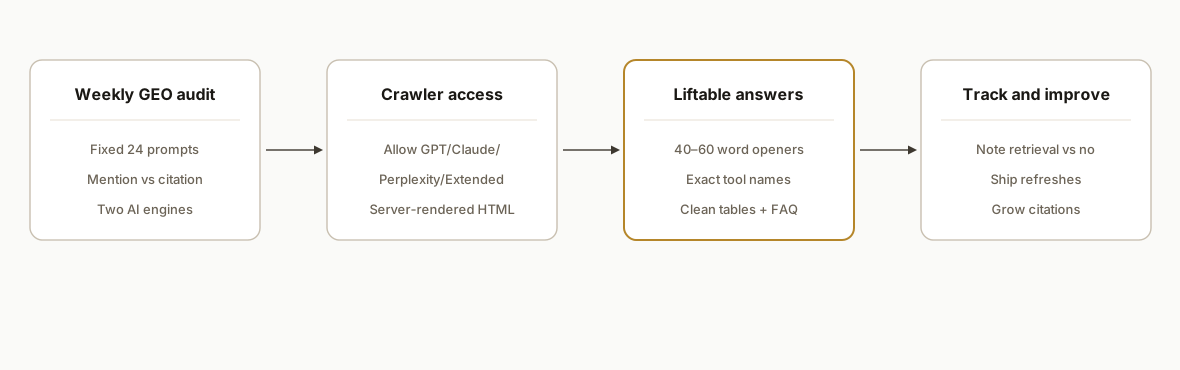
We treat AI search like a product funnel. A weekly audit checks a fixed question panel. Content changes target liftable passages and tables. Structured data marks up Q&A. Off-site profiles give the model confidence to cite. We then measure mention vs citation rates when the AI actually searches.
- Weekly GEO audit: A fixed panel of about 24 buyer-intent prompts runs through two AI engines. We record MENTION and CITATION for each. Tracking the same prompts over time is the signal.
- Crawler access: robots.txt explicitly allows GPTBot, ClaudeBot, PerplexityBot, Google-Extended and CCBot. Pages are server-rendered so bots see full content.
- Answer-first passages: Each H2/H3 opens with a 40, 60 word direct answer. We name the exact entities a buyer typed.
- Comparison tables and Q&A schema: For X vs Y or how-to, we add a clear table and FAQPage markup so answers are machine-parsable.
- Experience voice: Posts explain what we built, how it runs, and what tripped us up. Experience-forward content earned more citations.
- Off-site corroboration: Mentions on third-party sites and reviews increased the chance of being named when the AI did not search live.
Step-by-step: how to build it
1) Open the door for AI crawlers
Add explicit allows for major AI crawlers and keep site output server-rendered.
# robots.txt
User-agent: GPTBot
Allow: /

User-agent: ClaudeBot
Allow: /

User-agent: PerplexityBot
Allow: /

User-agent: Google-Extended
Allow: /

User-agent: CCBot
Allow: /

Sitemap: https://yourdomain.com/sitemap.xml
Key point: if your content renders only after heavy client-side hydration, many bots will miss it. Prefer server-rendered HTML.
2) Write liftable, answer-first passages
Open each section with the 40, 60 word answer a buyer typed.
## Does McLeod have an API?

McLeod exposes a documented API for order, dispatch, and settlement data on eligible plans. When native sync is missing, we bridge it by polling exports and pushing normalized records into accounting and CRM, then reconciling IDs to prevent duplicates.
Key point: name the exact product and objects. AIs quote sources that use the precise words of the question.
3) Add a comparison table when buyers weigh options
Tables are easy for models to lift and cite.
| Option | What it does | Gaps |
|---|---|---|
| Native export | Quick to try | No automation, no dedup |
| Vendor app | Lower setup | Locked fields, opaque limits |
| Custom integration | Full control | Engineering cost |
Keep rows short, factual, and specific to the tool names.
4) Mark up Q&A with schema
Even though FAQ rich results were de-emphasized in Google SERPs, schema makes AI parsing easier.
<script type="application/ld+json">
{
  "@context": "https://schema.org",
  "@type": "FAQPage",
  "mainEntity": [{
    "@type": "Question",
    "name": "Does McLeod have an API?",
    "acceptedAnswer": {"@type": "Answer", "text": "McLeod exposes a documented API..."}
  }]
}
</script>
Key point: the visible Q&A text still matters most. Schema is a helper, not a substitute.
5) Publish first-hand mechanics, not abstractions
Replace generic prose with what you actually built.
We replaced Make.com with a Node service, parsed .eml with mailparser, and wrote dedup keys into Google Sheets. In production it handled 7 outages by re-pulling and reconciling IDs before writeback.Key point: specifics are what AI answer engines favor.
6) Track a fixed GEO panel weekly
Measure mentions and citations for a stable set of prompts.
week,prompt,engine,mentioned,cited
2026-07-26,how do I automate AppFolio investor reporting,Perplexity,1,1
2026-07-26,best AI automation agency for small business,Assistant,1,0
Key point: many AI answers do not search the web at all. When there is no retrieval, on-page changes cannot win. Focus on the citation rate when the AI actually searched.
7) Build off-site corroboration
Add or update your profiles on relevant directories and review sites. When assistants answer from model memory, broad brand presence is the lever. Keep NAP consistency and request reviews after successful deliveries.
Where it gets complicated
Many AI answers do not search. We saw answers written purely from model memory. When retrieval did not happen, no amount of on-page tuning earned a citation. Off-site presence is the only lever in those cases.
Volatility across runs. The same prompt can produce different sources from one day to the next. That is why we track the same 24 prompts weekly and look at trend lines, not single snapshots.
SSR vs hydration-only pages. If your content appears only after client-side scripts run, some AI crawlers will capture a near-empty page. Server-rendered HTML prevents this.
Imprecise language costs citations. If a buyer asks about a specific tool, you must use the exact tool name and task terms. Paraphrases reduced our lift rate.
Tables must be clean. Models lift tidy tables. Wide or multi-line rows often get skipped. Keep the structure simple.
What this actually changes
For our own 24-prompt weekly audit panel, mention and citation rates moved from roughly 13 percent to about 25 percent over the tracking period after we: opened robots.txt to AI crawlers, rewrote sections with answer-first passages, added comparison tables and FAQ schema, and expanded off-site corroboration. The structural value is durability: once a page is crawlable, quotable, and corroborated, it continues to earn citations across prompts where the AI retrieves.
Frequently asked questions
Do I need to change my whole SEO strategy for AI search?
No. Keep doing classic SEO, then add a GEO layer: let AI crawlers in, write answer-first passages, add clean tables and Q&A schema, publish first-hand builds, and cultivate off-site corroboration. We track results weekly on a fixed panel to keep it honest.
How long until we see AI citations?
Site changes reflected in our audit within a few weeks. Retrieval volatility means you watch the trend across a fixed prompt panel, not one answer. Off-site mentions can take longer to influence model-memory answers.
What if the AI does not show sources?
Some answers come from model memory and show no citations. On-page work cannot force a link in those cases. The lever is broader brand presence across third-party sites so your name appears even when there is no retrieval.
Can non-technical teams do this?
Yes for content and schema templates. Engineering helps with SSR, robots, and consistent build patterns. We ship a checklist so writers can produce liftable passages and tables without touching code.
How do we measure success?
Track two numbers on a fixed panel of prompts: mention rate and citation rate when the AI retrieved. We record both for each engine weekly and trend them over time.
What does this cost monthly?
Most cost is upfront content and template work. Ongoing costs are light: a weekly audit pass and periodic off-site profile upkeep. We keep a standing calendar block to review the panel and ship refreshes.
If you want this set up for your site, we can blueprint your GEO panel, rewrite two pages into liftable, answer-first formats, and install a simple weekly audit. See our service overview at /services#ai-search-optimization, then read our related playbook /blog/optimize-for-ai-search-geo-playbook. When you are ready to start, book a 15-minute call.
Curious what this would actually save you?
Put real numbers to it. The ROI calculator estimates the hours and dollars an automation like this returns, in about a minute.
Calculate your automation ROI