
An Instagram DM AI setter qualifies leads in your DMs, handles common objections, and routes only ready buyers to your calendar. It is for creators and coaches who live on Instagram and need 24 by 7 lead handling without adding a setter headcount. This post walks through the interactive case-study demo we built for Jennie Blackwood, how it works, and how to build the same pattern safely.
Definition: an Instagram DM AI-setter automation is a chat workflow that runs inside your DM experience to capture intent, qualify on budget and fit, and hand off ready leads to booking while writing a structured summary for your CRM.
The problem it solves
You answer DMs manually, repeat the same questions, and often hop to a call that should never have been booked. A setter solves for speed, consistency, and pre-call readiness.
| Process | Manual DM handling | AI-setter DM handling |
|---|---|---|
| First response time | Minutes to hours, dependent on you being online | Seconds, consistent tone and info |
| Qualification | Ad hoc questions, easy to skip budget fit | Structured gates: money, timeline, offer fit |
| Objection handling | Varies by day and energy | On-brand, consistent rebuttals and reframes |
| Booking | Back and forth links and time zones | One-tap handoff with calendar link and recap |
| CRM notes | Rarely captured, scattered screenshots | Structured summary saved every time |
How the automation works
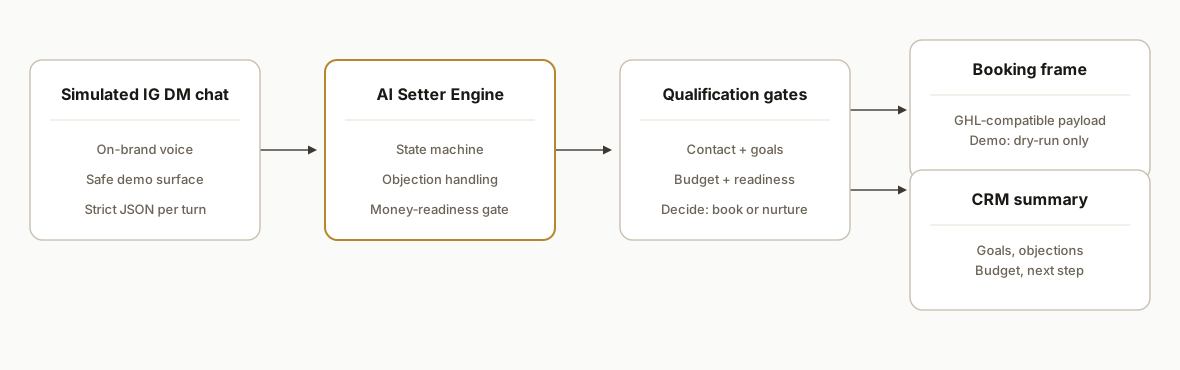
The demo is intentionally safe: no live Instagram write actions and no destructive operations. It simulates the DM chat, enforces strict JSON state, and frames a booking write-back for GoHighLevel so you can see the end-to-end outcome without touching production.
- Demo DM surface: a web chat that mirrors Instagram DM tone and pacing. It uses a white-label UI with Jennie's voice.
- AI setter engine: a serverless router that keeps a strict state machine: capture, qualify, handle objections, and decide to book or nurture.
- Money-readiness gate: explicit budget and payment-readiness questions so unqualified bookings do not land on your calendar.
- Booking frame: prepares a safe, dry-run payload in a GoHighLevel-compatible shape. In production this writes via your chosen integration path.
- CRM sink: a structured lead summary that includes goals, objections, budget, and next step. The demo writes to a safe stub.
Step-by-step: how to build it
1) Model the conversation as a state machine
Start with explicit states: greet, capture_name_email, discover_goals, qualify_budget, objections, decide. Keep transitions deterministic and log every turn.
// state.ts
export type SetterState =
  | { s: "greet" }
  | { s: "capture_contact"; name?: string; email?: string }
  | { s: "discover"; goals?: string[] }
  | { s: "qualify_budget"; budget?: number; ready_to_pay?: boolean }
  | { s: "objections"; list: string[] }
  | { s: "decide"; outcome: "book" | "nurture" | "disqualify" };

export type Turn = { user: string; agent: string; state: SetterState };
Gotcha: do not let the model invent state. Your code owns state, the model only proposes the next move.
2) Constrain the AI to emit strict JSON per turn
Use a json_schema or sentinel markers and validate before applying.
// guard.ts
import { z } from "zod";

export const TurnSchema = z.object({
  reply: z.string().min(1),
  next: z.enum(["capture_contact","discover","qualify_budget","objections","decide"]),
  data: z.record(z.any()).optional()
});

export function parseTurn(raw: string) {
  const start = raw.indexOf("---TURN---");
  const end = raw.indexOf("---END_TURN---");
  const json = raw.slice(start + 10, end);
  return TurnSchema.parse(JSON.parse(json));
}
Gotcha: fail closed. If validation fails, respond with a safe fallback and ask a clarifying question.
3) Encode the qualification gates explicitly
Budget and payment readiness are first-class. Make the gate logic code, not prompt text.
// qualify.ts
export function decideOutcome(ctx: { goals?: string[]; budget?: number; ready?: boolean }) {
  if (!ctx.budget || ctx.budget < 1) return { outcome: "disqualify", reason: "no budget" };
  if (ctx.ready !== true) return { outcome: "nurture", reason: "not payment ready" };
  return { outcome: "book" };
}
Gotcha: treat currency and ranges carefully. Normalize user phrases like "under 500" into a number before comparing.
4) Prepare a booking frame without writing to production
In the demo, we render the payload you would post to your CRM or calendar system and store it in a stub table.
// booking-frame.ts
export function toGhlLike(payload: {
  name: string; email: string; offer: string; budget: number; notes: string;
}) {
  return {
    contact: { name: payload.name, email: payload.email, tags: ["setter_demo"] },
    appointment: { pipeline: "Setter", stage: "Booked", notes: payload.notes },
    meta: { budget: payload.budget, offer: payload.offer, source: "ig_dm" }
  };
}
Gotcha: in a live cutover, run dry-run for a day and seed sent-state to avoid fan-out that spams old contacts.
5) Persist a structured recap for your CRM
Every conversation should produce a consistent recap: goals, objections, budget, readiness, and the next step.
// recap.ts
export type Recap = {
  name: string; email: string; goals: string[]; objections: string[];
  budget: number; ready: boolean; outcome: string; transcript_url?: string;
};

export async function saveRecap(db: any, r: Recap) {
  await db.insert("recaps", r); // stubbed sink for the demo
}
Gotcha: keep PII minimal in demos. Use a throwaway database and purge at intervals.
6) Author the on-brand voice once, then reuse
Keep voice, offer facts, and objection-handling in one file the model can reference.
# voice.md
- Tone: warm, confident, direct. No hype.
- Offers: Starter Intensive, 6-Week Accelerator, VIP Day.
- Common objections and approved replies: price, time, confidence.
Gotcha: test objection threads separately. A great greet flow can mask weak objection handling.
7) Ship the demo in a sandbox and scope deletes
Use a separate demo environment and disable destructive operations. In our build we scoped any cleanup to demo-tagged records only.
-- cleanup.sql
DELETE FROM recaps WHERE outcome = 'demo' AND created_at < NOW() - INTERVAL '30 days';
Gotcha: the near-miss that taught us this: unscoped deletes in a demo can target pre-existing demo contacts. Always filter on a demo tag.
Where it gets complicated
- Incumbent platforms and builders: if a client already has a CRM builder, the wedge is outcomes, not tooling. Show improved qualified-call rate and show rate, not a model change.
- Money-readiness gate: without an explicit budget and payment-readiness check, you will book calls that cannot convert. Make this a hard gate.
- Pre-nurture and show-rate: a short, hyper-personalized VSL and pre-call objection handling increase show rates. The setter should schedule those sends automatically.
- Safe write-backs: demos should never hit live CRMs. Use a stub sink and a clearly labeled GHL-compatible frame for review.
- Throwaway demo accounts: isolate API keys, databases, and hosting. Treat every demo as public and reversible.
What this actually changes
For creator and coaching brands, DM becomes a reliable front door. The AI setter answers in seconds, asks the same qualifying questions every time, and only books when budget and readiness are present. In our Jennie Blackwood case-study demo, the sales call concluded with a soft no because of an incumbent builder, but two concrete lift levers surfaced: add a money-qualification gate and use pre-nurture VSLs to raise show rates.
One relevant external benchmark: Harvard Business Review reported that companies responding to leads within an hour were about 7 times more likely to qualify the lead than those responding later (The Short Life of Online Sales Leads, https://hbr.org/2011/03/the-short-life-of-online-sales-leads). DM automation closes that response-time gap by default.
Frequently asked questions
Is this a live Instagram integration?
The public demo simulates DM behavior safely and frames the booking write-back without touching production systems. In paid deployments we connect to your approved messaging stack and CRM while preserving the same state machine and safeguards shown here.
Can it really qualify on budget in DMs without scaring people off?
Yes when phrased correctly and sequenced after value discovery. The gate should normalize ranges, offer tiered options, and give an easy out to a nurture path. The alternative is wasting calendar slots on leads that cannot buy now.
How do you prevent double-bookings or duplicate contacts?
Keep a sent-state ledger and idempotent writes. In production we tag demo or live runs, seed the ledger before go-live, and upsert on a stable key like email to avoid duplicates in your CRM.
What if I already have a GoHighLevel builder?
That is common. The wedge is not the CRM. It is the lift in qualified-call rate and show rate. We position the setter as a drop-in front door that hands your builder a better-qualified contact with an objection and budget recap.
How much does it cost to run monthly?
The hosting and model usage for this pattern are modest. Most of the cost is the initial build and testing. Ongoing costs scale with volume and the channels you connect. We scope a fixed build and keep your infra on your accounts.
How long to launch a safe pilot?
A demo like this ships in days. A production pilot with your brand voice, CRM write-backs, and pre-nurture content usually takes a short iteration cycle once assets and access are ready.
If you want this setter pattern running on your brand, we can adapt the Jennie Blackwood demo to your voice and stack. See our service overview at /services#ai-sales-outreach, read the related walkthrough on /blog/automate-instagram-dm-responses, and book a 15-minute call to scope your pilot.
Want us to build this for you?
Nine questions, about 90 seconds. You see the hours it is costing you, then pick a time. No pitch.
Get your free assessment