
The vendor's answer to your integration request already tells you whether to hire an implementation agency or stay the course. A long-lead engagement means stay with the vendor, a custom-project price means get a second bid, and an out-of-scope answer means hire an outside builder. The exception is anything touching a certified module or warranty, which stays with the vendor whatever the price. This guide is for the operations, finance or IT director at a $5M to $50M company whose staff retype records between an ERP, a billing system and a CRM. Rex Automaton builds integrations between business systems, and below we lay out how we would make the call, including the cases where we would tell you to stay with the vendor.
An integration agency, in this context, is an outside team that designs, builds and supports the connections between your business systems, instead of the vendor that sells one of them.
The problem it solves
Each vendor's services team is organized around its own product. The gap between two products is nobody's product, so the retyping between them never gets an owner. The useful move is to read the vendor's answer as a diagnosis, because the three answers you are likely to get point to different routes:
- A long-lead services engagement. The work is inside their product and they are queue-limited. Ask for a statement of work that names the interfaces it will use. If it does, and a certified module is involved, stay with the vendor.
- A quote that prices it as a custom project. The work is possible but priced as an exception. Ask them to split the interface build from the data mapping and cleanup, then use the split to compare against an outside bid.
- A statement that the other system is out of scope. This is the clearest signal for an outside builder, because no one at the vendor is allowed to own the seam.
The table below compares the routes. These are our practitioner judgments from how this work tends to go, not vendor-published figures, and we deliberately leave out hourly rates because the only one we found was unverified marketing.
| Factor | Vendor professional services | Outside integration agency |
|---|---|---|
| Scope fit | Strongest inside their own product and supported APIs | Strongest across two or more systems |
| Who owns the code | Ask. It may live inside the vendor's tenant or be licensed to you | Should be contractually yours, with documentation at handover |
| Vendor changes something | Vendor knows first, and may fix it under a support plan | Agency needs a maintenance agreement, or you carry the risk |
| Legacy or undocumented interfaces | Often declined, since it is outside supported use | Possible, but with explicit risk and fallback planning |
| Warranty and certified modules | Safest route | Can void support or certification if you bypass supported paths |
| Pick it when | The change is near a certified module or warranty clause | The change spans systems or you want to own what is built |
What keeping your systems in sync is worth
Move the sliders to your own numbers. The defaults are only an example business, not client data.
Revenue from deals that stop slipping each year
$100,800
80 a month × 12 × 5% × 70% × $3000
- Deals kept a year
- 34
- 80 × 12 × 5% × 70%
- Staff cost of doing it by hand each year
- $9,100
- 5 hrs a week × $35/hr × 52 weeks
- Hours handed to the system each month
- 22 hrs
- 5 hrs a week × 52 ÷ 12
How the automation works
The decision that matters is where the transform lives, because that is where business rules hide and where handover goes wrong. Inside the vendor's platform it is upgrade safe but may be licensed to you rather than owned. In middleware it survives a vendor swap, which is why Salesforce's integration patterns guide steers multi-system rule handling there. Point-to-point scripts are cheapest for one hop and multiply with every system you add.
Where a no-code module is involved, we write to a primary sink and a backup sink, because in our experience some modules drop fields on write and an HTTP PUT to a store is more reliable. These are quirks we have hit building Make scenarios, and they are the kind of detail worth asking any bidder about:
HTTP module: the method must be lowercase "put" for PUT actions
datastore:AddRecord: fields can be dropped when the blueprint is API-authored, so write with HTTP PUT
google-sheets:addRow: spreadsheetId needs a leading "/"
REST triggers expose fields flat, GraphQL responses sit under body.data
Step-by-step: how to decide
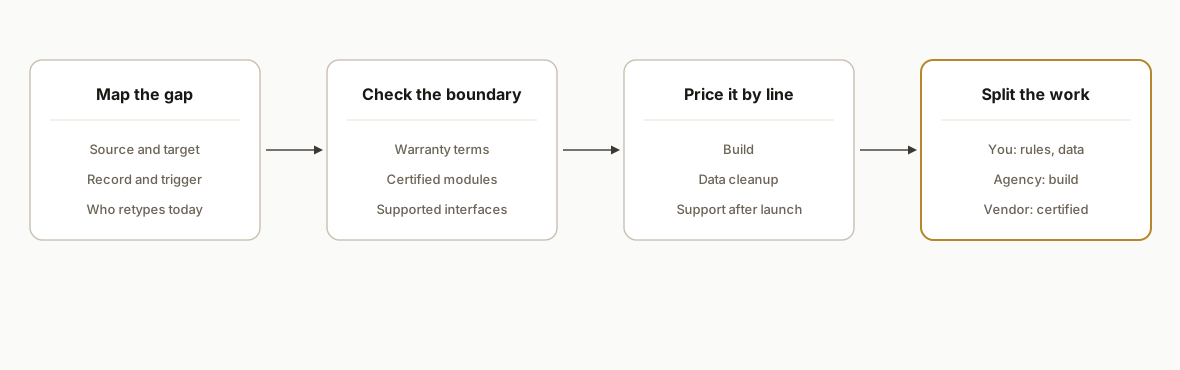
Step 1: Write down the gap in one page
If you cannot name the source, destination, record type, trigger and the person who retypes it today, neither party can quote it accurately.
Source: CRM (closed-won opportunity)
Destination: ERP sales order, then billing invoice
Trigger: stage change to closed-won
Manual step today: AP/AR clerk retypes line items
Failure we fear: duplicate orders, wrong tax code
Step 2: Ask the vendor one boundary question in writing
Ask: if we integrate through your documented API, does anything change about support, upgrades or certification? If the answer involves a certified module, a regulated process, or a warranty clause, that part belongs with the vendor or a vendor-certified partner.
Step 3: Ask who owns the connection, not just the code
Put code, pipeline and documentation ownership in the contract. The line most often missed is the connection itself. A builder often authorizes a system connection under a team member's account while access is pending, and that connection has to be re-pointed to your account at launch or it dies the day the builder's staff change. We have seen this happen when a platform's custom app approval was delayed and a temporary OAuth connection carried the build in the meantime.
Handover checks:
- Every system connection authorized under your account, not a builder's
- Source code in a repository you control
- Written list of every field mapping and business rule
Step 4: Price the data work separately
Data migration and cleanup is one of the most important and most underestimated tasks in ERP projects. Ask each bidder to quote the mapping and cleanup as its own line, so a low integration price does not hide a large data problem.
Quote lines to demand:
1. Interface build
2. Data mapping and cleanup
3. Testing with real records
4. Cutover and rollback plan
5. Post-launch support, monthly
Step 5: Decide on a hybrid split
A common and sensible split is to keep billing rules, approval policy and data ownership in house, and contract out the integration build and migration. Your people decide what should happen. The builder makes it happen.
In house: billing rules, approval thresholds, master data owner
Contracted: connectors, transforms, monitoring, migration
Vendor: certified modules, upgrades, warranty-bound changes
Step 6: Run a shadow period before cutover
Run the integration beside the manual process for a defined window and compare results record by record. Only switch off the manual step when the differences are explained.
Shadow log columns: record id | manual result | automated result | match | reasonWhere it gets complicated
Backfill is its own job. Records created between the project start date and launch day need a one-time backfill, and it should go through the same mapping as live records so the two sets match.
Test rows leak into production. Any build that writes to a shared sheet or store needs a cleanup routine for test rows before cutover, or finance finds them at month end.
Legacy access breaks first. An outside agency can work with file exports, database views or older interfaces the vendor will not discuss. Those are the first things to fail when the vendor changes something, so require monitoring and a fallback in the scope.
A certified module ends the debate. If a module is certified, audited or covered by a warranty that depends on supported configuration, go through the vendor.
What this actually changes
The choice changes who is accountable for the gap between systems. With a vendor team, accountability is clear inside their product and blurry across products. With an outside agency, it covers the seam but ends at the edge of what the vendor supports. The hybrid split gives each party the part it can stand behind.
When to stay with the vendor, plainly: the work is inside one product, it is near a certified module or warranty clause, and their quote names supported interfaces. When to hire an outside builder: the work spans systems, involves older interfaces, or you want to own what gets built, and the ownership and support terms are written into the contract. If you want to know who would build and support yours, see our team and the work we have published.
Frequently asked questions
Should I use my software vendor's professional services for an integration?
Use them when the work stays inside their product, touches a certified module, or could affect warranty or supported upgrades. A quote that names the supported interfaces is a good sign. For work spanning several systems, the other products are outside their remit.
When is an outside integration agency the better choice?
When the vendor says the other system is out of scope, or the integration needs a legacy or undocumented interface. It also fits when you want the code and documentation in your own repository. Verify support terms and ownership before signing.
How do I compare an agency quote with a vendor quote?
Compare line by line: build, data mapping and cleanup, testing, cutover and rollback, and monthly support. Use the vendor's split of build versus data work to benchmark the outside bid. We do not quote a typical hourly rate because we found no verified one.
Who owns the code and the connections an agency builds?
It should be you, but this is a contract term, not a default. Require the repository, credentials and every system connection under your account, plus a written runbook. Ask the vendor the same question, since logic built inside their platform may be licensed rather than owned.
If your staff are retyping records between systems and you have a vendor quote you do not love, we can tell you on a 20 minute call which route fits. See how we handle workflow automation, read a related comparison in off-the-shelf vs custom automation, meet the team, browse our work, or book a call.
Sources
- 1.Integration Patternsdeveloper.salesforce.com
- 2.snapshot state of salessalesforce.com
- 3.Tool: CIOs, How Not to Lose Your Job Over a Failed ERP Implementationgartner.com
- 4.Integration Patternsarchitect.salesforce.com
Curious what this would actually save you?
Put real numbers to it. The ROI calculator estimates the hours and dollars an automation like this returns, in about a minute.
See your options