
If you are running Stripe subscriptions, key your dunning and access gating off invoice.payment_failed. It carries invoice and subscription context and lines up with Stripe Smart Retries. charge.failed is a lower-level artifact and is not the recommended trigger for subscription recovery. Handle multiple deliveries idempotently, read attempt_count and next_payment_attempt, and restore access on invoice.paid.
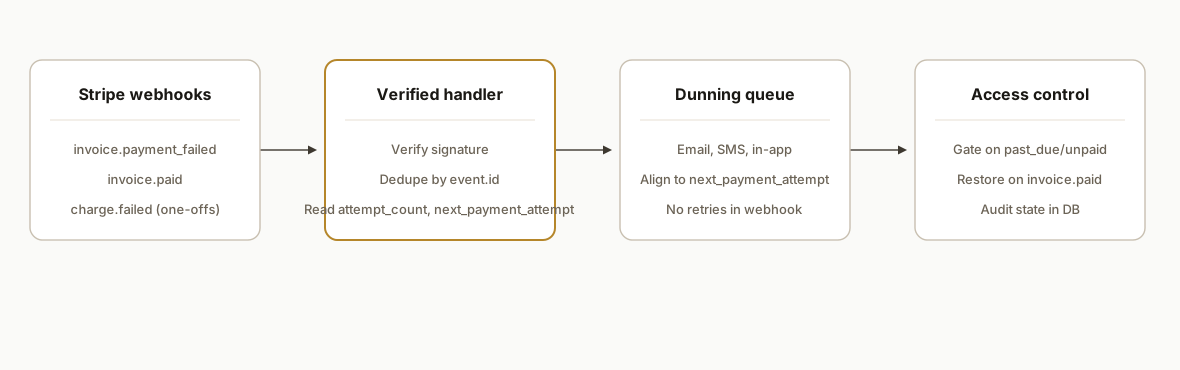
Stripe failed-payment automation is: a webhook-driven flow that reacts to invoice.payment_failed, schedules customer notices aligned to Smart Retries, gates access while status is past_due or unpaid, and flips access back on invoice.paid.
We built and shipped this pattern in production for subscription SaaS and client portals. In production it prevented double-notices, avoided retry collisions with Smart Retries, and kept billing state and app access in lockstep.
The problem it solves
Stripe fires several events around a failed payment. Developers often wire dunning to charge.failed and then fight missing subscription context, duplicate notices, and out-of-sync access. The right anchor for subscriptions is invoice.payment_failed: it has the invoice object, the subscription, attempt_count, and next_payment_attempt, which matches Stripe's own retry cadence.
| Manual handling | Webhook automation |
|---|---|
| Staff checks Dashboard for failed charges weekly and emails customers manually. | invoice.payment_failed webhook enqueues notices instantly, aligned to Smart Retries. |
| Access turns off late or inconsistently. | Access gates on subscription status and flips back on invoice.paid. |
| Duplicate emails when multiple attempts fail. | Idempotent handler deduplicates events and suppresses repeat messages. |
| Guesswork on retry timing and race conditions. | Use attempt_count and next_payment_attempt from the Invoice to schedule. |
How the automation works
Use invoice.payment_failed as the primary trigger for subscription recovery. On each event: verify the webhook signature, dedupe by event.id, read invoice.attempt_count and invoice.next_payment_attempt, enqueue a dunning job, and gate access based on the subscription's status. Then listen for invoice.paid to clear dunning and restore access. charge.failed can still be useful for one-off payments, but not as the anchor for subscriptions.
- invoice.payment_failed: preferred for subscriptions. It includes invoice and subscription context and aligns with Smart Retries timing (Stripe docs: Billing webhooks for subscriptions).
- Smart Retries: Stripe controls retry timing. Read attempt_count and next_payment_attempt on the Invoice rather than guessing a schedule (Stripe docs: Smart Retries).
- Idempotency: Stripe webhooks are delivered at least once. Duplicates and retries occur, so make your handler idempotent and consider queueing (Stripe docs: Webhooks).
- invoice.paid: the event to clear dunning and restore access for the subscription period that just succeeded.
Where to find the official invoice.payment_failed docs
If you need the canonical references quickly, start here:
- invoice.payment_failed event reference: https://docs.stripe.com/events/invoice.payment_failed
- Billing webhooks overview: https://docs.stripe.com/billing/webhooks
- Smart Retries overview: https://docs.stripe.com/billing/smart-retries
Use the Stripe Dashboard or Stripe CLI to inspect real event payloads in your account. Wire your local webhook to the CLI forwarder during development so you can verify signature handling and see the full Invoice object delivered with the event.
For a deeper build walkthrough, see our focused guide: Stripe invoice.payment_failed webhook guide. If you are deciding who schedules retries, compare options in Stripe Smart Retries vs custom retry logic. For message content and timing, use the templates in Stripe dunning emails automation guide.
What invoice.payment_failed includes and how to use it
In practice we read only a few fields from the Invoice payload that arrives with invoice.payment_failed:
- id: stable identifier for deduped state and logs.
- customer and subscription: the linkage you need to update your own account records.
- attempt_count: which retry just failed. Use it to pick the correct message.
- next_payment_attempt: epoch seconds for the next Stripe retry. Use it to time notices.
- status: past_due or unpaid. Gate access based on your product rules.
- hosted_invoice_url: a pay link that you can include in notices.
We avoid custom retry loops while Smart Retries is on. Our handler only updates state and enqueues comms. The queue produces the correct email or in-app notice based on attempt_count and schedules follow-ups relative to next_payment_attempt.
What does the invoice.payment_failed event look like?
Here is a trimmed example envelope to clarify the exact event type and the invoice fields we actually use in production:
{
  "id": "evt_123",
  "type": "invoice.payment_failed",
  "data": {
    "object": {
      "id": "in_123",
      "object": "invoice",
      "customer": "cus_123",
      "subscription": "sub_123",
      "attempt_count": 2,
      "next_payment_attempt": 1725400000,
      "status": "past_due",
      "hosted_invoice_url": "https://pay.stripe.com/invoice/example"
    }
  }
}
Use event.type to branch your handler, and read only the invoice fields you need. If subscription is null, treat it as a one-off invoice and do not apply app access gating intended for subscriptions. For the full and current schema, rely on the official docs page above and the Stripe Dashboard event inspector.
How to test and replay invoice.payment_failed safely
- Forward webhooks locally with the CLI:
stripe listen --forward-to localhost:3000/webhooks/stripe. - Create a failed collection in test mode so an invoice.payment_failed appears in Developers. Then replay that event to your endpoint from Developers. This exercises your signature verification and idempotency path with a real payload shape.
- Alternatively, use the Dashboard to send a test webhook to a registered endpoint and confirm your handler branches on event.type equals invoice.payment_failed.
- Run sends out of band. Do not send emails from the webhook thread. Enqueue to a worker and return 2xx quickly so Stripe stops retrying.
For end-to-end setup steps and code, see our deeper guide: Stripe invoice.payment_failed webhook guide. If you plan to own the retry cadence, read our comparison: Stripe Smart Retries vs custom retry logic.
Step-by-step: how to build it
1) Verify and route Stripe webhooks
Create a single webhook endpoint. Verify signatures, branch on event.type, and always handle at-least-once delivery safely.
// server/webhooks/stripe.js
import express from "express";
import Stripe from "stripe";
import { upsertEventDedup, alreadyHandled } from "../store/dedup.js";

const router = express.Router();
const stripe = new Stripe(process.env.STRIPE_SECRET_KEY, { apiVersion: "2024-06-20" });
const endpointSecret = process.env.STRIPE_WEBHOOK_SECRET;

router.post("/stripe", express.raw({ type: "application/json" }), async (req, res) => {
  let event;
  try {
    const sig = req.headers["stripe-signature"];
    event = stripe.webhooks.constructEvent(req.body, sig, endpointSecret);
  } catch (err) {
    return res.status(400).send(`Webhook Error: ${err.message}`);
  }

  // Idempotency: skip if we already processed this event id
  if (await alreadyHandled(event.id)) return res.status(200).end();
  await upsertEventDedup(event.id);

  try {
    switch (event.type) {
      case "invoice.payment_failed":
        await handleInvoiceFailed(event.data.object);
        break;
      case "invoice.paid":
        await handleInvoicePaid(event.data.object);
        break;
      case "charge.failed":
        await handleChargeFailedForOneOffs(event.data.object);
        break;
      default:
        // no-op for unrelated events
        break;
    }
    res.status(200).end();
  } catch (e) {
    // Let Stripe retry on 5xx to satisfy at-least-once delivery
    console.error(e);
    res.status(500).end();
  }
});

export default router;
Key gotcha: Stripe webhooks are at-least-once. Build explicit dedup on event.id and return 2xx only after durable write to your dedup store (Stripe docs: Webhooks).
2) Read attempt_count and next_payment_attempt
Use the invoice fields to decide what to send and when to send it. Do not invent your own retry schedule while Smart Retries is active.
async function handleInvoiceFailed(invoice) {
  // Important invoice fields
  const { id, customer, subscription, attempt_count, next_payment_attempt, hosted_invoice_url, status } = invoice;

  // Mark account access state in your DB
  await gateAccess({ subscriptionId: subscription, status });

  // Enqueue a dunning job aligned to Smart Retries
  await enqueueDunning({
    customerId: customer,
    subscriptionId: subscription,
    invoiceId: id,
    attemptCount: attempt_count,
    nextAttemptAt: next_payment_attempt ? new Date(next_payment_attempt * 1000) : null,
    payUrl: hosted_invoice_url
  });
}
Smart Retries control timing. Rely on invoice.attempt_count and invoice.next_payment_attempt to time notices so you do not conflict with Stripe's own attempts (Stripe docs: Smart Retries).
3) Gate access on past_due or unpaid, restore on invoice.paid
Keep your app's access in sync with billing state. Listen for invoice.paid to flip access back.
async function handleInvoicePaid(invoice) {
  const { customer, subscription, id } = invoice;
  await clearDunning({ customerId: customer, subscriptionId: subscription, invoiceId: id });
  await restoreAccess({ subscriptionId: subscription });
}
Use invoice.payment_failed to gate access as soon as a failure occurs, and invoice.paid to restore access when the payment succeeds (Stripe docs: Billing webhooks for subscriptions).
4) Send notices from a queue, not the webhook thread
Move email, SMS, and in-app notifications to a background worker. The webhook should only write state and enqueue a job so you respond 2xx quickly and let Stripe stop retrying.
// jobs/dunning-worker.js
export async function processDunningJob(job) {
  const { customerId, attemptCount, nextAttemptAt, payUrl } = job;
  const subject = attemptCount === 1 ? "We could not process your payment" : `Retry ${attemptCount} failed`;
  const body = nextAttemptAt
    ? `We will retry on ${nextAttemptAt.toLocaleString()}. You can pay now: ${payUrl}`
    : `Please update your payment method: ${payUrl}`;
  await sendEmail(customerId, subject, body);
  await sendInAppNotice(customerId, body);
}
5) Keep retries single-sourced
If you run your own charge retries while Smart Retries is on, you risk conflicting attempts and poor UX. Pick one source of truth. We defer to Smart Retries for scheduling and only nudge the user via dunning. If you choose to disable Smart Retries and own the schedule, do it in one place and document it clearly in code comments and runbooks.
6) Use charge.failed only for one-offs
For one-time charges that are not tied to a subscription, charge.failed can still power a recovery email or support ticket. For subscriptions, keep invoice.payment_failed as the anchor and treat charge.failed as informative at best.
async function handleChargeFailedForOneOffs(charge) {
  if (charge.invoice) return; // subscription case handled via invoice events
  await enqueueOneOffRecovery({
    customerId: charge.customer,
    chargeId: charge.id,
    amount: charge.amount,
    currency: charge.currency,
    receiptUrl: charge.receipt_url
  });
}
Where it gets complicated
Duplicate and out-of-order deliveries. Stripe guarantees at-least-once delivery. Retries and duplicates happen, and different event types can arrive out of order. Persist a processed event.id set and make all handlers idempotent (Stripe docs: Webhooks).
Smart Retries timing. The retry schedule is Stripe's domain when Smart Retries is on. Reading attempt_count and next_payment_attempt is the safe way to time customer communication without guessing the cadence (Stripe docs: Smart Retries).
Access gating semantics. A subscription can be past_due after one failure, then unpaid if final payment is missed. Gate based on what your product promises, but always let invoice.paid be the single source of truth to restore.
Mixing subscription and one-off flows. It is common to sell both subscriptions and one-offs. Keep two code paths: invoice.* drives subscription recovery and access, charge.* handles single payments. Avoid cross-wiring.
No-code vs code. Zapier and Make have official Stripe integrations that can send emails or create tickets on invoice.payment_failed. They are useful for ops alerts. For access gating and idempotent recovery logic, we ship a code path and keep no-code for notifications only.
What this actually changes
After we shipped this pattern, failed subscription payments were handled deterministically. Dunning went out once per failed attempt, aligned to Stripe's Smart Retries. Access toggled immediately on invoice.payment_failed and restored on invoice.paid. Engineering never had to guess retry timing or chase double-emails because the handler was idempotent and the queue owned sends. Stripe's documentation confirms the pieces we leaned on: invoice.payment_failed is the recommended subscription trigger, Smart Retries control timing via invoice fields, and webhooks are at-least-once with required signature verification and idempotency.
References: Stripe Billing webhooks for subscriptions, Smart Retries, Webhooks, and API authentication.
Frequently asked questions
Where are the official docs for the invoice.payment_failed event?
Stripe hosts them here: https://docs.stripe.com/events/invoice.payment_failed. For context on delivery and signatures, read https://docs.stripe.com/billing/webhooks. For retry cadence details, see https://docs.stripe.com/billing/smart-retries. We build against these three sources and then validate payloads with the Stripe CLI locally.
What is the exact Stripe event type I should listen for?
Listen for the event type named invoice.payment_failed. Branch on event.type equals invoice.payment_failed, then use event.data.object as the Invoice. For successful recovery, also listen for invoice.paid to clear dunning and restore access.
Does invoice.payment_failed fire for both subscription and one-off invoices?
Yes. Stripe emits invoice.payment_failed when an invoice cannot be collected. For subscription invoices, subscription will be present on the Invoice. For one-off invoices it may be null. We gate app access only when a subscription is present.
Which webhook should I use for subscription dunning in Stripe?
Use invoice.payment_failed. It contains invoice and subscription context and aligns with Stripe's Smart Retries. Listen for invoice.paid to clear dunning and restore access. charge.failed is lower-level and not the recommended anchor for subscriptions.
How do I prevent duplicate emails or jobs from Stripe webhooks?
Make your handler idempotent. Verify the webhook signature, store event.id in a processed table, and return 2xx only after the durable write. Stripe webhooks are at-least-once, so duplicates and retries are expected.
Can I run my own retry schedule on top of Smart Retries?
You can, but we do not recommend mixing schedules. When Smart Retries is on, rely on invoice.attempt_count and next_payment_attempt to time notices. Running your own charge retries on top risks conflicts and a confusing customer experience.
When is charge.failed appropriate to act on?
For one-off charges not tied to a subscription, charge.failed is a useful trigger for a recovery email or support workflow. For subscriptions, keep invoice.payment_failed as the anchor and treat charge.failed as informational only.
How do I authenticate to Stripe from my server code?
Use your Stripe secret key against https://api.stripe.com over HTTPS. Authenticate with HTTP Basic where the key is the username and the password is blank, or with a Bearer token header. Never put the secret key in client code.
If you want this wired into your stack without guesswork, we have shipped this exact flow in production: idempotent handlers, Smart Retry alignment, and access gating tied to invoice events. See our related deep dives: Stripe failed payment automation, Stripe failed payment retry strategy, and Stripe dunning emails automation guide. Or review our broader workflow automation services. When you are ready, book a short call and we will map your subscription and product specifics to this pattern.
Want us to build this for you?
Nine questions, about 90 seconds. You see the hours it is costing you, then pick a time. No pitch.
Get your free assessment