
A freelancer is usually the right hire for a small, contained automation job, and an AI implementation agency is the right hire for a system your business will depend on when the person who built it is on holiday, sick or gone. Rex Automaton builds and maintains AI automation systems for small and midsize businesses, so we sit on the agency side of this question, and this guide says plainly where a freelancer is the better buy. It is written for an owner or ops lead holding a marketplace quote and an agency quote that differ wildly and cannot tell why.
"AI implementation agency" names a service, not a product: no standard package, API or price list stands behind it, and agencies and freelancers alike build on platforms such as Zapier, Make or n8n. Compare deliverables, not job titles.
The problem it solves
Two quotes for what looks like the same job rarely describe the same deliverable. The freelancer quote usually prices the build: someone wires the tools together and shows you it works. The agency quote prices the build plus everything that keeps it working afterwards: a second person who understands it, alerts when it fails, documentation, access controls and a named route for help.
McKinsey's 2025 state of AI survey reports 88% of organizations using AI in at least one function, but no more than 10% scaling agents in any single function. Gartner finds organizations that master the fundamentals turn pilots into production at twice the rate. Read that as hiring input: the gap sits between a working demo and a running system, so ask each bidder which lines of the quote cover that gap.
We give no price ranges here, because the sources we trust hold no verified ones and a made-up range would mislead you more than help. The table is built differently: each row names the difference and the evidence you should ask each bidder to show, so you can compare quotes on deliverables rather than on totals.
| Factor | Freelancer | AI implementation agency | Ask to see |
|---|---|---|---|
| Price shape | Usually a build price. Check whether support is quoted at all | Build plus a handover and a support option, which may be priced separately | A quote with the after go-live lines itemized |
| Key person risk | One person holds the knowledge | Should be two or more, but a team page can hide a single engineer | The names of the people who would answer when it breaks |
| Monitoring | Only if you ask and agree it | Failure alerts routed to a named owner, agreed before the build | The alert recipient and channel, in writing |
| Documentation | Highly variable | Workflow map, field mappings and test log as a standard handover | A redacted sample handover pack |
| Account and credential ownership | Depends on the individual's habits, and some build in their own accounts | Should be client-owned from day one | Who owns the platform account today |
| Who answers when it breaks | The person, if available | A team with a support route | What happens if the builder is away for a week |
Treat the documentation row with some care. Much of the published comparison of freelancer documentation quality comes from agencies, who have an interest in the answer, so do not take it on faith from either side. Ask both for a sample deliverable and judge it yourself.
What automating one manual process is worth
Move the sliders to your own numbers. The defaults are only an example business, not client data.
Revenue the freed hours could earn each year
$41,600
8 hrs a week × 52 × $100
- Cost of errors and rework each year
- $6,000
- $500 a month × 12
- Staff cost of doing it by hand each year
- $14,560
- 8 hrs a week × $35/hr × 52 weeks
- Hours handed to the system each month
- 35 hrs
- 8 hrs a week × 52 ÷ 12
How the decision works
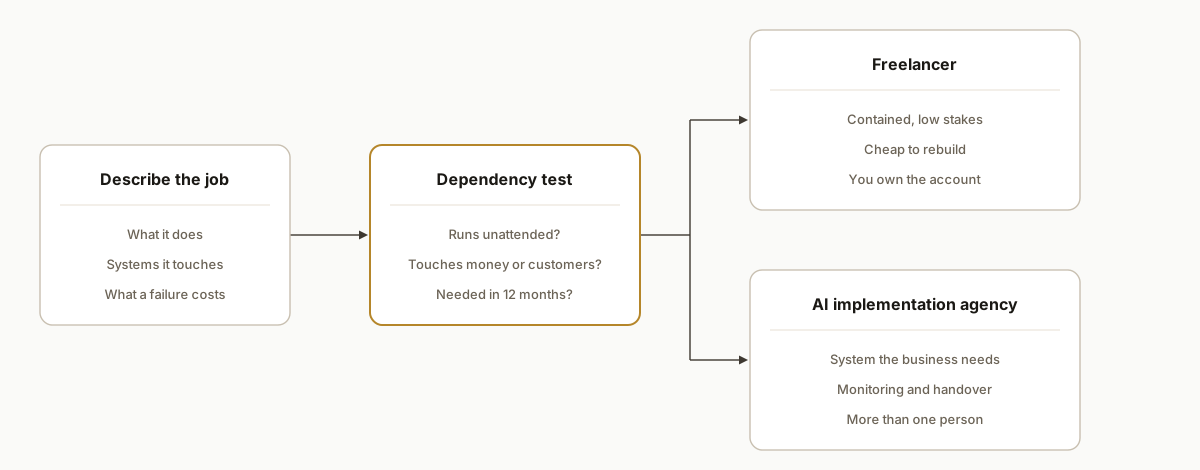
The decision comes down to one question: what happens to your business if this stops working on a Tuesday and the builder does not answer. Everything else is detail. The flow has three parts.
The job description. Write down what the automation does, which systems it touches and what data moves. A job you can describe in three sentences is a candidate for a freelancer. A job that needs a page of rules, exceptions and approvals is a system.
The dependency test. Ask how many people or processes rely on the output, and how long you could run by hand if it failed. If the answer is a few hours of mild inconvenience, the stakes are low. If customers, invoices or deadlines stall, the stakes are high.
The freelancer path. Contained, low stakes, easy to replace, and you are comfortable owning the account and the documentation yourself. A solo builder is often faster and cheaper here, and an agency would be overkill.
The agency path. The system runs unattended, touches money or customers, needs monitoring, or will outlive the person who first built it. You are paying for continuity as much as for the build.
Step-by-step: how to choose and hire
Step 1: Write a one page scope before you ask for quotes
Quotes differ because scopes differ, and most scopes leave out exactly the lines that explain the gap. Include the three lines at the bottom of this template, which force every bidder to say what they will do after go-live and who owns the account.
Job: when a new lead arrives in the CRM, send a first reply and create a task
Systems touched: CRM, shared inbox, calendar
Volume: roughly how many events per week
Failure impact: leads wait until someone notices
Manual fallback: yes, for up to a day
Data sensitivity: contact details only
Who uses the output: sales team
Account owner: client
Alert recipient after go-live: named person
Handover pack required: yes, sample requested with the quote
The gotcha: if you cannot fill in the failure impact line honestly, you are not ready to choose a vendor type yet.
Step 2: Run the dependency test
Score the job with a few blunt questions. Two or more yeses point toward an agency.
1. Does a failure reach a customer or touch money?
2. Does it run unattended, on a schedule or a trigger?
3. Would the business notice within a day if it silently stopped?
4. Will it still be in use in 12 months?
5. Does it handle personal, financial or health data?
The gotcha: question three is the dangerous one. Silent failure is the most common way automations hurt a business, because nobody is looking.
Step 3: Settle account and connection ownership before the build starts
In Make, the client creates the account and invites the builder as a team member, so you can remove their access yourself. That covers the account. It does not cover connections. A connection to Google, Shopify or any other tool is authorized under the login of whoever created it. In our standard pattern, a Google connection sits on a team member's login during the build and has to be swapped to the client's Google account at handoff. When a platform approval was delayed on one build, we used a temporary OAuth connection as a stopgap, which is fine only if it is written down with a swap date.
Make account: created by client, builder invited as team member
Connections: each one listed with the login that authorized it
Temporary connections: marked, with a swap date before go-live
Swap test: after re-authorizing, run one record end to end
Removal test: remove builder access in a test and confirm scenarios still run
Credentials: stored in the client's password manager
The gotcha: if a bidder wants to build inside their own account and migrate later, ask what the migration costs and who does it. Every connection has to be re-authorized under your login, and each one is a place the system can stop.
Step 4: Agree monitoring and maintenance in writing
A scenario that reports success is not proof the data landed. In Make, a data store add-record module can drop fields when the scenario is authored through the API, so the run looks green while a column is empty. That is why we write to a primary sink and a backup sink by different methods, and why a run-error alert alone is not monitoring.
Run error alert: named person plus a shared mailbox
Write check: the row exists and every field is populated
Backup sink: second copy written by a different method
Maintenance owner: named party, with a backup
Response expectation: stated in hours, not left implicit
The gotcha: ask each bidder how they would know a write succeeded but lost data. A freelancer can absolutely agree to this too, but ask what happens if they are unavailable for a week.
Step 5: Ask for a sample handover pack
Request a redacted example of what you will receive, and read the runbook first. A useful runbook records the quirks that cost the builder time, because those are what the next person will hit. These are real Make examples of the level of detail to look for.
HTTP PUT action: method must be lowercase put
Data store add-record: fields dropped in API-authored builds, so write by HTTP PUT
Google Sheets add row: spreadsheet ID needs a leading slash
Shopify REST trigger: fields arrive flat; GraphQL responses nest under body.data
Expression language: no or(), match() or test(); use nested if with contains
The gotcha: for Make, scenario blueprints export as JSON and can be part of the handover. A JSON export alone is not documentation, because it tells you what is configured but not why.
Step 6: Start with a contained pilot
Begin with one workflow and run it beside your manual process before you switch over. Week 2 is the one that earns its place: you compare the automation's output with the manual output line by line, which is the only point where a wrong field mapping shows up cheaply.
Before go-live: backfill from an agreed start date to launch day
Parallel run: compare each automated row with the manual one
Exclusions: cancelled, refunded or otherwise filtered records must be absent
End to end: check a handful of real records, not sample data
Then: go live with alerts on, review run logs and the handover pack
The gotcha: do not let the pilot quietly become the production system without the monitoring and documentation steps above.
Where it gets complicated
A freelancer is sometimes the better buy. For a one-off import, a simple form to spreadsheet flow, or an internal tool with a handful of users, an agency adds cost without adding much safety. If failure is cheap and you can rebuild the job in an afternoon, hire the freelancer and keep the account in your name.
Agencies can also hide a single key person. A firm with one real engineer behind a team page has the same fragility at a higher price. Ask who else has built and supported similar systems, and ask to meet the people who would answer when it breaks. Our team page shows who does the work here.
Temporary connections tend to become permanent. An approval delay pushes the builder to authorize a connection under their own login, and after launch nobody revisits it. Remove the builder from the account and the scenario stops. Ask every bidder for the list of connections and the login behind each.
A demo has no failure log. A build that works in a meeting has not yet met bad data, expired tokens or a changed field name. The test log in the handover pack is the evidence: ask each bidder to show the failing inputs they tried, not just the passing ones.
A green run is not a correct run. Dropped fields and filters that let through the wrong records leave no error behind. Ask what check compares the destination to the source, and who reads the result.
Credentials follow the account. If the builder works inside their own account, your customer data and logins sit there too. Put the account in your name and the credentials in your password manager, and treat a vague answer to "where will they be stored" as information.
What this actually changes
We have no hiring outcome figures to quote and will not invent any. What the dependency test changes is the comparison itself: instead of two totals, you hold two answers to the same four questions. Who owns the account and each connection, who gets the alert, how a lost write would be caught, and what the runbook records. The gap between a marketplace quote and an agency quote usually lives in those answers.
We scope our builds with client-owned accounts, monitoring and a handover pack as defaults, and price a support option separately so you can see what continuity costs. You can see how we document and hand over work on our work page.
Frequently asked questions
Should I hire a freelancer or an agency for business automation?
Fill in the failure impact line of the scope template. If the honest answer is that someone notices within a day and fixes it by hand, start with a freelancer. If a failure reaches a customer or touches money, or two or more dependency questions are yes, hire an agency. Dependency decides it, not the size of the quote.
Why is an agency quote so much higher than a freelancer quote?
The quotes often price different things. Ask both bidders to itemize what happens after go-live: who receives failure alerts, who owns maintenance, whether a parallel run is included and whether support is priced separately. If the freelancer quote has none of those lines, the gap is the missing scope, not necessarily a difference in skill.
What if my automation is already built in the builder's own account?
Ask for a migration quote before anything breaks. Account transfer is only part of it: every connection, such as Google or Shopify, has to be re-authorized under your login, and each one is a point where the scenario can stop. Run one record end to end after each swap, and check the platform's own help pages first.
Is a Make blueprint export enough to take over a system?
No. The JSON shows what is configured, not why. It will not tell you that a write step uses a lowercase put method because another module dropped fields, or which login authorized each connection. Treat it as one file inside a handover pack, alongside a runbook and a test log.
How do I tell a real handover pack from a padded one?
Read the runbook. A real one names specific failures and platform quirks and says what to check first for each. A padded one lists headings only. Because most published claims about documentation quality come from agencies, judge the redacted sample itself, whoever sends it.
If the system you are scoping is the kind your team would feel on a bad Tuesday, our custom AI integration service is built for exactly that, and our guide on hiring someone to automate business workflows goes deeper on what to look for in any builder. If you would like a second opinion on a quote you already have, book a 45 minute call and we will tell you honestly whether a freelancer is enough.
Sources
Who would build this
Rex Automaton is an AI implementation agency with 250+ projects shipped since 2018, rated 4.9 from 33 reviews. Clients include Soft Pull Solutions, Capcon Networks, Iron Age Investments, IT360. You work directly with the people who build it.


Want this built around your systems?
Nine questions, about 90 seconds. You see the revenue it is costing you, then pick a time.
See your optionsRather talk to a person first? Meet the team or tell us which system you run.