
Rex Automaton builds custom Entrata integrations that move leads, leases and work orders into the CRM, BI warehouse and accounting tools a multifamily operator already runs. The system is a throttled sync worker with a staging database in the middle, so downstream tools get clean, deduplicated records instead of raw API traffic. This guide is for mid-market operators who already know they need the build and want to know what Entrata's access model allows, where it pushes back, and what the work involves.
An Entrata integration, in this context, is a scheduled or event-driven process that reads and writes Entrata records through its API and reconciles them against external systems by stable keys.
The problem it solves
Most multifamily operators on Entrata end up with the same split. Leasing lives in Entrata, follow-up lives in a CRM or marketing tool, maintenance status is chased by phone or spreadsheet, and the BI team rebuilds the same lease and lead extracts by hand each month. Nobody owns the glue, so records drift.
The options are narrower than they look, because Entrata access is gated and there is no native Zapier or Make app that we could confirm.
| Option | What it gets you | Limits we see | Cost and setup shape |
|---|---|---|---|
| Native Zapier or Make app | Nothing today | We found no native Entrata app. A 2022 Zapier community thread asked for one | Not available, so not a plan |
| iPaaS connector (Tray.ai has an Entrata connector) | Prebuilt calls, visual flows | You still need Entrata API access, and all requests are POST calls to your subdomain's API path | Platform subscription plus build time |
| Unified PMS API vendor (Propexo is one) | One schema across property systems | Third-party reporting says Entrata access runs through paid pathways, with a sandbox and developer portal around 25k per year and webhooks around 60k per year. Treat those as reported, not confirmed by Entrata | Recurring vendor fee on top of the build |
| Custom sync worker | Exactly the objects and rules you need, in your stack | You carry rate limiting, ID reconciliation and monitoring | One-time build plus a small monitoring retainer |
| Manual exports and re-keying | Zero setup | We could not confirm CSV or scheduled-email export options, so do not assume them | Staff hours, every week |
The webhook tier matters for design. If you do not buy it, you poll. Our default plan assumes polling and treats webhooks as an optimization.
What instant follow up on every lead is worth
Move the sliders to your own numbers. The defaults are only an example business, not client data.
Your own estimate. Replies in the first few minutes convert far better than replies the next day.
Revenue from leads you stop losing each year
$144,000
150 a month × 12 × 40% × 10% × $2000
- Extra customers a year
- 72
- 150 × 12 × 40% × 10%
How the automation works
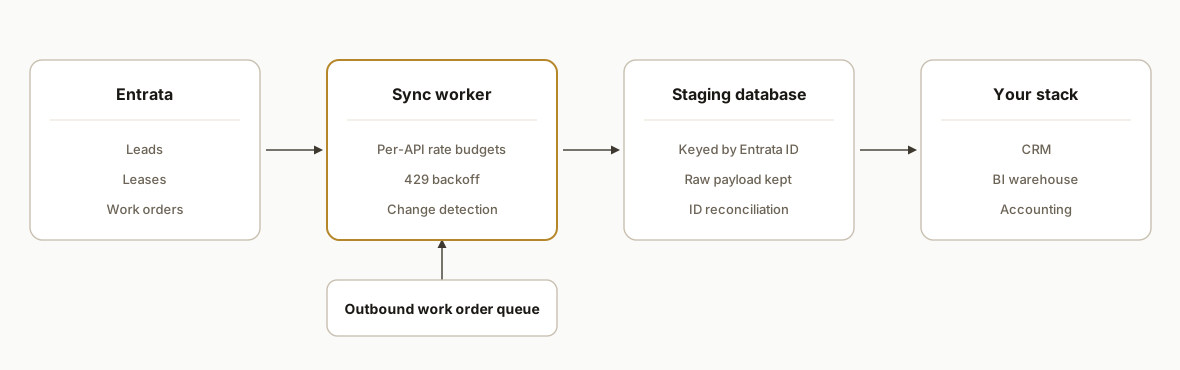
The architecture is a pull-first sync worker. On a schedule it asks Entrata for changed leads, leases and work orders, writes them to a staging database keyed by Entrata IDs, and then fans out to the CRM, the BI warehouse and the accounting system. Writes back into Entrata, such as new work orders from a resident portal or a vendor tool, go through a separate outbound queue.
The components we build:
- Entrata client: a thin wrapper that sends POST requests to your Entrata API path, applies credentials, and enforces per-API rate budgets. The sendWorkOrders endpoint, for example, is documented at the maintenance path on your Entrata domain.
- Staging database: Postgres tables for leads, leases and work orders with Entrata IDs, last-seen timestamps and a hash of each record, so unchanged rows are skipped.
- Mapping layer: translates Entrata fields to CRM objects, BI tables and accounting entries. Mapping lives in config, not code, so a property or unit-type change is an edit.
- Outbound queue: holds writes headed into Entrata, with retries and a dead-letter table.
- Monitor: alerts on 429 spikes, zero-row syncs and reconciliation mismatches.
Step-by-step: how to build it
Step 1: Confirm access and the current API surface
Entrata's documentation states that the legacy API gateway was deprecated on April 15, 2025, and points developers to its developer site for setup (Entrata API documentation notice). Before scoping anything, confirm with your Entrata account team which credential type you get, which endpoints are enabled, and whether a sandbox is included. Credential type decides the auth method, and we do not assume it.
# access-checklist.yaml (filled in before build starts)
entrata:
  subdomain: YOUR_SUBDOMAIN
  credential_type: TBD_FROM_ENTRATA
  sandbox_available: TBD
  webhooks_purchased: TBD
  endpoints_enabled: [leads, leases, maintenance]
  rate_limits_per_credential:
    leads: TBD_FROM_ENTRATA
    leases: TBD_FROM_ENTRATA
    maintenance: TBD_FROM_ENTRATA
Gotcha: limits are set per API and per credential, so write each one down separately.
Step 2: Build a throttled client
All requests are POST calls to your subdomain's API path. Wrap them once so every sync obeys the same budgets.
import time, random, requests

BASE = "https://YOUR_SUBDOMAIN.entrata.com/api/v1"

def call(path, payload, budget):
    for attempt in range(6):
        budget.wait()  # token bucket sized at 70 to 80 percent of the real limit
        r = requests.post(f"{BASE}/{path}", json=payload,
                          headers=build_auth_headers(), timeout=60)
        if r.status_code == 429:
            time.sleep(min(2 ** attempt, 60) + random.random())
            continue
        r.raise_for_status()
        return r.json()
    raise RuntimeError("throttled after retries")
build_auth_headers is deliberately a stub: it depends on the credential type Entrata issues. Gotcha: leads can be throttled while leases are not, so keep one budget object per API, not one global one.
Step 3: Stage records with change detection
Write everything to staging first. Never push straight from Entrata to the CRM.
create table staging_leases (
  entrata_lease_id text primary key,
  payload jsonb not null,
  payload_hash text not null,
  first_seen timestamptz default now(),
  last_seen timestamptz default now(),
  synced_to_crm boolean default false
);
Compare the hash on each pull and only flag rows whose content changed. Gotcha: store the raw payload, because field mapping will change and you want to replay without re-pulling.
Step 4: Map leads and leases to the CRM
Leads become CRM contacts and deals; leases update deal stage or contact status. Key on the Entrata ID, stored in a custom CRM field, never on email alone.
mapping:
  lead:
    crm_object: contact
    match_on: entrata_lead_id
    fields: [name, email, phone, property, source, status]
  lease:
    crm_object: deal
    match_on: entrata_lease_id
    stage_map:
      approved: closed_won_pending
      executed: closed_won
Gotcha: the field names above are our internal schema. Map them to Entrata's actual response fields only after you have sandbox or live sample responses in hand.
Step 5: Create work orders and reconcile IDs
Entrata's sendWorkOrders documentation lists a maintenance location ID, a category ID, a problem ID and a problem description as required inputs (sendWorkOrders documentation). That means your intake tool needs lookup tables for those IDs before it can create anything.
Third-party documentation reports that creating a work order does not return the new record's ID; it appears on the next sync. So the outbound queue records a pending row with a client-generated reference, and the next pull matches it.
create table outbound_work_orders (
  client_ref uuid primary key,
  entrata_work_order_id text,
  description text not null,
  status text default 'pending_match',
  created_at timestamptz default now()
);
-- on each maintenance pull: match pending rows by location, problem and timestamp window
Gotcha: match on several attributes and alert on ambiguous matches instead of guessing.
Step 6: Push to BI and accounting
BI reads straight from the staging database or a nightly copy to your warehouse. Accounting gets lease-driven entries through the accounting tool's own API, using the same staging keys for idempotency.
schedule:
  leads: every 15 minutes
  leases: every 30 minutes
  work_orders: every 15 minutes
  warehouse_copy: nightly 02:00
  reconciliation_report: daily 06:00
Gotcha: set cadences from your real rate limits, not from what feels responsive. Start slower and tighten.
Step 7: Monitor and reconcile
A daily report compares counts per property between Entrata and each destination, and flags any drift. Alert on 429 rates, zero-row pulls and stuck pending work orders.
Where it gets complicated
Access is the real critical path. Entrata's own notice says the legacy gateway was deprecated and sends developers to its developer site. If your account team has not enabled the right credentials, no engineering hour helps. Start that conversation before you sign a statement of work.
Rate limits are layered and unpublished to us. Limits apply per minute, per hour and per day, per API and per credential, and exceeding them returns HTTP 429. Published guidance from integrators suggests staying around 70 to 80 percent of the limit. We could not confirm the actual numbers, and examples differ by customer, so get yours in writing.
Work order IDs arrive late. Because creation does not hand back the new ID, anything that tracks a ticket from creation to completion needs the reconciliation step above. Skipping it produces duplicates or orphaned tickets.
Status sync can be one-way. Third-party documentation for one Entrata maintenance integration says work-order completion cannot be pushed back from Entrata in that tool. If a vendor app depends on completion status, verify the direction of each field before promising two-way behavior.
Webhooks are a pricing decision, not a technical one. Reported webhook pricing is high enough that most operators should plan on polling first. Polling plus change detection is boring and reliable, and you can add webhooks later without rewriting the mapping layer.
Multi-property mapping drifts. Property names, unit types and lead sources differ across communities. Keep mapping in config with an owner, or the CRM slowly fills with unmatched values.
What this actually changes
We are describing a pattern we build, not a deployment we can point to, so there are no client metrics here. What the pattern changes is structural: leasing staff stop re-keying leads, the BI team stops hand-building extracts, and maintenance requests get one traceable record from intake to completion.
The cost of getting this wrong is mostly silent. A sync without reconciliation looks fine until a month-end count disagrees across three systems. The staging database and daily report exist so the disagreement is caught the next morning, not at close.
What does it cost and who builds it?
Rex Automaton scopes Entrata integrations as a fixed-price build plus an optional monitoring retainer. Price depends on three things: how many objects you sync (leads only is much smaller than leads, leases and work orders), how many destination systems, and whether Entrata access fees apply on your account. Third-party reporting puts Entrata developer access in the tens of thousands per year, so confirm that figure with Entrata before budgeting. Timeline is driven by access approval more than coding. We quote after a call, once we know your credential type and limits.
Frequently asked questions
Does Entrata have a public API?
Entrata publishes API documentation, including endpoints such as sendWorkOrders, and requests are POST calls to your subdomain's API path. Access appears to be gated by your agreement with Entrata, and its notice says the legacy gateway was deprecated in April 2025. Confirm your credential type and enabled endpoints with your account team first.
Is there a native Zapier or Make integration for Entrata?
We could not find one. A 2022 Zapier community thread asked for it, and Tray.ai offers a connector. For Zapier or Make workflows, the usual routes are an iPaaS connector, a unified API vendor, or a custom sync worker that exposes clean data to those tools.
Can I get Entrata webhooks?
We could not confirm webhook details from Entrata directly. Third-party reporting describes webhooks as a separate, expensive tier. Our default design polls on a schedule with change detection, which works without webhooks and leaves room to add them if you buy that access.
What happens when Entrata rate limits the sync?
Throttled calls return HTTP 429. A well-built client backs off with jitter, keeps separate budgets per API, and stays under the limit with headroom. Because leads can be throttled while leases are not, a single global limiter either wastes capacity or still trips one API.
Can work orders flow both ways?
Creating work orders in Entrata is documented through sendWorkOrders, with required location, category, problem and description inputs. Reading them back works through sync, but the new ID is not returned at creation. Pushing completion status back may be one-way in some tools, so verify each field's direction.
How long does an Entrata integration take?
The build itself is typically a matter of weeks for one or two objects, but access approval and sandbox availability set the real calendar. We confirm credentials and limits before committing to a date, since those are outside anyone's control except Entrata's.
If you run Entrata and want leads, leases and work orders flowing into your CRM, BI and accounting without re-keying, see our custom AI integration services. For a comparable access-and-limits breakdown on another property platform, read our guide to AppFolio API access and integration. When you are ready to scope it, book a 20 minute call and we will map your Entrata access to a build plan.
Sources
- 1.Important Notice:docs.entrata.com
Who would build this
Rex Automaton is an AI implementation agency with 250+ projects shipped since 2018, rated 4.9 from 33 reviews. Clients include Soft Pull Solutions, Capcon Networks, Iron Age Investments, IT360. You work directly with the people who build it.


Want this built around your systems?
Nine questions, about 90 seconds. You see the revenue it is costing you, then pick a time. No pitch.
See your optionsRather talk to a person first? Meet the team or tell us which system you run.