
Jackrabbit Class CRM sync works three ways: Zapier for quick wins, Zapier plus Webhooks for more control, or the Jackrabbit Labs API with webhooks for full, real-time integration. If you run a dance, swim, gymnastics, music or after-school studio, this guide shows how each option works, what it costs, where it breaks, and when to hire help.
Definition: Jackrabbit Class CRM sync is the automation that creates or updates CRM records when families register or change enrollments in Jackrabbit, without manual export or copy-paste.
The problem it solves
Most studios export spreadsheets or retype registration details into a CRM. That causes delays, duplicates, and missed follow-ups. You want new and changed registrations to land in the right CRM pipeline instantly with the family contact, student, class and enrollment context your team needs to act.
| Workflow | Manual copy-paste | Automated sync |
|---|---|---|
| Timeliness | Hours to days later | Minutes with Zapier. Seconds with API webhooks |
| Data quality | Typos, missed fields, inconsistent tags | Consistent mapping and validation rules |
| Duplicates | Common when families re-register | Idempotent upserts by external IDs |
| Backfills | Painful CSV merges | Scripted API pagination or scheduled exports |
| Staff time | Repetitive admin every week | Near zero after setup |
How the automation works
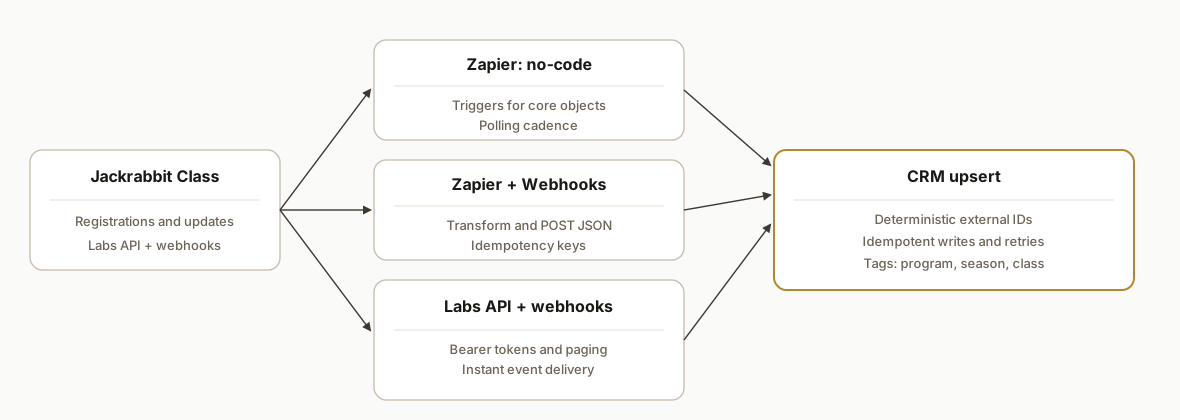
At a high level you choose one of three patterns and map Jackrabbit objects to people or companies in your CRM. All three end in a deterministic upsert that prevents duplicates.
- No-code: Use the official Zapier app for Jackrabbit Class. Triggers poll for new or updated items, then actions map fields to your CRM. Coverage includes Family, Contact, Student, Class and Enrollment. Triggers are polling, so it is near-real-time, not instant.
- Low-code: Stay in Zapier but add Webhooks by Zapier as a middle step to transform payloads and POST to a custom CRM endpoint. This adds routing, custom logic, and cleaner idempotency without leaving Zapier.
- Custom API: Use Jackrabbit Labs API for backfills and reference data and enable webhooks in Labs for instant notifications. Your service receives events, verifies signatures if configured, and upserts to your CRM via its API.
Step-by-step: how to build it
1. Pick your approach with a simple decision rule
Answer-first: start with Zapier if you only need basic contact and enrollment sync. Move to API webhooks when you need instant updates, full control, or heavy volume.
- If your team just needs new registrations in a CRM list today: pick Zapier.
- If you need custom routing, dedupe keys, and a small transform: Zapier plus Webhooks by Zapier.
- If you need instant events, reliable backfills, and full control: Labs API plus webhooks.
Decision rule:
- Basic objects, light volume, OK with polling: Zapier.
- Custom mapping, light code, post to your own endpoint: Zapier + Webhooks.
- Real-time, pagination, complex logic, or analytics reuse: API + webhooks.
Key gotcha: Make.com does not list an official Jackrabbit Class app at the time of writing (unconfirmed). Plan on Zapier or the direct API rather than relying on a Make module that may not exist.
2. No-code: set up the Zapier trigger and map fields
Zapier has an official Jackrabbit Class app with triggers and actions for Family, Contact, Student, Class and Enrollment. Triggers run on a polling schedule. Create a Zap that listens for new or updated enrollments, then map fields to your CRM action.
Zapier outline:
- Trigger: Jackrabbit Class: New or Updated Enrollment
- Action: Find or Create Person in <Your CRM>
- Action: Add to Pipeline / List with tags like program, season, class code
- Optional: Filter out trials or waitlists
Key gotcha: Because triggers poll, you will see a small delay. If sub-5 minute response matters, choose the Labs webhook route.
3. Low-code: transform and POST with Webhooks by Zapier
When your CRM prefers a custom JSON shape or you want your own idempotency keys, add Webhooks by Zapier.
POST https://your-crm.example.com/hooks/jackrabbit
Content-Type: application/json

{
  "source": "jackrabbit",
  "objectType": "enrollment",
  "objectId": "{{trigger.id}}",
  "familyEmail": "{{trigger.family_email}}",
  "studentName": "{{trigger.student_name}}",
  "classLabel": "{{trigger.class_name}}",
  "status": "{{trigger.status}}",
  "occurredAt": "{{trigger.updated_at}}"
}
Key gotcha: Use your own deterministic idempotency key in the request body or headers so your endpoint can upsert safely when Zapier retries.
4. Custom: call the Jackrabbit Labs API with proper auth and pagination
Jackrabbit Labs exposes a bearer-token API. Pagination defaults to 25 with a documented max pageSize of 100, so always implement paging for backfills and audits. Options endpoints exist to discover IDs for dropdown fields.
# Backfill a resource with paging: replace <resourcePath> with an API path from the docs
JR_BASE="https://sandbox-api.jackrabbitclass.com"
curl -s \
  -H "Authorization: Bearer $JR_TOKEN" \
  "$JR_BASE/v1/<resourcePath>?pageSize=100&page=1"
// Node.js example: simple pager you can adapt to any resource
async function* pager(fetchFn, baseUrl, resourcePath) {
let page = 1; const pageSize = 100;
while (true) {
const url = `${baseUrl}/v1/${resourcePath}?pageSize=${pageSize}&page=${page}`;
const res = await fetch(url, { headers: { Authorization: `Bearer ${process.env.JR_TOKEN}` }});
if (!res.ok) throw new Error(`Jackrabbit API ${res.status}`);
const data = await res.json();
const items = Array.isArray(data) ? data : (data.results || []);
if (!items.length) break;
yield items;
page += 1;
}
}Key gotcha: A hard pageSize cap means you must page through large datasets. Avoid partial syncs that silently truncate at 100.
5. Receive webhooks and upsert into your CRM
Enable webhooks in Jackrabbit Labs to receive instant events. Your service should verify the request, normalize the payload, and upsert using deterministic keys.
// Express handler: generic webhook receiver
import express from "express";
import bodyParser from "body-parser";
const app = express();
app.use(bodyParser.json());

app.post("/hooks/jackrabbit", async (req, res) => {
  // TODO: verify signature if configured in Labs
  const event = req.body;            // do not assume field names, map from docs
  const key = event.id || event.objectId; // pick a stable external key
  await upsertToCRM({ key, event }); // your CRM API call with idempotency
  res.sendStatus(200);
});
Key gotcha: Treat webhook delivery as at-least-once. Your CRM write must be idempotent.
6. Backfill safely and monitor ongoing sync health
Run an initial backfill with the API pager, not webhooks. After go-live, add lightweight health checks: last successful event time, last API page processed, and a dead-letter queue for failed upserts.
# Minimal health endpoint contract for your sync service
curl -s https://sync.example.com/health | jq
# { "jackrabbit": { "lastWebhookAt": "2026-10-06T13:12:00Z", "backfillComplete": true },
#   "crm": { "writeLatencyMsP50": 140 } }
Key gotcha: CSV exports are great for spot audits. Jackrabbit reports can export to Excel or CSV, which helps reconcile counts against your CRM when you want a second opinion.
Where it gets complicated
- Pagination cap at 100: The API's max pageSize is 100. Large backfills need robust paging and resume checkpoints so you do not miss rows.
- Polling vs instant: Zapier triggers poll on a schedule. If you require true real-time, use Labs webhooks and your own receiver.
- Object coverage: Zapier's official app focuses on core objects like family, contact, student, class and enrollment. Plan custom API work for objects outside that set.
- Field discovery: Use Options endpoints to discover valid IDs before writing to reference fields. Hardcoding magic numbers breaks on the next season.
- Idempotency and retries: Webhooks and Zapier both retry on failures. Without a stable external key and idempotent write, you will create duplicates.
- Make.com uncertainty: An official Jackrabbit module on Make.com is not confirmed. If you build on Make, assume you will bridge with generic HTTP modules or switch to Zapier or direct API.
What this actually changes
Studios stop copying data and start contacting families when interest is highest. Speed to follow-up matters: companies that respond to new leads within 5 minutes are many times more likely to connect and qualify than those that wait longer. Harvard Business Review reported a 21x difference vs 30 minutes in one study. Source: https://hbr.org/2011/03/the-short-life-of-online-sales-leads
Practically, the change is structural: registrations reach your CRM with consistent tags and no duplicates, your staff workflows trigger automatically, and you can audit sync health without opening spreadsheets.
Frequently asked questions
Does Jackrabbit Class have an official API?
Yes. Jackrabbit Labs exposes a bearer-token REST API with pagination and Options endpoints to discover valid IDs. The sandbox base is https://sandbox-api.jackrabbitclass.com and tokens are passed via Authorization: Bearer. Webhooks are supported and enabled via Labs.
Is there a native Zapier integration for Jackrabbit Class?
Yes. There is an official Zapier app with triggers and actions around Family, Contact, Student, Class and Enrollment. Triggers are polling based, so it is near-real-time rather than instant. You create an API key in Jackrabbit settings to authenticate the Zap.
Can I sync in real time instead of polling?
Yes. Enable webhooks in Jackrabbit Labs and point them at your service. Your receiver verifies, normalizes, and upserts to the CRM. For backfills and reference data, call the API with paging. This combination gives both instant events and complete history.
What CRMs can I connect to?
Any CRM that offers an API or a Zapier app can work. With Zapier you map fields directly. With a custom build you call the CRM's REST API in an idempotent upsert. The pattern is the same: deterministic keys, consistent tags, and safe retries.
How do you prevent duplicates?
Pick a stable external identifier from Jackrabbit and store it in your CRM. Every write becomes an upsert by that external ID. Add an idempotency key to webhook requests so retried deliveries do not create extra records.
What does this cost monthly?
Zapier: priced by tasks and plan limits. Custom: hosting is minimal for a small webhook service, and most cost is the initial build. The Labs API itself is part of Jackrabbit's developer surface. Your real cost is driven by volume and how much custom logic you need.
If you want a clean, real-time sync with backfills and zero-duplicate upserts, we ship this pattern as part of our CRM automation work. See our related guide on Jackrabbit Class to HubSpot integration and our broader CRM automations. When you are ready, book a 15-minute call.
Want us to build this for you?
Nine questions, about 90 seconds. You see the hours it is costing you, then pick a time. No pitch.
Get your free assessment