
There is no self-serve ResMan API key. Access runs through ResMan's partner program, documentation is released only after approval, and every customer account needs its own Account ID requested from ResMan. Once access exists, we build a scheduled adapter that pulls residents, units and financials into a Postgres staging store you own, then feeds reporting and your CRM from there. This guide is for mid market operators who already know they need a build, and it covers what each access path allows, what we will and will not state before approval, and the design we use.
Rex Automaton is an AI implementation agency that builds and runs this kind of system for mid market operators.
In short, a ResMan API integration is a scheduled, authenticated sync from ResMan into your own database and CRM, so nobody re-keys a resident or a unit by hand.
The problem it solves
The decision is rarely whether to integrate. It is which access path to take, because ResMan does not publish a developer portal. The partner program is how developers get API access, and that one fact shapes every option below.
| Option | What it needs | Good for | Main limit |
|---|---|---|---|
| Custom build on the partner API | Partner approval, plus a per-customer Account ID from ResMan | Residents, units and financials into your own database, BI and CRM | Approval and onboarding are manual, so the calendar is the long pole |
| Unified API vendor (Propexo is one example) | Vendor account, plus the same ResMan-side approval | Teams that want one schema across several property systems | Another subscription, and you inherit the vendor's field model |
| Prebuilt product connector (HappyCo documents one) | An existing subscription to that product | Syncing properties, units and residents into that specific product | Documented as a daily sync, and it feeds that product, not your warehouse |
| Zapier or Make | A listed ResMan app | Light triggers | We did not find a ResMan listing on either directory. Check both before planning around it |
| Manual export and re-key | Staff time | One-off questions | Stale the moment it is done, and it does not scale across properties |
The honest summary: a direct build gives you the most control, and the gate is access, not engineering.
What keeping your systems in sync is worth
Move the sliders to your own numbers. The defaults are only an example business, not client data.
Revenue from deals that stop slipping each year
$100,800
80 a month × 12 × 5% × 70% × $3000
- Deals kept a year
- 34
- 80 × 12 × 5% × 70%
- Staff cost of doing it by hand each year
- $9,100
- 5 hrs a week × $35/hr × 52 weeks
- Hours handed to the system each month
- 22 hrs
- 5 hrs a week × 52 ÷ 12
How the automation works
Our standard pattern is one adapter, one staging store, two consumers. The adapter is the only code that knows ResMan's shape, so a change on the ResMan side touches one module and everything downstream reads from your own database.
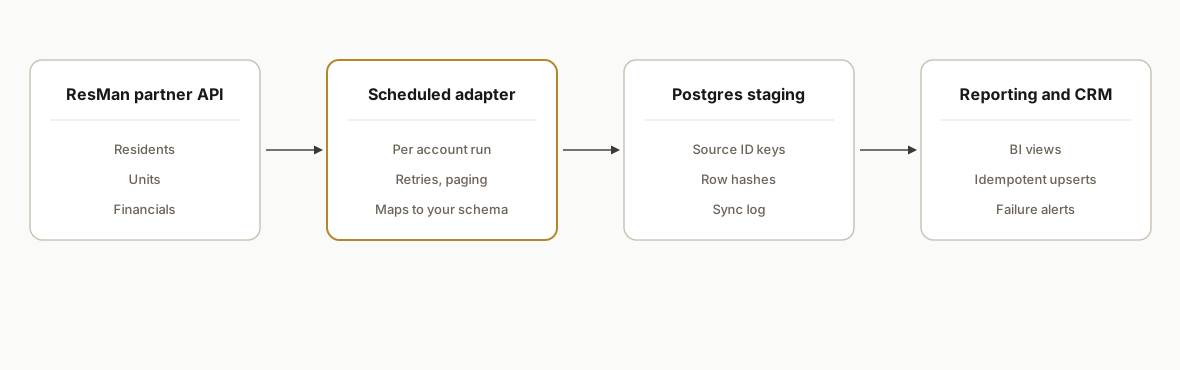
ResMan partner API: the source of record. Per Propexo's integration guide, credentials are an Integration Partner ID, an API key and an Account ID for each customer. We do not state the auth scheme or rate limits until we hold the approved documentation.
Scheduled adapter: runs per portfolio on a schedule, owns retries and pagination, and maps ResMan fields to your schema.
Staging store: Postgres with a table per entity plus a sync log. Each row carries a source ID and a content hash, so reruns update instead of duplicating.
Reporting and CRM consumers: your BI tool reads the staging tables, and a second job upserts residents and lease events into the CRM.
Step-by-step: how to build it
Step 1: Get partner access before anything else
Start the approval process on day one because everything else waits on it. ResMan's partner materials describe API access, training and dev instances for approved partners. Two official pages describe the program and they appear to differ on cost: the Join the ResMan Ecosystem page describes tiers, with the Silver tier involving a minimal fee and ongoing API support, while the ResMan+ Partner page describes a self-paced process that is free for most service types with a small co-branding requirement. Confirm with ResMan which program applies to you.
Then request the Account ID for each customer account you will sync. This is manual per client.
Step 2: Define your own schema, keyed on source IDs
Write your schema first, then map ResMan to it, so ResMan's field names never leak into reporting.
create table staging_unit (
  source_id text primary key,
  property_source_id text not null,
  unit_label text,
  status text,
  row_hash text not null,
  synced_at timestamptz not null default now()
);

create table staging_resident (
  source_id text primary key,
  unit_source_id text,
  full_name text,
  email text,
  lease_end date,
  row_hash text not null,
  synced_at timestamptz not null default now()
);

create table sync_log (
  id bigserial primary key,
  entity text not null,
  started_at timestamptz not null,
  rows_seen int,
  rows_changed int,
  status text not null,
  error text
);
The source ID is the primary key because names and unit labels change and IDs should not. Residents point at units by source ID, so a transfer between units changes one link rather than rewriting a record.
Step 3: Write down what is known and what is not
Before coding, we keep a short access record and fill the unknowns from the approved documentation. This stops guesses from becoming hard-coded behavior.
known_from_sources:
  credentials: [integration_partner_id, api_key, account_id_per_customer]
  docs_released: after_partner_approval
  dev_instances: provided_to_approved_partners
unconfirmed_until_docs:
  auth_scheme: unknown
  rate_limits: unknown
  webhooks: unknown
  csv_or_scheduled_export: unknown
  base_url: only_an_unofficial_third_party_doc_exists
Secrets live in your secret manager, and each Account ID is a config row, so onboarding a new portfolio is a config change rather than a deploy.
Step 4: Write the adapter with hash-based upserts
The adapter fetches, normalizes, hashes, and writes only what changed.
import hashlib, json

def row_hash(row: dict) -> str:
    return hashlib.sha256(json.dumps(row, sort_keys=True).encode()).hexdigest()

def upsert(conn, table, rows):
    changed = 0
    for r in rows:
        h = row_hash(r)
        cur = conn.execute(f'select row_hash from {table} where source_id = %s', (r['source_id'],))
        existing = cur.fetchone()
        if existing and existing[0] == h:
            continue
        write_row(conn, table, r, h)  # insert or update
        changed += 1
    return changed
A failed page fails the whole entity run in sync_log. A half-synced units table that looks healthy is worse than a loud error.
Step 5: Feed reporting and push to the CRM
Point BI at views over the staging tables so business logic lives in one place. For financial lines, agree the period and sign convention with whoever owns owner reporting before any chart is built.
For the CRM, match on a stored ResMan source ID first, then email. Never create on a name match alone.
crm_sync:
  match_order: [resman_source_id, email]
  on_no_match: create
  fields: [full_name, email, unit_label, lease_end]
  suppress_if: do_not_contact_flag
Write the source ID back onto the CRM record on first match, so every later sync is an exact lookup.
Step 6: Monitor and alert
Alert on any sync_log row with a non-success status, and on any entity whose rows_seen drops sharply from the prior run. A silent zero is the failure you most need to catch.
Where it gets complicated
Access is the schedule. Partner approval, dev instance access, and a manual Account ID request per customer happen on ResMan's timeline. Build time is short next to this. Plan the project around the approval, and start it before you sign a build.
We do not state what the docs have not told us. The only description of a base URL pattern we found is an unofficial third-party document, so we treat the base URL, auth scheme and rate limits as unconfirmed. Any vendor who quotes you exact endpoints before approval is guessing.
Do not promise real time. HappyCo's documented ResMan connector syncs daily. Webhooks and scheduled exports are unconfirmed for ResMan, so we design for scheduled polling and say so up front.
Unofficial shortcuts carry durability risk. Supergood offers a layer built by reverse-engineering browser flows. That can get you data sooner, but it can break whenever the front end changes. For a feed an owner relies on, we prefer the sanctioned partner path.
Fees and terms differ by program. The two official pages describe the program differently, and Supergood reports that access carries a fee and per-account authorization. Get fee, support and co-branding terms in writing before budgeting.
What this actually changes
This is the pattern we build, not a case study, so we claim no customer result. The change is structural: reporting and CRM stop depending on a person's export schedule, because the adapter writes to a database you own. ResMan's own integration page describes an open API, though we confirm what it covers for residents, units and financials only once documentation is in hand.
How to choose a path:
- ResMan is your main system and you want full control of the data model: custom build on the partner API.
- You run several property systems and want one schema: a unified API vendor, accepting a subscription and the vendor's field model. ResMan-side approval is still required.
- You only need data inside a product you already pay for: use that product's prebuilt connector and accept the daily sync.
- You need an answer this week: manual export, knowing it will not scale.
Frequently asked questions
Does ResMan have a public API I can use today?
Not openly. ResMan gives API access to approved partners, with documentation, training and dev instances released after approval. Each customer account also needs its own Account ID requested from ResMan. Plan for an approval step before any development starts.
Can I connect ResMan with Zapier or Make?
We found no ResMan listing on either directory, so we do not plan around it. Check both directly, since listings change. If none exists, the options are a custom adapter on the partner API or a unified API vendor such as Propexo.
How fresh will the data be?
Plan for scheduled syncs, not real time. HappyCo's documented ResMan connector syncs daily, and webhook support for ResMan is unconfirmed. We only design around push events if the approved documentation shows them.
What does a ResMan integration cost and how long does it take?
We do not quote a number before seeing the approved documentation, because the entity list and number of consumers drive effort. Two things sit outside our build fee: ResMan's program terms, which the two official pages describe differently, and approval time, which is ResMan's. A short discovery call gives you a scoped quote.
Should I use a unified API vendor instead of a custom build?
Choose a vendor if you run several property systems and want one schema. You still need ResMan-side approval and take on a subscription. Choose a custom adapter when ResMan is your main system and you want full control of the data model with no extra layer.
If you run ResMan and want residents, units and financials flowing into reporting and your CRM without manual exports, see our workflow automation and CRM automation work, and read how we approach a similar gated system in our AppFolio API integration guide. When you are ready to scope it, book a 20 minute call and we will map your portfolios to a plan and tell you what the approval step looks like.
Sources
- 1.Join the ResMan Ecosystemmyresman.com
- 2.Become a ResMan+ Partnergo.myresman.com
- 3.ResMan Integrationmyresman.com
Who would build this
Rex Automaton is an AI implementation agency with 250+ projects shipped since 2018, rated 4.9 from 33 reviews. Clients include Soft Pull Solutions, Capcon Networks, Iron Age Investments, IT360. You work directly with the people who build it.


Want this built around your systems?
Nine questions, about 90 seconds. You see the revenue it is costing you, then pick a time. No pitch.
See your optionsRather talk to a person first? Meet the team or tell us which system you run.