
An AI phone agent that books appointments correctly needs four things working together: reliable telephony in and out, a voice stack that hears and speaks clearly, a deterministic booking policy that never guesses, and calendar plus CRM write-backs with duplicate and overbooking guards. We built and shipped this pattern for inbound reception and for outbound qualification. This guide shows the architecture and the gotchas that matter in production.
Appointment-booking phone automation is: a voice agent that answers calls, qualifies the request, proposes real time slots, places a temporary hold, confirms with the caller, then commits to calendar while writing a clean audit trail and notifications.
If you run any service business that books on the phone, this is for you. We cover the system design, exact build steps with code, what tripped us up, and how we keep agents from creating bad bookings.
The problem it solves
You want every caller answered, qualified, and booked without bouncing between tools or risking double bookings. Manually, staff juggle calls while checking a calendar, mishear names or dates, and forget to log the booking in the CRM.
| Manual booking | AI phone agent booking |
|---|---|
| Call rings while staff are busy. Caller repeats info. | Always answers. Captures caller details once and confirms back. |
| Calendar context switching and human typos. | Reads availability programmatically and validates fields before commit. |
| Double bookings and missed CRM entries. | Places a hold, confirms, writes atomically to calendar and CRM with dedupe keys. |
| No audit trail if a booking goes wrong. | Full call log, transcript summary, and booking record with timestamps. |
Answer first: the best way to build this is a state-machine voice workflow with strict confirmation steps and a temporary calendar hold. The agent proposes slots only from free windows, repeats back the choice, then commits with a unique booking key so you never double book.
How the automation works
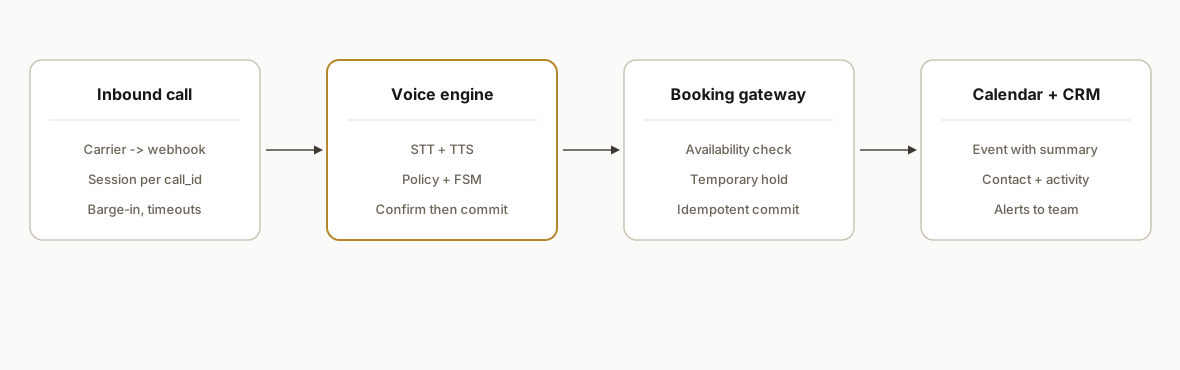
At a high level: the phone number points to a webhook that drives a conversational engine. Speech-to-text turns audio into text. The agent follows a finite state machine: identify, qualify, propose availability, confirm, hold, commit, notify. A booking gateway mediates calendar holds and dedupes. Final writes go to your calendar and CRM, and the system alerts the right person.
- Telephony ingress and session control: The carrier receives the call and posts events to your webhook. We track a call_id and maintain a session store for state across turns.
- Voice engine: Real-time STT and TTS with a conversation loop. We run a short timeout for dead-air and inject barge-in handling so callers can interrupt.
- Policy and state machine: Deterministic steps: who are you, what service, when, confirm terms, then book. No freeform booking without a policy match.
- Booking gateway: A server function that checks availability, places a 3, 5 minute hold, then commits or releases on confirmation or timeout. It also prevents duplicates.
- Calendar and CRM sync: On commit we create the event with the confirmed fields, attach a transcript summary, and write the contact plus activity into the CRM.
- Monitoring and controls: Live logs, a pause switch, quota guards, and alerts if anything looks off.
In production we validated this pattern two ways: an outbound booking dialer for a real estate team where we added deterministic disposition guards to stop false bookings, and a home-care receptionist demo where we ran a voice bake-off and separated voice quality from workflow errors. The same confirm-then-commit pattern makes both safe to run.
Step-by-step: how to build it
1) Stand up the telephony webhook and session store
Answer first: terminate the phone number to your HTTPS webhook and keep per-call state in a fast store.
// server/index.js
import express from "express";
import { getSession, saveSession } from "./session.js";

const app = express();
app.use(express.json());

app.post("/voice/incoming", async (req, res) => {
  const { call_id, event, audio_url, digits } = req.body;
  const s = await getSession(call_id) || { state: "greet", slots: {} };
  // route event to your conversation loop
  const reply = await handleEvent({ s, event, audio_url, digits });
  await saveSession(call_id, reply.session);
  return res.json(reply.actions); // say, listen, gather, hangup
});

app.listen(8080);
Key gotcha: persist state on every turn. Do not trust in-memory session only, since voice providers can retry webhooks.
2) Add real-time STT and TTS, then enforce short turns
Answer first: transcribe each chunk, stream back speech, and keep each turn short to reduce error.
// voice/engine.js
export async function transcribe(audioUrl) {
  // fetch audioUrl, send to your STT provider, return text
  return { text: "I want Tuesday at 3 pm", confidence: 0.92 };
}

export async function speak(text, voice) {
  // request TTS from your provider and return a playable URL
  return { mediaUrl: await synthesize(text, voice) };
}
Key gotcha: timeouts. Set a sensible no-speech timeout and barge-in so callers can interrupt when they already know their answer.
3) Implement the booking state machine with explicit confirmations
Answer first: never book on a single utterance. Always confirm back the structured fields you heard.
// booking/policy.js
export const policy = {
  services: ["Consult", "Install", "Follow-up"],
  locations: ["East", "West"],
  hours: { start: "09:00", end: "17:00", tz: "America/Chicago" },
  slot: 30 // minutes
};

// booking/fsm.js
export async function nextTurn(session, userText) {
  const s = { ...session };
  // NLU: extract name, phone, service, date, time from userText
  s.slots = { ...s.slots, ...extract(userText) };

  if (s.state === "greet") {
    s.state = "qualify";
    return { say: "Thanks for calling. What service do you need and which location?", session: s };
  }

  if (s.state === "qualify" && have(s.slots, ["service", "location"])) {
    s.state = "propose";
    const windows = await getWindows(s.slots);
    return { say: `I can do ${windows[0]} or ${windows[1]}. Which works?`, session: s };
  }

  if (s.state === "propose" && s.slots.when) {
    s.state = "confirm";
    return { say: `Just to confirm: ${s.slots.service} at ${s.slots.location} on ${fmt(s.slots.when)}. Is that correct?`, session: s };
  }

  if (s.state === "confirm" && yes(userText)) {
    s.state = "book";
    return { say: "One moment while I secure that time.", session: s, action: "HOLD_AND_COMMIT" };
  }

  return { say: "Sorry, I did not catch that. Could you repeat?", session: s };
}
Key gotcha: keep a strict slot model and an explicit confirm step. This is what prevents false bookings.
4) Build the booking gateway: hold then commit, idempotently
Answer first: place a short hold, then commit only on an affirmative confirmation. Use a unique key to prevent duplicate events.
// booking/gateway.js
import { v4 as uuid } from "uuid";
import { putHold, commitEvent, releaseHold } from "./calendar.js";
import { withMutex } from "./mutex.js";

export async function holdAndCommit({ caller, service, location, when }) {
  const key = `book:${caller.phone}:${when.start.toISOString()}`;
  return withMutex(key, async () => {
    const holdId = await putHold({ service, location, when, who: caller });
    const ok = await confirmStillFree(holdId);
    if (!ok) { await releaseHold(holdId); throw new Error("Slot taken"); }
    const event = await commitEvent({ holdId, meta: { key } });
    return { eventId: event.id };
  });
}
Key gotcha: idempotency. Wrap the critical section so retries do not double book.
5) Write to calendar and CRM, then notify with a summary
Answer first: after commit, create the event, attach structured notes, sync to the CRM, and alert the assignee.
// booking/aftercare.js
export async function afterCommit({ eventId, caller, transcript }) {
  await upsertContact({ phone: caller.phone, name: caller.name });
  await logActivity({ contactPhone: caller.phone, type: "Booked", eventId });
  const summary = summarize(transcript); // short, factual
  await attachNote({ eventId, note: summary });
  await sendAlert({ to: assignee(eventId), text: `New booking: ${summary}` });
}
Key gotcha: keep the summary factual and short. Attach it to the event so the team sees context without opening another tool.
6) Add safety controls: pause, quotas, and health checks
Answer first: expose controls to pause the agent, cap daily bookings if you depend on limited staff, and alert on anomalies.
// ops/controls.js
let paused = false;
export function setPaused(v) { paused = v; }
export function isPaused() { return paused; }

export function canBookToday(countSoFar, cap) {
  return countSoFar < cap;
}
Key gotcha: include a pause switch that operations can use without a redeploy.
Where it gets complicated
STT and accent or noise variance. We ran a voice bake-off in a home-care receptionist demo and saw real differences on accented callers and background noise. Always test your real recordings and pick the engine that hears your market.
False bookings come from missing confirmations. In an outbound booking dialer for a real estate team we initially saw misclassifications by an AI classifier. We fixed it by adding server-side deterministic guards and an explicit confirm-repeat step. We have not seen new false bookings after that change.
Vendor quota overages can rack up silently. During a voice rollout we observed text-to-speech vendors continue serving beyond plan limits, billing overage while calls succeeded. We added a quota check that can pause campaigns until quotas reset. Apply the same guard to an inbound agent if you run volume spikes.
Calendar holds and time zones. Do not skip the temporary hold. Callers think more slowly than APIs respond. Place a short hold in the correct time zone, then commit after verbal confirmation. Release the hold on timeout or negative confirmation.
Compliance and PII. For healthcare and finance adjacent workflows, record consent before recording, store only what you need, and avoid storing full identifiers in plain text. We hash or encrypt sensitive fields and keep audit logs without raw PII wherever possible.
Human handoff is a feature, not a failure. Some calls do not fit booking rules. Make it easy to press 0 for a human or to schedule a callback. Calls that fall out cleanly will save more time than forcing the AI to handle every edge case.
What this actually changes
In production we used this pattern to run an outbound booking agent for a real estate team where the agent processed 3,130 leads and the guardrails stopped false bookings after we tightened confirmations and server-side checks. We also built a home-care receptionist demo that cleanly separated voice quality from workflow failures so we could tune each layer.
One external benchmark matters here: firms that tried to contact leads within one hour were nearly 7 times as likely to qualify them as those that waited longer, and more than 60 times as likely as those that waited 24 hours or more (Harvard Business Review, The Short Life of Online Sales Leads: https://hbr.org/2011/03/the-short-life-of-online-sales-leads). Phone agents that answer immediately and book on the first contact move you into that high-conversion window by default.
The structural value: every call is answered, booking accuracy improves because the agent confirms fields, and your team only handles exceptions and the appointment itself.
Frequently asked questions
What is the best stack for an AI booking agent?
Use a telephony provider that posts webhooks reliably, a speech-to-text and text-to-speech pair that performs on your real recordings, and a server-side state machine that enforces confirm-then-commit. Add a booking gateway that places temporary holds and writes to calendar and CRM atomically.
Can this work with Google Calendar, Outlook, or Calendly?
Yes. Treat calendar as a capability, not a vendor. The gateway checks availability, places a short hold window, then commits the event and releases the hold if the caller declines or times out. We attach summaries and sync the contact and activity into your CRM regardless of the calendar provider.
How do you prevent bad or duplicate bookings?
Two layers: a deterministic confirm step where the agent repeats back the structured details, and an idempotent booking gateway that uses a unique key per caller and time. We also wrap the critical section with a mutex so webhook retries do not create duplicates and we cap bookings per day when needed.
Can one agent handle inbound and outbound?
Yes, the core is the same state machine. Inbound focuses on answer and qualify. Outbound adds a scheduler, lead import, and strict guardrails so it never books from a weak signal. We add pause and quota controls and an audit trail for each disposition so the team can review edge cases.
How long does it take to ship the first version?
A focused inbound booking agent with one calendar and one service usually ships in one to two weeks. Add time for a voice bake-off on your recordings, calendar credential setup, and a short shadow-mode period to prove accuracy before flipping it on for all calls.
What does it cost to run monthly?
You pay your telephony provider for minutes and your voice engine for speech. Calendar and CRM writes are usually negligible at typical booking volume. The largest lever is call volume and average call length. Safety controls for quotas and pauses help prevent surprise overages.
If you need an AI phone agent that actually books, we have already built and shipped this flow with the confirm-then-commit pattern, pause controls, and calendar holds. See our service overview at /services#ai-voice-agents, and our related post on setup details in How to Set Up an AI Voice Receptionist. When you are ready to scope your first agent, book a 15-minute call.
Want us to build this for you?
Nine questions, about 90 seconds. You see the hours it is costing you, then pick a time. No pitch.
Get your free assessment