
An AI voice receptionist answers your phone, qualifies callers, and books appointments into your calendar or CRM while handing edge cases to a human via a live warm transfer. We built and shipped voice agents in production and a receptionist POC for a home care agency, so this guide covers what actually works: approach selection, architecture, guardrails, and live-ops.
AI voice receptionist automation is: a phone front door that listens, understands intent, and uses safe tools to schedule, route, and follow up without putting sensitive data at risk.
The problem it solves
An AI receptionist consistently picks up, asks the right triage questions, and uses sample receptionist scripts to book on the first call. It closes the after hours gap and removes the scramble to return missed calls. For owners who want calls answered every time without adding headcount, this section shows why the manual workflow breaks and what the automated version replaces.
| Manual receptionist workflow | Automated AI receptionist |
|---|---|
| Missed calls after hours or during peak times | 24/7 pickup with consistent greeting and triage |
| Caller repeats details to different staff | Single structured capture with confirmation |
| Double bookings and bad-fit appointments | Policy-aware booking tool with eligibility checks |
| Notes live in scattered inboxes | Append-only call log with outcomes and replays |
| Staff time on screening and reschedules | Automated screening, SMS confirms, self-serve reschedule link |
How the automation works
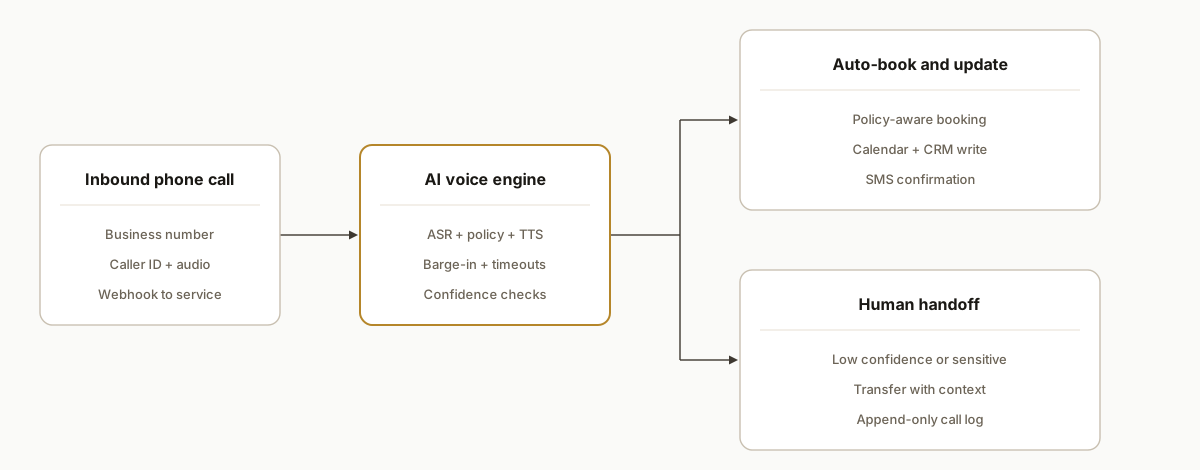
A production receptionist has five moving parts that you can assemble from a platform or build custom. Calls flow from the phone carrier into an ASR engine, through a dialogue policy that can call safe tools like your calendar and CRM, then either book automatically or hand off to a human; for sample openings and triage, see receptionist call flow examples.
- Telephony ingress: Your business number routes calls to a webhook on your service. Caller ID, basic call metadata, and audio stream arrive in near real time. The same ingress can drive SMS for confirmations.
- Speech layer: Automatic speech recognition converts audio to text. Text-to-speech renders natural responses. You tune models for noisy lines and accents and set timeouts to prevent dead air.
- Dialogue and policy: An LLM plans conversation turns, but booking rules and compliance guardrails live outside the model. The policy decides when to ask for help, confirm, or escalate.
- Deterministic tools: Calendar booking, CRM upserts, and SMS confirmations are precise functions. They validate hours, prevent overlaps, and write clean records. The LLM never guesses slots.
- Handoff and logging: When confidence is low or a workflow is sensitive, the call transfers to a human with context; see warm transfers and routing. Every step is logged to an append-only ledger for QA and recovery.
Step-by-step: how to build it
1) Choose your approach: off-the-shelf, platform, or custom
Pick the smallest surface that solves your use case. We ship three patterns: prebuilt agent tools for simple triage, a telephony platform plus agent plugins for moderate control, and a full custom orchestrator when you need compliance and deep system hooks.
# Selection checklist
use_case: intake + booking + SMS confirms
volume: medium
constraints:
  - PHI boundary? false
  - PCI boundary? false
  - after_hours: true
approach:
  if simple and low risk: off_the_shelf_agent
  elif needs custom tools + logs: telephony_platform + agent_plugin
  else: custom_orchestrator (Node/Python + queue + DB)
Key gotcha: pick the approach that matches your data sensitivity. If you must segment PII or redact fields, go platform-plus or custom so you control storage.
2) Wire the phone number to your webhook
Provision a number with your carrier and point it to your HTTPS webhook (see RingCentral number routing). Your handler should accept call metadata and audio and respond quickly to keep media flowing. Keep the first hop thin and push heavy work to a worker.
// server/voice.js
import express from "express";
const app = express();
app.post("/api/voice-inbound", express.json(), async (req, res) => {
  const { callId, from, to } = req.body;
  queue.enqueue({ type: "call.start", callId, from, to });
  return res.status(200).json({ ok: true });
});
app.post("/api/voice-media", express.raw({ type: "audio/*" }), (req, res) => {
  mediaBuffer.write(req.body); // stream to ASR pipeline
  res.status(200).end();
});
Key gotcha: do not block on ASR or LLM in the ingress route. A slow response can drop the call.
3) Add ASR and TTS with timeouts and barge-in
Use streaming ASR for low latency and TTS for natural responses. Set max-silence timers, allow barge-in so callers can interrupt long prompts, and normalize transcripts before intent parsing.
// speech/loop.js
for await (const chunk of asr.stream(mediaBuffer)) {
  transcript.push(chunk.text);
  if (chunk.isFinal) break;
}
const reply = await policy.decide(context, transcript.join(" "));
const audio = await tts.speak(reply.text, { voice: voiceId, speed: 1.0 });
player.play(audio, { bargeIn: true });
Key gotcha: noisy mobile lines inflate false starts. Debounce partials before intent extraction.
4) Keep booking deterministic and off-LLM
Put business rules in code. The model can propose a time window, but a tool function must check hours, prevent overlaps, and write the record. Confirm back to the caller before finalizing.
// tools/booking.ts
export async function bookAppointment(who, intent) {
  const slot = await findNextAvailableSlot(intent.service, intent.window);
  if (!slot || !withinBusinessHours(slot)) return { ok: false, reason: "no_slot" };
  const ok = await holdSlot(slot);
  if (!ok) return { ok: false, reason: "race" };
  await upsertCRM({ who, intent, slot });
  await sendSMS(who.phone, `Booked ${intent.service} on ${slot.start}`);
  return { ok: true, slot };
}
Key gotcha: never let the LLM build iCal strings or invent slot math. It suggests. Code decides.
5) Add a second guardrail on critical intents
We reduced false bookings in production by pairing model classification with a deterministic guard. Use pattern checks and requirement gates on phrases like yes, book it and anything that implies payment or binding commitments.
# guards/classify.py
intent = model.classify(text)
if intent == "book" and not regex.search(r"\b(book|schedule|confirm)\b", text.lower()):
    intent = "ask_clarify"
if intent == "payment":
    raise SoftHandoff("payments require human")
Key gotcha: build the server-side veto. Do not trust a single classification to change calendars or charge cards.
6) Handoff cleanly and log everything append-only
When confidence drops or a policy blocks the action, transfer to a human with a short context packet using warm transfer routing. Store an append-only log for each call so you can audit and improve prompts without losing history.
-- db/audit.sql
create table call_log (
  id uuid primary key,
  started_at timestamptz not null,
  from_number text not null,
  to_number text not null,
  event jsonb not null -- one row per event, append-only
);
Key gotcha: if you handle sensitive data, hash identifiers and avoid writing raw PHI. Keep decryptable fields out of app logs.
7) Add live-ops: quota checks, pause, and shadow mode
Quota overruns and vendor hiccups happen. Add a health endpoint, a quota check that can auto-pause, and run shadow mode on real calls for a week before you let it book without a human.
// ops/quota.js
export async function guardRun() {
  const q = await tts.getQuota();
  if (q.used > q.limit * 0.95) {
    await ops.pause("tts_quota");
    return { ok: false };
  }
  return { ok: true };
}
Key gotcha: protect your bill. We shipped a quota guard that pauses gracefully when a TTS provider approaches overage.
Where it gets complicated
LLM misclassification on bookings: We saw confident wrong calls early. What fixed it was a two-layer check: tightened prompts plus a server-side regular expression and phrase gate. Production misfires dropped to near zero after that change.
Vendor quota and overage risk: Text-to-speech will happily keep talking while you accrue billable overage. We added a preflight quota check and a pause switch. When it nears a threshold, campaigns pause until quota resets.
Stale or wrong CRM contacts: If your sync is upsert-only, the system can keep calling or booking against trashed leads. We moved to an evict-on-sync strategy so deletions upstream deactivate locally.
Noisy lines and accents: Choose ASR models by bake-off, not brand. In our home-care receptionist POC we tested two speech stacks and tuned silence thresholds and barge-in to handle caregiver phones in the field.
Compliance boundaries: If your callers may state SSNs, credit cards, or health details, do not store them. We use hashed identifiers, redact logs, and segregate any decryptable storage behind access logging and short TTLs.
Dead air and talk-over: Set max-silence and fallback messages, and allow barge-in so callers can interrupt. Both changes reduce hang-ups and keep the flow natural.
What this actually changes
In production, the system answers every call, books cleanly inside business rules, and hands off edge cases with full context. After we shipped, owners stopped worrying about missed calls and bad-fit bookings because the guardrails sit in code, not in prompts. One wider market proof point: companies that respond to leads within five minutes are far more likely to qualify them than those that wait longer, a 21 times lift observed in a Harvard Business Review study (The Short Life of Online Sales Leads, https://hbr.org/2011/03/the-short-life-of-online-sales-leads). A receptionist that always answers makes that speed real for phone, and our ROI for voice receptionists shows how the numbers pencil out.
Frequently asked questions
Does this require a specific phone provider?
No. You point your number to a webhook that your service controls. We have used major telephony providers and SIP trunks, including RingCentral setup steps. The key is a stable media stream, quick webhook responses, and a path to SMS for confirmations.
Should I use an off-the-shelf agent or go custom?
If you only need simple triage and booking with low risk, an off-the-shelf agent can work. If you need policy-aware tools, clean CRM writes, compliance controls, and pause switches, use a platform plus plugins or a custom orchestrator. We map this in the selection step.
Can it book directly into my calendar or CRM?
Yes. We add a deterministic booking tool that talks to your calendar and CRM and enforces hours, overlap prevention, and confirmation. The agent proposes. The tool decides and writes. You get SMS confirms and a clean audit trail.
How do you prevent bad or fake bookings?
Two layers. First, a model proposes intent with confidence. Second, server-side guards validate phrases, eligibility, hours, and any required fields. If anything is off, the agent asks a clarifying question or hands off.
What about compliance and sensitive data?
We treat SSNs, payment data, and health details as do not store. We verify without retaining where possible, redact logs, hash identifiers, and segregate any decryptable storage behind access logging and short TTLs.
What does this cost monthly?
Your cost is driven by call minutes, speech model usage, and whether you run on a vendor agent platform or a custom stack. We design for predictable usage, add quota guards, and pause safely rather than allowing silent overage; for specifics, see our pricing and ROI breakdown.
If you want a receptionist that answers every call, books cleanly, and hands off safely, we have built and run these systems. See how we harden voice agents in our related post on AI calling with Follow Up Boss, and explore our AI voice agents service. When you are ready to scope yours, book a 15 minute call.
Want us to build this for you?
Nine questions, about 90 seconds. You see the hours it is costing you, then pick a time. No pitch.
Get your free assessment