
If you are about to hire a forward deployed engineer, a VP or Head of AI Transformation, an automation manager, or an AI solutions engineer, the job underneath every one of those titles is the same three steps: audit how the business actually runs, cut the waste out of the process, then automate what is left with AI. A small or mid sized business rarely needs a full time person to do that. It needs the three steps done well on one workflow at a time, and someone to keep the result running. This guide breaks down what each title really covers, what the market pays for it, and when an AI automation agency like ours is the better way to fill the seat.
A forward deployed engineer (FDE) is an engineer embedded inside a client business to learn its operations, find the waste, and ship AI agents and workflows that save time, make money or raise service quality. The term comes from enterprise software, where vendors sent engineers on site to make the product work inside each customer.
The skill set is having a moment. In a widely shared LinkedIn post this week, Corey Ganim wrote that anyone who can audit business processes, cut the fat and automate them with AI can command a six or seven figure income, and that some private equity firms now pay FDEs a share of the savings they produce. The top end of that claim is the top end. The Levels.fyi median for a US forward deployed engineer was $201,250 in total compensation as of August 2026, with the 90th percentile at $328,000. Either way, it is an expensive seat to fill.
Which AI roles are companies hiring for in 2026?
Open LinkedIn jobs and the same work appears under at least six names. Here is what each one usually means, what it costs to hire, and how we cover it.
| Role title | What the job actually is | Typical US pay (cited) | How we fill it |
|---|---|---|---|
| Forward Deployed Engineer (FDE) | Embedded engineer who learns the operation and ships agents and workflows inside it | $201,250 median total comp (Levels.fyi) | The same engineering work, on your systems, scoped per workflow |
| VP or Head of AI Transformation, Chief AI Officer | Owns the AI roadmap, picks the first use cases, answers to the owners or the board | $355,844 median for Head of AI (Glassdoor) | A ranked roadmap from a process audit, reviewed with you monthly |
| Automation Manager | Runs the automation backlog, keeps Zapier, Make or n8n flows healthy | $152,028 average (Glassdoor) | A request queue with monitoring on everything we build |
| AI Solutions Engineer or AI Solutions Architect | Designs and builds the integration between the model and your stack | Varies widely by company | Custom builds against your CRM, inbox, accounting and APIs |
| AI Automation Specialist or AI Operations Manager | Hands on builder and operator for day to day AI workflows | Varies widely by company | Same queue, same monitoring, no ramp time |
| AI Integration Engineer | Connects AI into systems that have no clean API | Varies widely by company | Our core work: bridging tools that were never meant to talk |
One finding explains why so many of these hires stall. An analysis of AI leadership job postings by Inform Growth found they advertise a median of $210,000, the highest of any operations role class it measured, and that 62% of them name no software tool at all. Companies know they want an AI executive. Most cannot yet say what that person will build.
The problem it solves
A full time AI hire is a bet that one person can do strategy, process design, engineering and operations at once, and that you will keep them busy for years. For most businesses under a few hundred people, the work comes in bursts: a heavy month of building, then mostly monitoring and small changes.
| Hiring an in house AI role | Using an AI automation agency |
|---|---|
| Months to recruit, then ramp time | Scoped and started within the first week or two |
| A six figure salary plus benefits, every month | A fixed build fee or a flat monthly membership you can pause |
| One person's skill set and one person's blind spots | A team that has seen the same failure on other stacks |
| Knowledge leaves when they do | Code, keys and runbooks live in your accounts |
| Vague mandate ("lead our AI strategy") | One outcome per request, with acceptance tests |
| Hard to judge if they are good until months in | Shadow mode shows results before anything goes live |
How the work actually happens: audit, cut, automate
Whatever the title, the method is the same, and it is the method we run on every engagement.
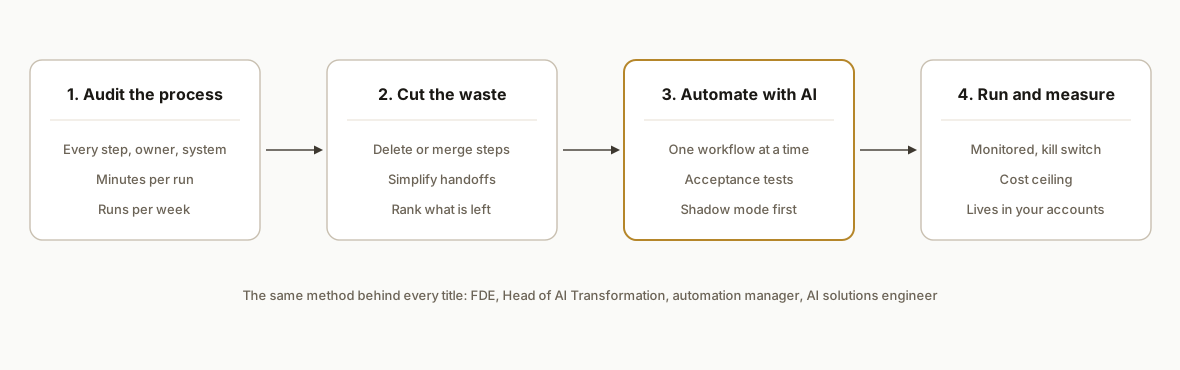
The order matters. Automating a wasteful process gives you a faster wasteful process. The audit and the cut are where much of the saving comes from, and they are the part a tool vendor will never do for you.
Step-by-step: how we fill the role
1) Audit the process the way it really runs
We start by writing down the workflow as people actually do it, not as the handbook says. Every step gets an owner, a system, a time cost and a frequency, because that is what turns "we should use AI" into a ranked list.
# process-audit.yml (one row per step, measured, not guessed)
workflow: "New lead to booked call"
steps:
  - step: "Copy web form lead into CRM"
    owner: "Office manager"
    system: "Gmail -> HubSpot"
    minutes_each: 4
    per_week: 60
  - step: "Look up company size and website"
    owner: "Sales rep"
    system: "Browser"
    minutes_each: 6
    per_week: 60
  - step: "Send first reply and booking link"
    owner: "Sales rep"
    system: "Gmail"
    minutes_each: 3
    per_week: 60
2) Cut the fat before anything gets automated
Each step gets one of four verdicts: delete, merge, simplify or automate. Deleting a step that exists only because two systems never talked is free, and it is the step an "AI hire" focused on models is most likely to skip.
# cut.yml
- step: "Copy web form lead into CRM"
  verdict: delete        # the form can write to the CRM directly
- step: "Look up company size and website"
  verdict: automate      # enrichment API plus a model summary
- step: "Send first reply and booking link"
  verdict: automate      # drafted by AI, sent after a human glance for the first 2 weeks
3) Pick one workflow and define done
We take the single highest value row from the audit and write acceptance tests a non developer can check. This is the brief we price against, and it is what keeps the work from turning into an open ended "AI transformation".
# brief.yml
outcome: "Every new lead is in the CRM, enriched, and has a first reply within 5 minutes"
acceptance_tests:
  - "No duplicate contacts for the same email inside 30 days"
  - "7 day shadow run: the AI draft matches what a rep would send on at least 9 in 10 leads"
  - "All API keys and logs live in the client's own accounts"
4) Build a thin slice and run it in shadow mode
The first version runs next to your team, not instead of it. It writes what it would have done to a comparison log, and a person reviews the log before anything is sent for real.
{
  "lead_id": "L-1042",
  "ai_action": "reply_drafted",
  "human_action": "reply_sent",
  "match": true,
  "notes": "AI picked the same booking link and tone"
}
5) Go live with guardrails and a kill switch
Live means monitored. Every workflow we ship has a daily cost ceiling, an alert when it fails, and a single switch that pauses it without a developer.
# runbook.md (excerpt)
# Pause the workflow:   set ENABLED=false in the environment
# Daily spend ceiling:  MAX_DAILY_COST_USD=15, the workflow pauses itself when reached
# Who gets alerted:     your ops inbox and ours
6) Hand over, then keep it running
Everything lives in your accounts: the code, the keys, the logs and a runbook. On our monthly automation membership, we monitor and maintain it and take the next request off your queue. Without it, you keep running the system yourself.
Where it gets complicated
When you should hire in house instead. If AI is the product you sell, if you need someone in the building every day, or if you have more than a handful of workflows changing every week, a full time FDE or Head of AI pays for itself. An agency is the better fit before you reach that point, and a good one will tell you when you have.
The vague mandate problem. "Lead our AI transformation" is not a job, it is a hope. The Inform Growth finding that 62% of AI leadership postings name no tool at all is the warning sign. Whoever fills the seat, give them one measurable outcome first.
Change management is real work. The hardest part of most automations is not the model. It is the person whose job changes. Shadow mode helps because the team sees the AI's work side by side with their own before anything switches over.
Systems with no clean API. Plenty of industry software has partial or undocumented APIs. Bridging those gaps safely (exports, scheduled reports, careful browser automation) is specialist work, and it is a common place for an in house generalist to get stuck.
Gain share deals. Some FDE roles pay a percentage of the savings produced. That only works when savings are measured the same way before and after, which is exactly what the audit in step 1 gives you.
What this actually changes
The point of any of these roles is a business that runs with less manual work. Two of our case studies show the shape of it: an AppFolio investor distribution pipeline where monthly per investor statements now go out from a single trigger with zero manual steps, and a receipt extraction pipeline that handles 700+ receipts a month for $4 to $9 in total API spend after replacing a paid third party service.
Neither needed a new hire. Both needed someone to audit the process, cut what did not need to exist, and automate the rest, which is the job description behind every title above.
Frequently asked questions
What is a forward deployed engineer?
A forward deployed engineer is an engineer placed inside a business to understand its operations and build AI agents and workflows that save time or make money. The role started at enterprise software companies and is spreading to private equity portfolios and mid sized firms that want AI results rather than AI strategy decks.
How much does a forward deployed engineer make in 2026?
Levels.fyi reported a US median total compensation of $201,250 for forward deployed engineers in August 2026, with the 75th percentile at $275,000 and the 90th at $328,000. Some private equity firms add a share of the savings the engineer produces, which is where the larger figures quoted on LinkedIn come from.
Do I need a Head of AI Transformation or an AI automation agency?
If you need one accountable executive steering many teams, hire the Head of AI. If you need the first few workflows audited, built and kept running, an agency gets you there faster and for less, and the audit it produces is exactly what a future Head of AI would want on day one.
What is the difference between an automation manager and an AI solutions engineer?
An automation manager runs the backlog and keeps existing automations healthy across tools like Zapier, Make or n8n. An AI solutions engineer designs and builds new integrations between AI models and your systems. Small businesses usually need a little of both, which is why we cover building and maintaining under one membership.
Can an agency replace a full time AI hire?
For most businesses under a few hundred people, yes, at least for the first year or two. You get the same audit, build and maintenance work without recruiting, ramp time or a fixed salary. Once AI work fills a full calendar every week, hiring in house starts to make sense, and documented systems make that handover easy.
How fast can you start?
We scope a first workflow on a 20 minute call, then start building within days rather than the months a recruiting cycle takes. The first version runs in shadow mode next to your team, so you see real output before anything goes live.
If you are weighing a forward deployed engineer or an AI transformation hire, start with one workflow instead of one job description. See how we build custom AI integrations, read how to hire someone to automate your business workflows, or book a 20 minute call and we will audit your first process with you.
Want us to build this for you?
Nine questions, about 90 seconds. You see the hours it is costing you, then pick a time. No pitch.
Get your free assessment