
If you need an AI voice agent or AI dialer this quarter, the fastest path is a 30 day pilot with a specialist agency: one narrowly scoped workflow, measured against your CRM, then a go or no-go. This guide shows how we evaluate agencies for small businesses, the budget ranges that are realistic, a pilot plan you can copy, and the red flags to avoid.
Definition: an AI voice automation agency for SMBs is a team that implements phone or SMS agents and AI dialers on top of your telephony and CRM, with measurable booking or disposition outcomes and clear guardrails for compliance.
We also cover local intent and tool queries people type today: ai automation agency vancouver, ai automation vancouver, ai sales automation for SMBs, and buyers comparing platform options like a JustCall AI dialer.
The problem it solves
A small business usually has three choices: buy a voice bot from a tool vendor, hire freelancers to wire it together, or hire a specialist agency to design, pilot, and harden it. The first two often stall on accuracy, CRM writebacks, or compliance. The right agency reduces the risk: scoped pilot, measurable outcomes, and a clear cutover plan.
| Manual or piecemeal | Specialist agency pilot |
|---|---|
| Tool first, outcomes later. Sales demos look good but break against your real data. | Outcome first. Pilot is scoped to one workflow with go or no-go rules and a rollback. |
| Freelancers wire features but miss guardrails like DNC, consent, quota, and overage caps. | Guardrails baked in: consent, local DNC handling, credit and overage caps, and pause controls. |
| Shadow mode missing. You only see errors after going live. | Shadow mode by default. Compare AI outcomes to human baselines before live traffic. |
| CRM and analytics drift. Duplicates and bad stages appear. | Deterministic CRM writes, idempotent sync, and a daily exception log. |
Why this matters: Harvard Business Review found companies that contacted leads within an hour were nearly 7 times more likely to qualify the lead than those that waited longer than an hour (source: https://hbr.org/2011/03/the-short-life-of-online-sales-leads). AI voice agents exist to hit that response window consistently.
How the automation works
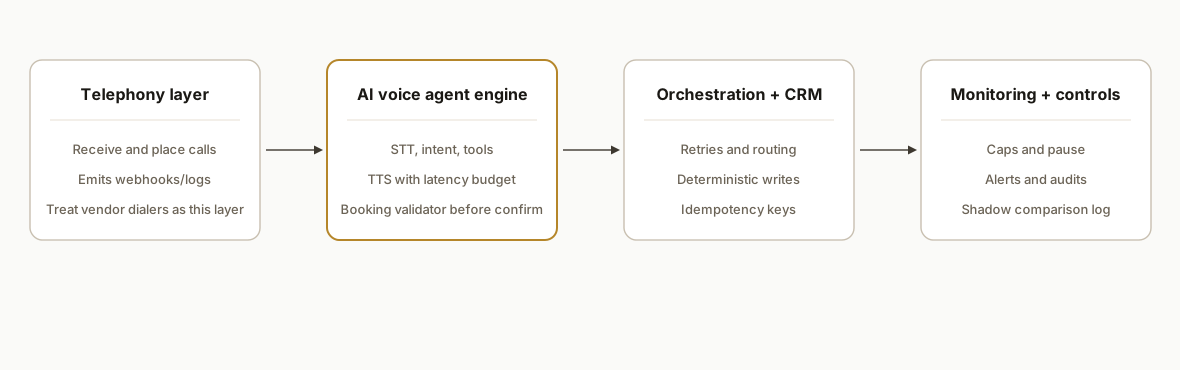
Every credible agency you consider will assemble roughly the same pattern. Differences show up in how they test accuracy, protect your reputation, and wire your CRM.
- Telephony layer: your existing phone system or a CPaaS or voice platform. The voice agent must receive calls, place calls, and emit webhooks or logs for dispositions. If you are evaluating a vendor like a JustCall AI dialer, treat it as this layer and apply the same pilot plan.
- AI voice agent engine: speech to text, intent parsing, tools for actions, and text to speech. The model choice is less important than guardrails, latency, and how bookings are verified.
- Orchestration and CRM: the workflow brain that routes calls, schedules retries, writes outcomes to the CRM, and prevents duplicates across campaigns.
- Monitoring and controls: budget caps, pause and resume, audit logs, error alerts, and a replay path for disputed calls.
Step-by-step: how to build it
Below is the exact 30 day pilot flow we recommend asking any agency to follow. Copy these artifacts into your RFP and kickoff.
1) Write a one page problem brief
State scope, success line, and what a bad outcome looks like. Keep it under 250 words.
# Problem brief
Workflow: Inbound missed calls after hours. Goal: qualify, answer FAQs, book a call.
Success: 80 percent of after-hours missed calls get a same-night answer or a next-morning booking draft.
Guardrails: never confirm bookings without name + number + purpose. Respect local DNC and consent.
Evidence: CRM dispositions + call recordings. Shadow mode for week 1.
Gotcha: do not start with scripts. Start with outcomes and guardrails. Scripts change. Guardrails do not.
2) Send a minimal RFP with test data
An agency cannot quote meaningfully without at least five anonymized call flows and two ugly edge cases.
# pilot-rfp.yaml
workflows:
  - name: After-hours receptionist
    channels: [voice, sms]
    intents: [book_call, faq_pricing, voicemail]
    edge_cases: [noisy_line, duplicate_caller]
crm:
  platform: <your CRM>
  required_writes: [contact_upsert, disposition, booked_event_url]
telephony:
  provider: <your phone system or vendor under evaluation>
  access: shadow-only for week1
measurement:
  baseline: human results last 14 days
  success_line: meet or beat baseline show-rate, no increase in wrong-bookings
Gotcha: keep vendor access shadow-only for week 1. You want comparable data, not live surprises.
3) Require a shadow-mode webhook and comparison log
You want a simple endpoint that receives every AI disposition in shadow mode and logs it next to your human result for the same lead.
// shadow-log.js
import express from "express";
const app = express();
app.use(express.json());

app.post("/shadow/disposition", async (req, res) => {
  // Provider payloads vary. Never assume field names.
  const event = req.body;
  // Store raw for audit, then map to your schema server-side.
  await saveRaw("voice_shadow", event);
  const mapped = safeMap(event); // your deterministic mapper
  await upsertComparisonRow({
    caller: mapped.caller,
    ts: mapped.ts,
    ai_disposition: mapped.disposition,
    ai_confidence: mapped.confidence,
    human_disposition: await lookupHumanOutcome(mapped.caller, mapped.ts)
  });
  res.sendStatus(204);
});

app.listen(8080);
Gotcha: never key matching purely on phone number. Time windows and channel also matter to avoid cross-thread collisions.
4) Set budget caps and pause controls before traffic
Ask for hard stops and a simple control endpoint.
{
  "daily_outbound_call_cap": 120,
  "tts_char_quota": 500000,
  "pause_on_quota_exceeded": true,
  "notify": ["ops@yourdomain.com"],
  "pause_endpoint": "/api/agents/pause",
  "resume_endpoint": "/api/agents/resume"
}
Gotcha: overage billing on some speech providers continues even when your vendor endpoint is healthy. Caps must live in your orchestration, not only in vendor dashboards.
5) Agree on CRM writes and idempotency keys
Decide what is written, where, and how duplicates are prevented.
# crm-writes.md
Records: Contact upsert, last_disposition, next_action_due, booked_event_url
Idempotency: one write per caller per day per campaign. Key: hash(caller, yyyymmdd, campaign)
On retry: same key. On manual override: suffix -manual.
Gotcha: without idempotency, your AI dialer will inflate pipeline counts and pollute reporting.
6) Run the pilot and review with numbers, not vibes
Week 1: shadow mode only. Week 2 to 4: controlled live traffic with caps and daily logs.
metric,value,baseline,pilot
speed_to_contact_median,4m,37m,6m
wrong_booking_rate,NA,1.8%,1.6%
contact_rate,NA,22%,24%
voicemail_to_callback,NA,12%,19%
Gotcha: optimize for a small set of stable metrics: speed to contact, contact rate, wrong booking rate, and show rate. Everything else is noise in the first month.
Where it gets complicated
- Booking accuracy versus call accuracy: a perfect conversation that books the wrong time is a failure. Insist on a server-side booking validator before confirmations.
- Local compliance: consent to record and local DNC rules vary by region. If you want a Vancouver focus, ask for a privacy posture aligned to Canada's federal PIPEDA and provincial rules, and confirm how recording notices are delivered.
- Latency budgets: stacked speech and model hops add seconds. Anything above a couple seconds of dead air feels robotic. Bake timing checks into QA.
- Overage traps: speech providers and dialers can accrue usage after your plan limits. Require a pause-on-quota-exceeded control that you can trigger.
- CRM backfills: backdating dispositions to fix live mistakes can corrupt attribution. Use an append-only audit log and a daily reconciliation job.
- Model drift and script creep: do not let week 2 prompts diverge from week 1 without tagging and version notes, or you will not know why accuracy changed.
What this actually changes
When the right agency runs a structured pilot, you get three things quickly: consistent speed-to-lead, measurable dispositions in your CRM, and a safe go or no-go. That matters for any SMB handling inbound leads, missed calls, or outbound reactivation. The structural value is consistent response time and a reduced manual burden on your team. Harvard Business Review reports contacting prospects within an hour made companies nearly 7 times more likely to qualify a lead than waiting longer than an hour (https://hbr.org/2011/03/the-short-life-of-online-sales-leads). AI voice agents exist to make that response window standard, not aspirational.
If you are comparing platforms like a JustCall AI dialer, keep the same pilot plan: shadow logging in week 1, CRM idempotency keys, booking validation before confirmations, and hard caps with pause controls. Tool choice is secondary to measurement discipline.
Frequently asked questions
Which is the best AI automation agency for small businesses in 2026?
The right one is the team that will run a 30 day pilot with shadow mode, daily caps, CRM writebacks, and a go or no-go tied to your numbers. Ask for guardrails, idempotency, and a rollback plan. Geography and hourly rate matter less than pilot discipline and proof on your data.
How much does an AI voice agent or dialer pilot cost for SMBs?
Expect a low four figure one time pilot budget plus platform usage. Ongoing fees typically land in the mid three figures to low four figures per month for light to moderate volumes. Keep usage on your accounts where possible so you see and control spend.
What should I ask in an RFP for an AI dialer or voice receptionist?
Ask for: a one page pilot plan, shadow mode and comparison logs, CRM write schema and idempotency keys, budget caps and pause controls, booking validation rules, daily exception logs, and a plain rollback plan. Require read access to raw logs for audit.
Does a Vancouver AI automation agency make a difference?
If you need PST collaboration, in person workshops, or a Canadian privacy posture, a Vancouver based agency is useful. For pure telephony and CRM work, remote teams deliver well provided they agree to shadow mode, daily caps, and proof on your data before go live.
Is a vendor AI dialer enough, or do I still need an agency?
A vendor dialer can be a solid telephony layer. The gaps usually show up in CRM writebacks, guardrails, and measurement. If your team can run a structured pilot and own orchestration, you may not need an agency. If not, hire for the pilot and guardrails.
How do I test a platform like a JustCall AI dialer safely?
Treat it as the telephony layer. Week 1 in shadow mode with a webhook that logs every AI disposition against your human baseline. Week 2 to 4 live with caps, pause controls, and a booking validator. Decide on numbers, not demos.
A practical next step: if you want help scoping a 30 day pilot, see our AI voice agent services at /services#ai-voice-agents, read how we approach results in AI voice agents that actually work, and when ready, book a 20 minute call to map your first workflow.
Want us to build this for you?
Nine questions, about 90 seconds. You see the hours it is costing you, then pick a time. No pitch.
Get your free assessment